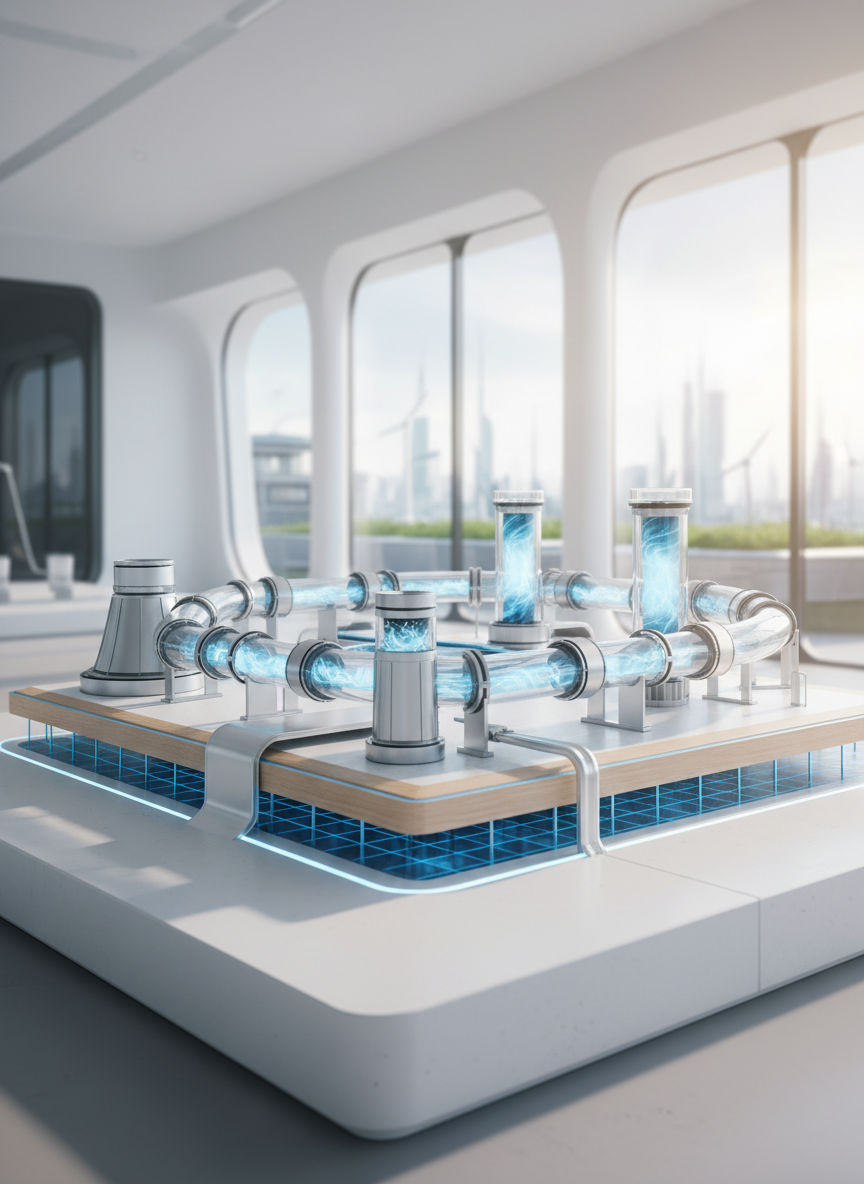
How do you tame thermodynamics in modern buildings?
Prompted by NerdSip Explorer #3276
Master Daikin's exclusive compressor and refrigeration cycles.
In 1982, Daikin revolutionized climate control with Variable Refrigerant Volume (VRV). However, modern buildings demand more than just inverter control. Enter Variable Refrigerant Temperature (VRT) technology.
Unlike static systems, VRT dynamically adjusts the evaporating temperature based on real-time load and outdoor conditions. Since systems operate in part-load for 90% of the year, VRT raises the evaporating temperature closer to the room temperature. This reduces the pressure lift required by the compressor.
By narrowing this gap, energy efficiency (SEER) jumps by up to 28%. Beyond savings, the higher discharge temperature eliminates cold drafts, significantly boosting indoor comfort. It's a silent, efficient, and precise approach to thermal management.
Key Takeaway
VRT optimizes partial load by dynamically adjusting refrigerant temperature.
Test Your Knowledge
What physical effect occurs when VRT raises the evaporation temperature?
Standard rotary compressors face a major hurdle at low speeds: internal refrigerant leakage. When the vane fails to track the rotor perfectly, high-pressure gas escapes, slashing volumetric efficiency.
Daikin’s patented Swing Compressor solves this with a brilliant mechanical redesign. The rotor and vane are integrated into a single, solid unit. This assembly moves in a smooth, oscillating motion within a specialized swing bushing.
Because there is no dynamic gap between the blade and the piston, refrigerant cannot bypass the compression chamber. Even at speeds as low as 4 rps, the process remains virtually loss-free. This eliminates friction-related wear and ensures peak performance for inverter-driven systems.
Key Takeaway
The integrated rotor and vane prevent leakage at low compressor speeds.
Test Your Knowledge
Why is the Swing Compressor superior to rotary compressors at part-load?
The shift to R-32 (Difluoromethane) is more than just regulatory compliance; it’s a thermodynamic upgrade. While R-410A is a blend, R-32 is a single-component refrigerant, offering massive engineering advantages.
R-32 boasts a 10% higher volumetric cooling capacity and superior heat transfer. This allows for smaller pipe diameters and a 20% to 30% reduction in total refrigerant charge. Crucially, as a pure fluid, R-32 has no temperature glide during phase changes, making evaporation and condensation highly predictable.
With a GWP of 675—just one-third of R-410A—it delivers high performance with a lower environmental footprint. Precise electronic expansion valves proactively manage the slightly higher discharge temperatures to ensure long-term reliability.
Key Takeaway
R-32 offers higher volumetric capacity and zero temperature glide.
Test Your Knowledge
What is the primary flow advantage of R-32 being a single-component fluid?
Renovating older buildings often requires high flow temperatures for existing radiators. Conventional single-stage heat pumps struggle with these pressure ratios in freezing weather. Daikin’s Altherma High-Temp series solves this with a cascade refrigeration cycle.
The system uses two serially coupled Carnot cycles. First, the outdoor unit extracts energy from the air, lifting it to a medium level. This heat is transferred via a plate heat exchanger to a *second, separate circuit* in the indoor unit.
Inside, a second inverter compressor elevates the energy to a final water temperature of 80°C. This cascaded architecture remains efficient in deep winter, eliminating the need for inefficient electric backup heaters.
Key Takeaway
A serial cascade system delivers 80°C heating without electric backup.
Test Your Knowledge
How does Altherma High-Temp reach 80°C without electric heaters?
While most air purifiers rely on passive filters to trap particles, Daikin’s Flash Streamer takes an active approach. It uses an intensive plasma discharge to oxidatively decompose viruses, bacteria, and volatile organic compounds (VOCs).
Unlike standard 'glow discharge' systems, the Flash Streamer fires a high-frequency, 3D stream of high-speed electrons. These electrons collide with oxygen and nitrogen molecules in the air to create highly reactive species, such as hydroxyl radicals.
This oxidative process is 1,000 times faster than conventional discharge methods. Microbial surface proteins are structurally destroyed and inactivated within milliseconds. The final products are harmless byproducts like water and oxygen, ensuring a molecularly clean environment.
Key Takeaway
Flash Streamer uses high-speed electrons to decompose pollutants 1000x faster.
Test Your Knowledge
What physically distinguishes the Flash Streamer from glow discharge systems?
Track your progress, earn XP, and compete on leaderboards. Download NerdSip to start learning.