Do you have a hidden magnetic compass in your eyes?
Prompted by A NerdSip Learner
Uncover how birds and humans use the exact same eye protein.
Have you ever wondered how your body knows when it's time to sleep? The secret lies in a fascinating, light-sensitive protein called cryptochrome.
Found across the tree of life—from plants and insects to birds and humans—cryptochromes are ancient biological tools. In the human body, specifically in our eyes and organs, we rely on versions called CRY1 and CRY2. Their main job is to help regulate our circadian rhythm, the internal 24-hour clock that dictates our sleep-wake cycle.
When your eyes are exposed to light, especially blue light from the morning sun or your digital screens, cryptochromes react. This chemical reaction sends signals to your brain, essentially telling your body, 'Wake up, it's daytime!'
While we use these proteins to keep time, other animals use them for a much more seemingly magical purpose. Migratory birds, for example, have evolved to use cryptochromes not just for timing, but for global navigation.
Key Takeaway
Cryptochromes are light-sensitive proteins that help regulate the human circadian rhythm.
Test Your Knowledge
What is the primary role of cryptochrome proteins (like CRY1 and CRY2) in the human body?
Imagine looking up at the sky and literally *seeing* the Earth’s magnetic field. Current understanding suggests that migratory birds, like the European robin, might do just that!
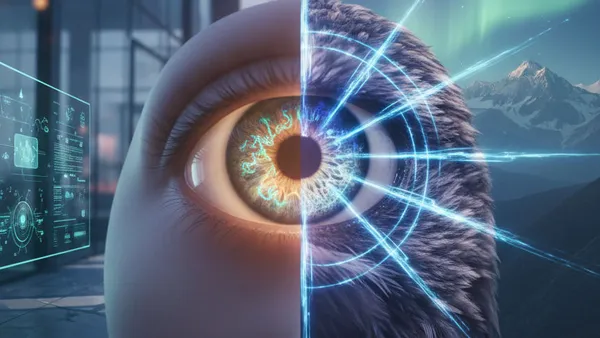
In the retinas of these birds, scientists have identified a specific cryptochrome protein, known as Cry4. When blue light enters the bird's eye, it strikes this protein and triggers a fascinating quantum reaction called the radical pair mechanism.
In simple terms, the light creates a pair of highly reactive molecules inside the bird's eye. The chemical behavior of these molecules is incredibly sensitive to the exact angle, or *inclination*, of the Earth’s magnetic field.
Instead of just pointing North or South like a standard compass, this biological sensor helps the bird detect the tilt of the magnetic field lines. Scientists theorize this might create a subtle visual pattern—like a heads-up display—overlaying the bird's normal vision, allowing them to navigate thousands of miles across the globe with pinpoint accuracy.
Key Takeaway
Migratory birds use a specific cryptochrome to visually sense the Earth's magnetic field for navigation.
Test Your Knowledge
How do cryptochromes help migratory birds navigate?
Since humans also have cryptochromes in our retinas, does that mean we have a hidden superpower?
In a fascinating laboratory experiment, scientists took the human version of cryptochrome (CRY2) and genetically inserted it into fruit flies that lacked their own magnetic sensor. Astonishingly, the human protein successfully restored the flies' ability to navigate using magnetic fields under blue light! This proved that human cryptochrome *is* fundamentally capable of sensing magnetic fields.
So, why can't we find our way home blindfolded?
While our proteins might react to magnetic forces at a quantum level, human biology lacks the downstream "wiring." We don't have the necessary neural apparatus to transmit these tiny magnetic signals from our eyes to our brain. Our brains simply aren't equipped to translate that data into conscious navigation. It remains a captivating biological quirk—a remnant of our evolutionary past or simply a side effect of how light-sensing proteins naturally behave.
Key Takeaway
Human cryptochromes are magnetically sensitive, but we lack the neural wiring to navigate by them.
Test Your Knowledge
Why can't humans navigate using the Earth's magnetic field, despite having cryptochromes?
Track your progress, earn XP, and compete on leaderboards. Download NerdSip to start learning.