What’s actually spinning in our cosmic backyard? Let's find out.
Prompted by NerdSip Explorer #4928
Master the secrets and order of all 8 planets orbiting our Sun.
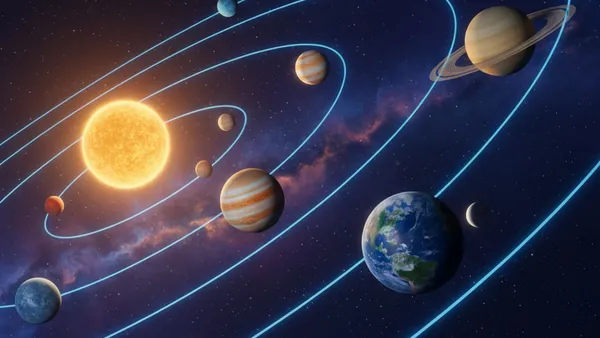
Imagine our solar system as a massive neon target with the Sun pulsing at the center. On the innermost rings of this cosmic disk, we find the first four worlds: Mercury, Venus, Earth, and Mars.
These are known as the terrestrial planets. Unlike the giants further out, they are compact and built from rock and metal. This means you could actually park your spaceship on their surface and take a walk—assuming you have the right gear!
Mercury is a scorched rock closest to the Sun. Venus is a greenhouse nightmare trapped in thick clouds. Earth is our perfect liquid-water oasis, and Mars is a frozen red desert that explorers dream of colonizing one day.
To remember the order, try this classic hack: My Very Educated Mother... (Mercury, Venus, Earth, Mars).
Key Takeaway
The first four planets are small, rocky worlds located closest to the Sun.
Test Your Knowledge
What are the four inner planets primarily made of?
As we move past the asteroid belt, we hit the true heavyweights of our system: Jupiter and Saturn. These are the titans of our galactic neighborhood, and they are absolutely massive.
Forget finding solid ground here; these are gas giants. Imagine them as colossal, swirling spheres of dense clouds and violent storms. A spaceship could never land; it would simply sink forever into their crushing atmospheric layers.
Jupiter is the king of planets, so large that over 1,300 Earths could fit inside it. Saturn is the system's showstopper, famous for its glowing ring system made of billions of ice chunks and space dust orbiting like a halo.
Continuing our memory hack: ...Just Served... (Jupiter, Saturn).
Key Takeaway
Jupiter and Saturn are massive spheres of gas with no solid surface to stand on.
Test Your Knowledge
Why is it impossible to land a spaceship on Jupiter?
Out on the dark fringes where the Sun looks like just another bright star, we find the final two planets: Uranus and Neptune. These mysterious worlds guard the edge of our system.
Scientists call these two ice giants. While they are large and gassy, their extreme distance from the Sun makes them incredibly cold. Their internal components are a slushy, super-chilled mix of water, ammonia, and methane ice.
Both planets glow with a distinct, beautiful blue hue. This neon-like color comes from methane gas in their atmospheres absorbing red light and reflecting the blue back at us.
Your full memory hack: My Very Educated Mother Just Served Us Noodles (Mercury, Venus, Earth, Mars, Jupiter, Saturn, Uranus, Neptune). Pluto was once the ninth, but it's now classified as a dwarf planet.
Key Takeaway
Uranus and Neptune are the freezing, blue-tinted giants at the edge of the solar system.
Test Your Knowledge
Why are Uranus and Neptune known as ice giants?
Track your progress, earn XP, and compete on leaderboards. Download NerdSip to start learning.