Ever wondered where stars are actually born in the deep darkness of space?
Prompted by A NerdSip Learner
Master the lifecycle of star-forming dark nebulae.
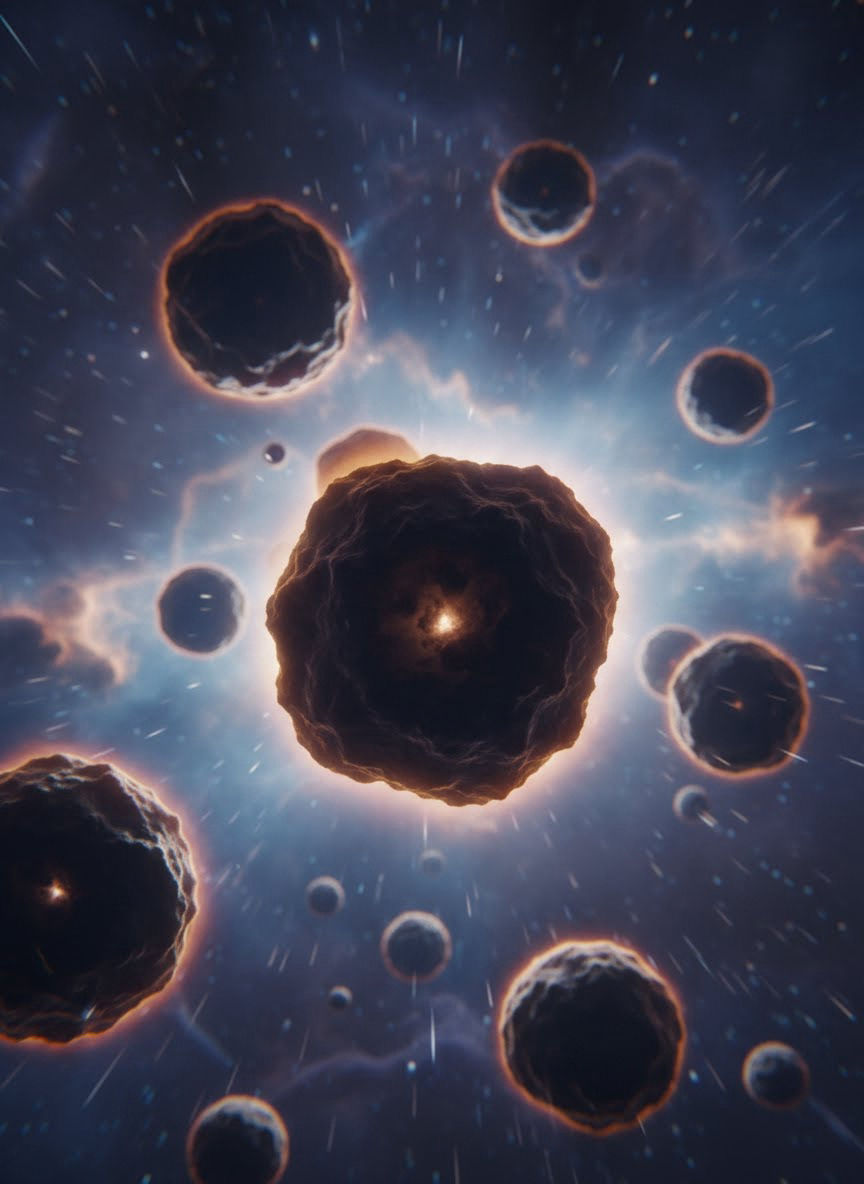
Imagine looking up at the glittering Milky Way and seeing a hole—a pitch-black patch where no stars shine. For a long time, astronomers thought these were literal voids in space. But in the 1940s, an astronomer named Bart Bok had a hunch that they weren't empty at all.
He suspected these dark spots were actually dense clouds of cosmic dust and gas, thick enough to block the light from stars behind them. He called them Bok globules. Think of them not as holes, but as silhouettes standing in front of a bright window.
These isolated dark nebulae are relatively small (in cosmic terms!), usually less than a light-year across. While they look like spooky shadows, they are actually one of the most important structures in our universe. They are the quiet, dark nurseries where the magic of creation begins.
Key Takeaway
Bok globules are dense, dark clouds of gas and dust that block background starlight.
Test Your Knowledge
Before Bart Bok, what did many astronomers believe these dark patches were?
To build a star, you need ingredients, and Bok globules are packed with them. These clouds are made of about 99% gas (mostly hydrogen and helium) and 1% interstellar dust (silicate and carbon grains). That 1% dust might sound small, but it’s crucial—it acts like a heavy curtain, absorbing visible light and keeping the interior pitch black.
Inside a Bok globule, it is incredibly cold. We are talking about temperatures dropping to 10 Kelvin (–263°C). This extreme cold is vital. If the gas were hot, the atoms would be zipping around too fast to clump together.
By staying freezing cold, the gas moves slowly, allowing gravity to start pulling the atoms closer and closer. It’s like a cosmic freezer designed to preserve the ingredients until they are ready to be cooked into a star.
Key Takeaway
Bok globules are frigid environments where dust blocks light and cold gas prepares to clump together.
Test Your Knowledge
Why is it important for the interior of a Bok globule to be extremely cold?
Now the action starts. A Bok globule is in a constant battle between two forces: gas pressure (pushing out) and gravity (pulling in). Usually, they are balanced. But sometimes, a shockwave from a nearby supernova or a collision with another cloud tips the scales.
Gravity starts to win. The core of the globule begins to collapse under its own weight. As the gas squeezes into a tighter and tighter space, the pressure shoots up, and the temperature begins to rise rapidly.
Deep inside this dark cocoon, a protostar forms. It’s not quite a full star yet—it’s not fusing hydrogen—but it’s getting hot and heavy. This is the moment of conception for a solar system. The globule protects this fragile process from the harsh radiation of the outside universe, acting like a protective shell.
Key Takeaway
Gravitational collapse inside the globule raises pressure and heat, creating a protostar.
Test Your Knowledge
Which force must overcome gas pressure for a star to begin forming?
Here is a cool fact: our Sun is a single child, but most stars are actually born as twins or triplets! Bok globules are often responsible for these multiple star systems.
As the globule collapses, it doesn't always shrink into one neat ball. Because the cloud is usually spinning, it can flatten out and fragment. The core might break into two or more distinct clumps, each collapsing on its own to form a separate star.
These siblings will orbit each other for billions of years. In fact, astronomers observing Bok globules often find not just one heat source inside, but two or three distinct infrared signals. This fragmentation process explains why binary stars (two stars orbiting a common center of mass) are so common in our galaxy.
Key Takeaway
Collapsing globules often fragment, leading to the creation of binary or multiple star systems.
Test Your Knowledge
What happens if a collapsing globule fragments into pieces?
All good things must come to an end, including the Bok globule itself. Once the new star (or stars) inside becomes massive and hot enough, it turns on its nuclear engine.
The star begins to emit powerful stellar winds and intense ultraviolet radiation. This energy pushes outward, eroding the remaining gas and dust of the globule. It’s like a chick pecking its way out of an eggshell.
Eventually, the dark cloud is completely blown away, and the new star shines visibly for the first time. The globule has done its job: it gathered the material, protected the collapse, and birthed a new light into the universe. When we look at open star clusters today, we are looking at the siblings that hatched from a destroyed giant cloud complex!
Key Takeaway
The newborn star destroys its parent globule with stellar winds, revealing itself to the universe.
Test Your Knowledge
What ultimately destroys the Bok globule?
Track your progress, earn XP, and compete on leaderboards. Download NerdSip to start learning.