Why did NASA launch a golden honeycomb into deep space?
Prompted by A NerdSip Learner
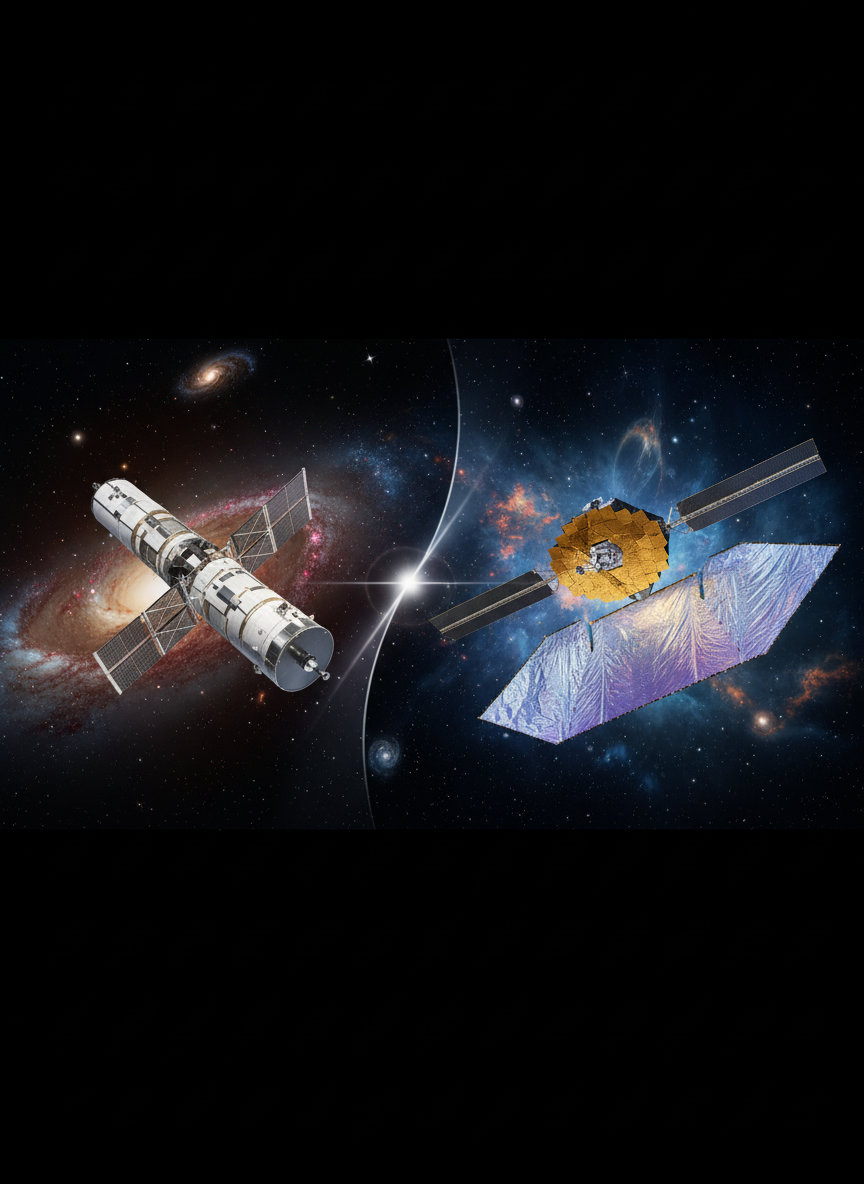
Compare the tech of humanity's two greatest space telescopes.
Imagine you are trying to look at a friend hiding behind a thick cloud of smoke. With your normal eyes, you just see the smoke. But if you put on thermal goggles, you can see their body heat shining right through. This is the fundamental difference between these two legends.
The Hubble Space Telescope sees the universe mostly like we do—in visible light (plus a bit of Ultraviolet). It captures stunning, true-color photos of galaxies that look like standard photography on steroids. It's been our primary eye on the sky for over 30 years!
The James Webb Space Telescope (JWST) is different. It views the universe in Infrared. Why? Because space is full of dust clouds that block visible light. Infrared waves are longer and slip right through that dust, allowing Webb to see stars being born inside nebulas that are completely invisible to Hubble. It’s like giving humanity X-ray vision for the cosmos!
Key Takeaway
Hubble sees visible light like our eyes; Webb sees infrared light to peek through cosmic dust clouds.
Test Your Knowledge
Why does the James Webb Telescope look at the universe in infrared light?
To catch faint light from deep space, you need a giant bucket. In telescope terms, this 'bucket' is the primary mirror. Hubble’s mirror is a solid piece of glass about 2.4 meters wide (roughly the height of a standard room ceiling). It sits in Low Earth Orbit, just 570 km above our heads. This is close enough that astronauts used to visit it for repairs!
Webb is a beast. Its mirror is 6.5 meters wide, made of 18 gold-plated hexagonal segments that folded up like origami to fit inside the rocket. Because Webb detects heat (infrared), it must be kept freezing cold.
That's why Webb isn't in Earth's orbit. It sits 1.5 million kilometers away at a special gravitational balance point called L2. It stays behind Earth to block out the Sun, using a sunshield the size of a tennis court to keep its mirrors at -223°C (-370°F). If Hubble is in our backyard, Webb is camping in the next state over!
Key Takeaway
Webb has a much larger mirror and sits much further away (L2) to stay cold enough for infrared detection.
Test Your Knowledge
What is the primary reason the James Webb Telescope is located so far away at point L2?
Telescopes are actually time machines. Because light takes time to travel, looking at distant stars is looking into the past. But as the universe expands, light from the very first stars stretches out, shifting from visible light into—you guessed it—infrared.
This phenomenon is called Redshift. Because Hubble focuses on visible light, it can only look back so far—about 13.4 billion years, seeing the universe as a 'toddler' galaxies.
Webb was built specifically to chase that stretched-out infrared light. It can see back to just a few hundred million years after the Big Bang. Webb is hunting for the very first galaxies that ever formed—the 'baby pictures' of our universe. While Hubble showed us how galaxies evolve, Webb is showing us how they began. Together, they give us a complete history of everything!
Key Takeaway
Webb uses infrared to overcome 'redshift,' allowing us to see the very first galaxies formed after the Big Bang.
Test Your Knowledge
What happens to light from the earliest universe as it travels through expanding space?
Track your progress, earn XP, and compete on leaderboards. Download NerdSip to start learning.