What happens when a giant star squishes into a city-sized ball?
Prompted by A NerdSip Learner
Understand the mind-bending weight of neutron stars.
Start with a massive star, much bigger than our own Sun. When this giant runs out of fuel, it can no longer support its own immense weight. The core suddenly collapses inward, triggering a violent and spectacular explosion known as a supernova!
What remains is the star's crushed core. The gravity during this collapse is so incredibly strong that it forces the building blocks of atoms together. It squishes protons and electrons until they merge to form neutral particles called neutrons.
Imagine taking an enormous, fluffy cloud of cotton candy and crushing it down with massive hydraulic presses until it becomes a single, rock-hard pebble. That's essentially what happens to the star's matter.
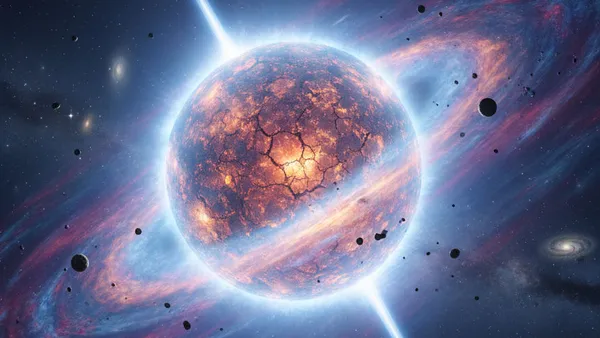
The result is a neutron star: a leftover core that packs the mass of an entire sun into a sphere no wider than a typical city, roughly 12 miles across!
Key Takeaway
Neutron stars are the crushed, extremely dense leftovers of exploded giant stars.
Test Your Knowledge
What cosmic event creates a neutron star?
Because a neutron star is essentially an entire sun crammed into a space the size of a single city, its density is almost impossible to comprehend using everyday logic.
To picture this, imagine taking a magical spaceship to a neutron star and scooping up just one single teaspoon of its material. If you somehow brought that tiny spoonful back to Earth, it would weigh as much as a gigantic mountain—roughly a billion tons!
This makes neutron stars some of the densest objects in the entire universe. They are the absolute closest things can get to becoming a black hole without actually crossing the line and turning into one.
Regular matter—like the atoms making up your body or the chair you are sitting on—is actually mostly empty space. But in a neutron star, all that empty space has been completely crushed out, leaving only a solid wall of matter.
Key Takeaway
Just one teaspoon of a neutron star weighs about as much as a mountain on Earth.
Test Your Knowledge
How much would a teaspoon of a neutron star weigh on Earth?
With an entire star's worth of weight packed into such a remarkably tiny space, a neutron star creates a gravitational pull that is absolutely mind-boggling.
If you could somehow magically survive the heat and tried to stand on the surface of a neutron star, its gravity would be billions of times stronger than Earth's. It would instantly pull you down so hard that you would be flattened into a microscopic puddle only a few atoms thick!
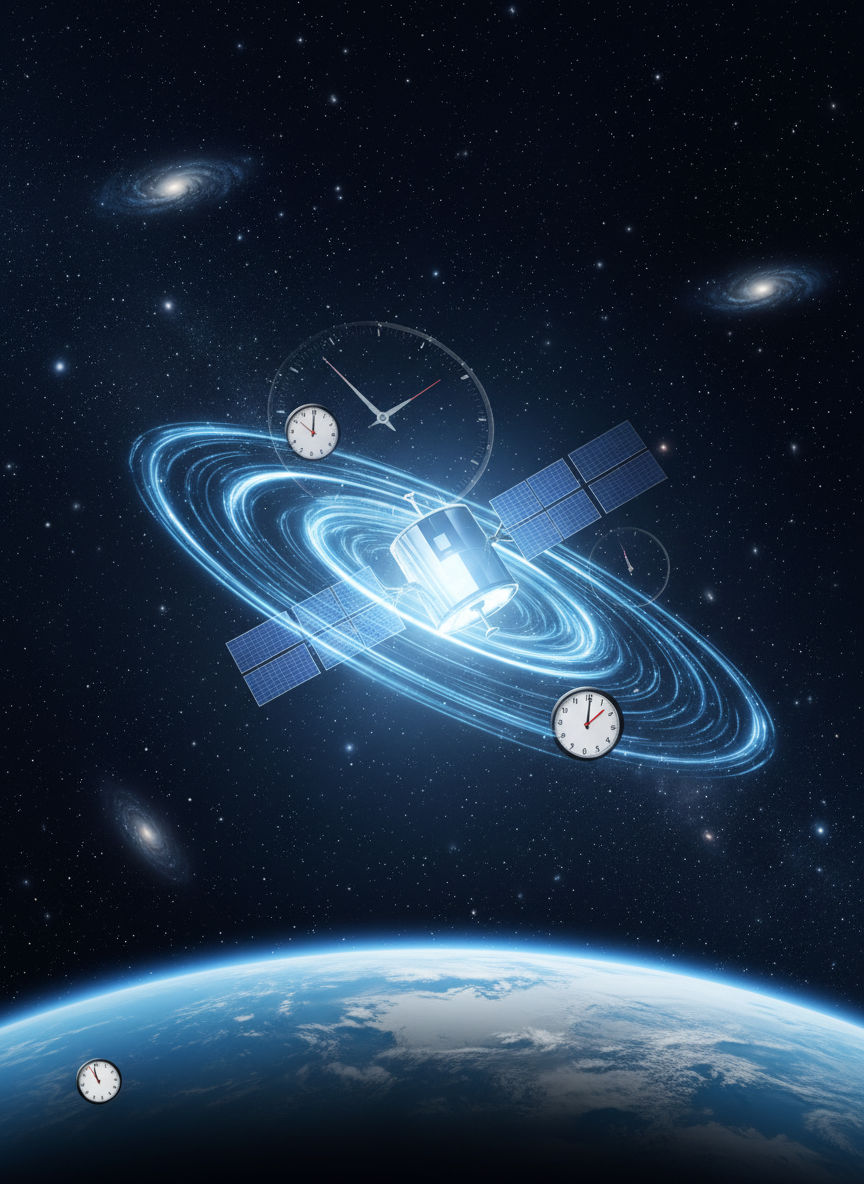
This gravity is so intense that even light struggles to travel in a straight line around it. The star literally bends the light around itself. This means if you were floating nearby, the twisted gravity would allow you to see the back of the star while looking directly at the front!
Despite being incredibly small, these heavy-weight champions hold immense power. They spin incredibly fast, sometimes shooting beams of radiation into space like cosmic lighthouses.
Key Takeaway
The intense weight of a neutron star creates gravity so strong it can bend light and flatten objects to an atomic level.
Test Your Knowledge
How does a neutron star's gravity affect light?
Track your progress, earn XP, and compete on leaderboards. Download NerdSip to start learning.