What hidden chemicals are secretly running the microscopic city inside you?
Prompted by A NerdSip Learner
Master the 5 chemical building blocks of all cells.
Imagine a bustling city. Before you can build skyscrapers or power plants, you need the infrastructure. In the microscopic city of a cell, that foundational infrastructure is made of inorganic compounds: primarily water and mineral salts.
Water is the ultimate biological solvent. It makes up roughly 70% to 85% of a cell's mass. Because water molecules are polar (having slight positive and negative ends), they can easily pull apart and dissolve other substances, allowing essential chemical reactions to take place.
But water doesn't work alone. Mineral salts, or ions like sodium, potassium, and calcium, act as the spark plugs and regulators of the cell. They help maintain the cell's fluid balance, transmit electrical signals in nerves, and even assist in muscle contraction.
Without this watery, mineral-rich environment, the complex molecules of life wouldn't be able to interact, fold, or function properly.
Key Takeaway
Water provides the essential environment for cellular reactions, while mineral salts regulate vital biological functions.
Test Your Knowledge
What is the primary role of water in the cell?
When you need a quick burst of energy to run for a bus, your cells turn to carbohydrates. These organic molecules are the preferred, rapid-access fuel source for cellular activities.
At their core, carbohydrates are made of carbon, hydrogen, and oxygen. The simplest forms are called monosaccharides, like glucose. Think of glucose as the raw electricity powering the cell's machinery. When your cells need energy immediately, they break down glucose to release it.
Cells can also link these simple sugars together into massive chains called polysaccharides. Animals store excess energy as a polysaccharide called glycogen, often tucked away in the liver and muscles. Plants use a different chain called starch.
Beyond just energy, carbohydrates play a structural role. Cellulose, another tough polysaccharide, builds the sturdy walls of plant cells, giving stems and leaves their rigid shape.
Key Takeaway
Carbohydrates are the primary source of rapid energy for cells and can also provide important structural support.
Test Your Knowledge
Which carbohydrate acts as the main structural component in plant cell walls?
If carbohydrates are the quick fuel, lipids are the cell's long-term battery backup. Lipids include fats, oils, and waxes. Because they pack a dense amount of energy, cells use them to store fuel for the long haul.
However, lipids do something even more crucial: they build the literal boundaries of the cell. A special type of lipid called a phospholipid has a split personality. It features a "head" that loves water and a pair of "tails" that repel water.
When phospholipids are dropped into the watery environment of our bodies, they automatically organize themselves into a double layer. The water-fearing tails hide in the middle, while the water-loving heads face the outside. This forms the cell membrane, a flexible, protective barrier that controls what enters and exits the cell.
Additionally, some lipids function as hormones, acting as chemical messengers that travel throughout the body to regulate complex processes.
Key Takeaway
Lipids provide long-term energy storage and form the protective structural boundaries of all cells.
Test Your Knowledge
How do phospholipids organize themselves to form a cell membrane?
If you look at almost any job happening inside a cell, a protein is likely doing it. Proteins are the molecular machines, builders, and messengers of life, taking on an astonishing variety of shapes and roles.
Every protein is constructed from a set of basic building blocks called amino acids. There are 20 standard amino acids, and they link together like beads on a string. How this string folds and twists into a complex 3D shape determines exactly what the protein will do.
Some proteins act as structural scaffolding, giving cells their shape. Others serve as antibodies, defending your body against viruses.
Perhaps the most important proteins are enzymes. Think of enzymes as biological catalysts; they dramatically speed up chemical reactions that would otherwise take years to happen. Without enzymes, the fast-paced life of a cell would grind to an absolute halt.
Key Takeaway
Proteins are folded chains of amino acids that perform almost all the mechanical and chemical work inside a cell.
Test Your Knowledge
What determines the specific function of a protein?
How does a cell know how to build the right proteins at the right time? The answer lies in the ultimate instruction manuals: nucleic acids. These complex molecules store and transmit the genetic information required for life.
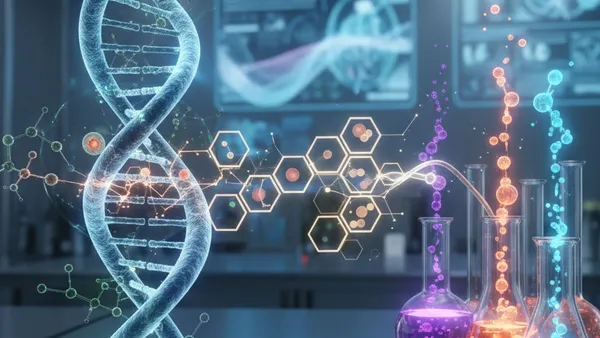
The most famous nucleic acid is DNA (Deoxyribonucleic Acid). Safely housed in the cell's nucleus, DNA holds the master blueprints for your entire body. It is composed of a long, double-stranded helix made of smaller units called nucleotides.
But DNA never leaves the safety of the nucleus. To actually build a protein, the cell uses a second nucleic acid called RNA (Ribonucleic Acid). RNA acts as a messenger. It makes a temporary copy of the DNA's instructions and carries it out to the cellular factories, where proteins are assembled.
Together, DNA and RNA ensure that the intricate machinery of the cell operates perfectly, allowing organisms to grow, function, and pass their traits to the next generation.
Key Takeaway
DNA stores the master genetic blueprints, while RNA helps translate those blueprints into functional proteins.
Test Your Knowledge
What is the main role of RNA in the cell?
Track your progress, earn XP, and compete on leaderboards. Download NerdSip to start learning.