How did we land a robot on a speeding, duck-shaped ice mountain?
Prompted by A NerdSip Learner
Understand the historic Rosetta mission and comet science.
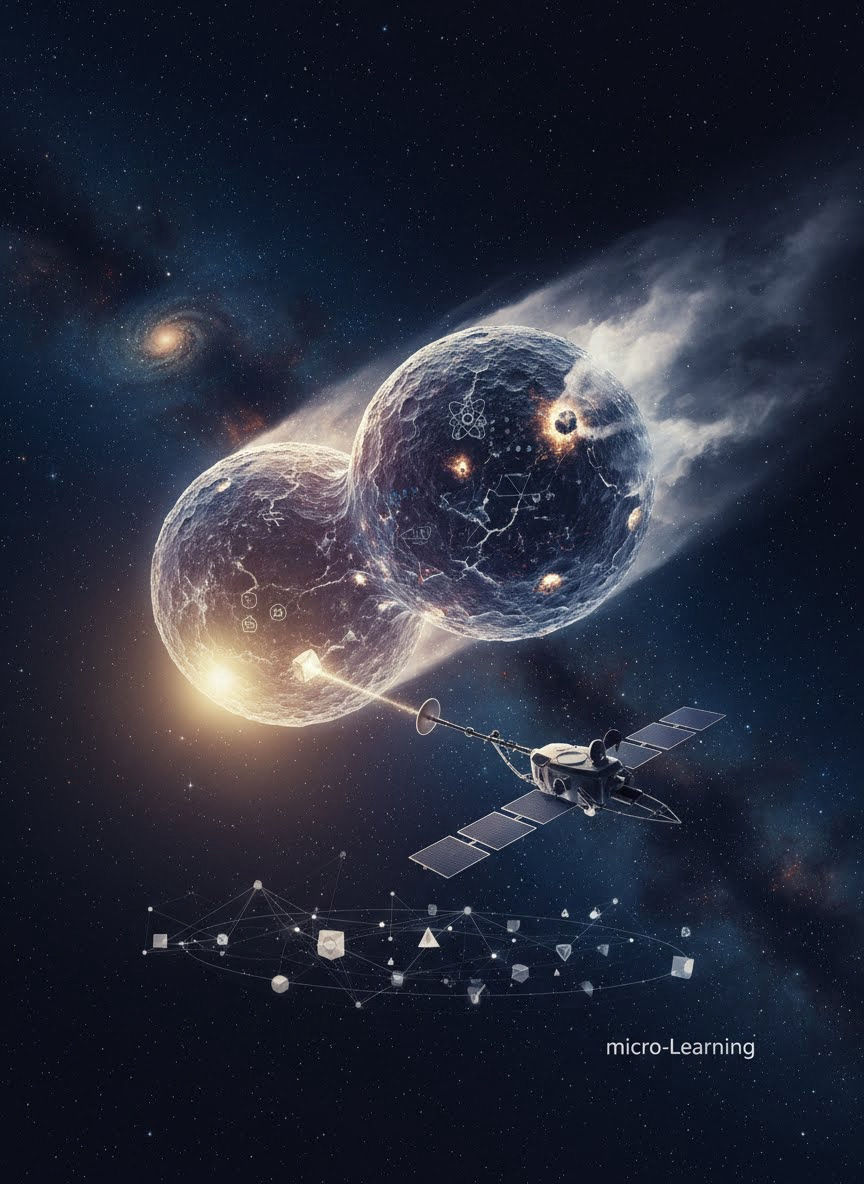
Welcome to one of the weirdest objects in our solar system! When scientists first got a good look at Comet 67P/Churyumov–Gerasimenko, they were shocked. It wasn't a round snowball; it looked exactly like a rubber duck.
This odd shape happened because two smaller comets collided in slow motion billions of years ago and stuck together. In astronomy, we call this structure a contact binary. It’s about 4 kilometers wide—imagine a mountain the size of a city tumbling through space!
Because of this strange shape, the gravity on 67P is uneven. If you stood on the "head" of the duck, you'd feel lighter than if you stood on the "body." It’s a dusty, icy time capsule that has been frozen since the birth of our solar system, holding secrets about how planets formed.
Key Takeaway
Comet 67P is a 'contact binary' formed by two objects gently smashing together to look like a rubber duck.
Test Your Knowledge
Why does Comet 67P have its distinct 'rubber duck' shape?
Catching a comet is harder than hitting a bullet with another bullet. The European Space Agency (ESA) launched the Rosetta spacecraft in 2004 to chase down 67P. It took *ten years* of slingshotting around Earth and Mars just to pick up enough speed to catch it!
Once Rosetta arrived, it did something historic: it dropped a washing-machine-sized lander named Philae onto the surface. This was the first time humanity ever touched a comet.
But the landing was wild! Philae’s anchoring harpoons failed to fire. Instead of sticking the landing, the robot bounced twice—once reaching a kilometer into space—before finally settling in a dark crack under a cliff. Despite the drama, Philae sent back incredible data before its batteries ran out in the shadows.
Key Takeaway
The Rosetta mission successfully deployed the Philae lander, which bounced across the surface before sending back data.
Test Your Knowledge
What unexpected event happened when the Philae lander touched down?
What did we find on the duck? First, if you could smell 67P, you’d probably throw up. It releases gases that smell like rotten eggs (hydrogen sulfide) and bitter almonds (cyanide). But the biggest discovery was about water.
Scientists used to think comets crashed into Earth long ago, filling our oceans. However, the water on 67P is different. It has a high ratio of deuterium—an isotope of hydrogen that makes the water "heavy."
Since 67P's water signature is three times "heavier" than the water in our oceans, it suggests that comets like this one *didn't* bring us our water. This discovery forced astronomers to look at other suspects, like asteroids, as the source of Earth's blue oceans. It basically rewrote the history books on where we came from!
Key Takeaway
The 'heavy' water found on 67P suggests that comets might not be the main source of Earth's oceans.
Test Your Knowledge
What did the water analysis on Comet 67P reveal?
Track your progress, earn XP, and compete on leaderboards. Download NerdSip to start learning.