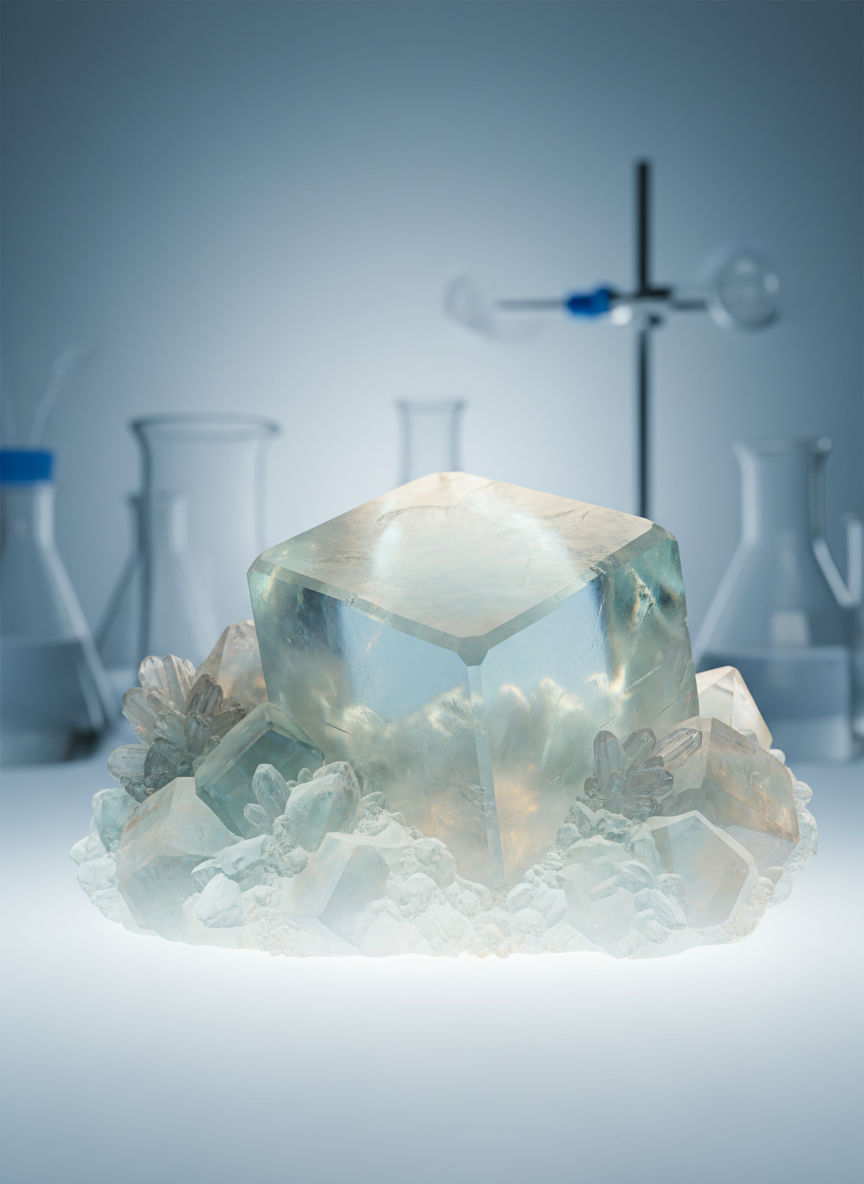
What if a single clear stone helped Viking explorers navigate the foggy oceans?
Prompted by A NerdSip Learner
Master the optical and geological secrets of calcite crystals.
Calcite is one of the most abundant and fascinating minerals on Earth. Chemically known as calcium carbonate (CaCO3), it is the primary building block of limestone, marble, and the beautiful stalactites hanging in deep underground caves. Even the shells of many marine organisms are made of this versatile material!
Despite being everywhere, calcite is most famous for its stunning, geometrically perfect crystals. If you are a budding geologist, calcite is incredibly easy to identify thanks to the Mohs Hardness Scale, a standard used to measure scratch resistance.
Calcite is the defining mineral for a hardness of 3. This means it is relatively soft. While you can't scratch it with your fingernail, it can easily be scratched by a standard copper penny or a steel pocketknife. This softness, combined with its unique chemical makeup, makes calcite an essential tool for understanding the geological processes that shape our planet.
Key Takeaway
Calcite is an abundant, relatively soft calcium carbonate mineral that is crucial to Earth's geology.
Test Your Knowledge
What is calcite's rating on the Mohs Hardness Scale?
If you take a completely clear, transparent piece of calcite—often referred to as Iceland Spar—and place it over a printed word in a book, something magical happens. You won't just see the word; you will see two identical copies of it side by side!
This mind-bending optical illusion is caused by a phenomenon called birefringence, or double refraction. Because of the highly ordered, anisotropic atomic structure of the crystal, light doesn't just pass straight through. Instead, the crystal actually splits the incoming light beam into two distinct rays.
One ray, called the ordinary ray, travels straight through the stone just as it would through glass. The other ray, known as the extraordinary ray, is bent at a different angle and travels at a slightly different speed. When these two rays exit the crystal and hit your eye, your brain registers two separate images. It’s a natural optical illusion!
Key Takeaway
Clear calcite crystals split light into two separate rays, creating a double-image effect known as birefringence.
Test Your Knowledge
What is the scientific term for calcite's ability to create a double image?
For centuries, historians were baffled by the incredible maritime navigation of the Viking explorers. They successfully sailed across the treacherous, fog-covered North Atlantic long before the invention of the magnetic compass. How did they avoid getting lost at sea?
The answer is believed to be hidden in a geological marvel: the legendary Viking Sunstone. Many modern researchers and historians hypothesize that these mythical stones were actually clear crystals of Iceland Spar calcite.
Because of calcite’s unique ability to polarize light, a navigator could hold the crystal up to a cloudy or foggy sky and slowly rotate it. When the crystal was aligned perfectly with the hidden sun, the light passing through it would suddenly brighten and equalize the double images inside the stone. This brilliant use of natural crystal optics allowed Viking sailors to pinpoint the sun's exact position, ensuring safe passage through the most unforgiving, overcast weather.
Key Takeaway
Historians hypothesize that Vikings used the polarizing properties of clear calcite to find the sun on cloudy days.
Test Your Knowledge
How did clear calcite theoretically help Vikings navigate at sea?
When geologists are out in the field trying to identify rocks, they don't just rely on their eyes. They use a technique that feels a bit like a high school chemistry experiment: the acid test.
If you suspect you have found a piece of calcite, simply placing a single drop of dilute hydrochloric acid on its surface will reveal its true identity. Almost instantly, the mineral will begin to vigorously fizz, bubble, and effervesce.
This dramatic reaction occurs because the acid attacks the calcium carbonate structure of the crystal. As the chemical bonds break down, the mineral releases carbon dioxide (CO2) gas, creating those highly visible bubbles. You don't even need industrial chemicals to see this in action. If you have a rough piece of calcite at home, dropping a little bit of warm household kitchen vinegar on it will produce a similar, albeit much slower, bubbling reaction!
Key Takeaway
Calcite chemically reacts with acid to break down its structure and release bubbling carbon dioxide gas.
Test Your Knowledge
What gas is released when calcite reacts with a drop of acid?
If you were to take a heavy hammer and strike a piece of quartz, it would shatter into random, jagged shards much like a broken glass window. But if you did the exact same thing to a calcite crystal, the result would be beautifully geometric.
This happens because calcite possesses a property known as perfect rhombohedral cleavage. In mineralogy, cleavage refers to how a crystal naturally breaks along flat planes of structural weakness within its internal atomic lattice.
Because of how the calcium, carbon, and oxygen atoms are bonded together, calcite will always split into distinct, slanted shapes that look like leaning, tilted boxes (rhombohedrons). No matter how many times you smash it, even the tiniest microscopic speck of the shattered dust will retain that exact same slanted box shape. It is a stunning visual reminder that the chaotic natural world is often built on strict mathematical foundations.
Key Takeaway
Due to its perfect cleavage, a shattered calcite crystal will always break into distinct, slanted box-like shapes.
Test Your Knowledge
What shape does a calcite crystal naturally break into when struck?
Track your progress, earn XP, and compete on leaderboards. Download NerdSip to start learning.