What secret invisible machinery keeps you, a tree, and a puppy alive?
Prompted by NerdSip Explorer #5918
Understand the 5 core rules of life.
Imagine a rock and a puppy. You intuitively know one is alive and the other isn't. But what exactly is the difference? In biology, life has a specific checklist.
First, living things are highly organized. Even a tiny speck of mold is a complex, structured machine compared to a grain of sand.
Second, living things consume energy. Just like a car needs gas to run, living creatures need fuel (like sunlight or food) to grow, move, and heal themselves.
Finally, living things respond to their world and reproduce. They notice a hot stove, or they grow towards the sun, and they make more of themselves. If something ticks these boxes, it belongs to the amazing club of life!
Key Takeaway
Living things are organized structures that use energy, respond to their environment, and reproduce.
Test Your Knowledge
Which of the following is a key requirement for something to be considered alive?
If you look closely at a brick house, you see it's made of individual bricks. Your body—and every living thing on Earth—works the exact same way. The "bricks" of life are called cells.
A cell is a tiny, microscopic bubble of life. Some creatures, like bacteria, are made of just one single cell. They are solitary nomads drifting through the world.
You, on the other hand, are a walking metropolis made of trillions of cells working together! You have skin cells, brain cells, and muscle cells, all doing different jobs to keep you healthy.
Inside every cell is a miniature factory. There are tiny "workers" that break down food, take out the trash, and build the structures you need to survive.
Key Takeaway
Cells are the fundamental, microscopic building blocks that make up all living things.
Test Your Knowledge
How many cells make up the human body?
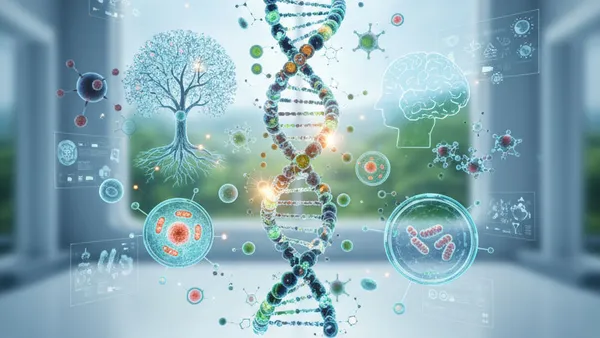
How does an acorn know how to become a mighty oak tree? How did your body know what color your eyes should be? The answer is a tiny molecule called DNA.
Think of DNA as an incredibly long, microscopic instruction manual hidden inside your cells. It is written in a special chemical alphabet that tells your body exactly how to build and operate you.
You inherited half of this instruction manual from your biological mother and half from your biological father. That's why you might have your mother's smile or your father's nose.
Every single living thing on Earth uses this exact same type of instruction manual. A banana, a mushroom, a dog, and a human all rely on DNA to exist.
Key Takeaway
DNA is a microscopic chemical instruction manual inside your cells that determines your traits.
Test Your Knowledge
What is the best way to describe DNA?
Every living thing has a job to do, even if that job is just staying alive. Doing work requires power, and the process of getting and using this power is called metabolism.
Think of your body like a bustling city. For the city to run, the power plant needs to burn fuel. In the biological world, plants are the ultimate power plants—they capture energy directly from the sun.
Animals and humans are more like hybrid cars. We have to consume our fuel by eating plants (or eating animals that ate plants). Our bodies then digest this food, breaking it down into raw energy.
Your metabolism is constantly humming in the background. It is the invisible engine that powers your heartbeat, your breathing, and even your thoughts!
Key Takeaway
Metabolism is the biological engine that turns food and sunlight into usable energy.
Test Your Knowledge
Where do plants get the energy to fuel their metabolism?
The world is constantly changing. The weather gets hotter, rivers dry up, and new predators appear. To survive in a changing world, living things must adapt over long periods of time. This is the basic idea behind evolution.
Imagine a group of animals living in a snowy forest. By pure chance, some are born with thicker fur. When a really harsh winter hits, the ones with thicker fur survive and have babies, while the others don't.
Over many generations, the whole population will end up with thicker fur because that helpful trait was passed down. Nature "selected" the winners based on who fit the environment best.
This slow, gradual process of passing down helpful traits has shaped all life on Earth, creating the incredible variety of plants and animals we see today!
Key Takeaway
Evolution is the gradual process where helpful traits are passed down over generations to help species survive.
Test Your Knowledge
How do helpful traits spread through an animal population over time?
Track your progress, earn XP, and compete on leaderboards. Download NerdSip to start learning.