What happens if you surgically remove half a human brain?
Prompted by NerdSip Explorer #5490
Master the neuroscience of lateralization & brain networks.
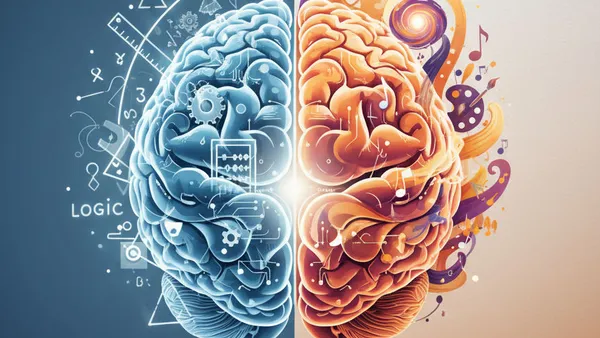
While the overarching 'creative right vs. logical left' personality divide is a myth, structural and functional asymmetries *do* exist in human neurology—a concept called lateralization. Evolutionarily, it is highly efficient to group specialized neural circuits together to reduce signal transmission time.
For example, in about 90% of right-handed people, core language production and comprehension regions (like Broca’s and Wernicke’s areas) are strictly lateralized to the left hemisphere. This is precisely why a stroke on the left side of the brain so frequently causes aphasia.
Conversely, the right hemisphere often dominates in facial recognition, spatial processing, and interpreting prosody—the emotional tone, rhythm, and pitch of speech. It doesn’t 'do art,' but it does help you catch sarcasm or understand the emotional punchline of a joke. Interestingly, left-handed individuals often show more bilateral language distribution, highlighting how incredibly adaptable our neural blueprints can be.
Key Takeaway
Lateralization is about specific processing mechanics like language or spatial awareness, not overarching personality traits.
Test Your Knowledge
Which of the following is an accurate example of true functional lateralization in most right-handed individuals?
If you needed a right brain for creativity and a left brain for logic, losing half your brain should logically wipe out half of your complex human experience. Yet, rare and extreme medical procedures prove this assumption completely wrong.
A hemispherectomy is a radical surgical procedure used to treat severe, intractable epilepsy in children, where an entire cerebral hemisphere is physically removed or disconnected. Astoundingly, these patients do not lose their ability to be creative, nor do they lose their capacity for logic.
Thanks to intense neuroplasticity—the brain's inherent ability to dynamically reorganize itself by forming entirely new neural pathways—the remaining hemisphere rapidly adapts. A solitary left hemisphere can learn to process complex spatial relationships, and a solitary right hemisphere can take over nuanced language functions.
This extreme edge case shatters the myth of rigid localization. It proves that cognitive abilities are not permanently locked into specific geographic coordinates.
Key Takeaway
Through extreme neuroplasticity, a single cerebral hemisphere can rewire itself to handle both logical and creative functions.
Test Your Knowledge
What does a successful hemispherectomy primarily demonstrate about human neurology?
If creativity isn't confined to the right hemisphere, where does it actually come from? Modern cognitive neuroscience has shifted away from archaic geographical brain mapping. Instead, researchers focus on large-scale neural networks that constantly communicate across both sides of the brain.
True creative thought arises from the dynamic interplay of distinct systems. First is the Default Mode Network (DMN), which spans both hemispheres and activates during daydreaming, mind-wandering, and generating spontaneous, divergent ideas.
Next is the Executive Control Network (ECN), which evaluates these raw ideas, applying focused logic to see if they actually work in reality. Finally, the Salience Network acts as a crucial switchboard, seamlessly toggling the brain between the DMN's imaginative brainstorming and the ECN's critical analysis.
You aren't 'right-brained' when you write a poem or design an app. You are actively hyper-coupling widespread, bilateral networks—simultaneously generating abstract concepts and meticulously enforcing rules.
Key Takeaway
Creativity is a whole-brain symphony driven by the interaction of the Default Mode, Executive Control, and Salience networks.
Test Your Knowledge
According to the network theory of creativity, what is the specific role of the Salience Network?
Track your progress, earn XP, and compete on leaderboards. Download NerdSip to start learning.