Why did NASA just change its master plan for the Moon?
Prompted by A NerdSip Learner
Grasp the latest Artemis lunar roadmap.
Space exploration is notoriously unpredictable, and NASA recently proved that agility is key. In early 2026, the space agency made a massive update to its lunar roadmap, entirely reshaping the upcoming Artemis missions to prioritize safety and technological readiness.
Originally, Artemis 3 was slated to be the first human Moon landing since 1972. However, the mission—currently targeting approximately 2027—has been transformed into a critical Earth-orbit dress rehearsal.
Instead of flying to the Moon, the Artemis 3 crew will remain in Low Earth Orbit. Their primary job is to perform complex rendezvous and docking tests with the commercial lunar landers being developed by companies like SpaceX and Blue Origin.
They will also rigorously test the next-generation spacesuits in the vacuum of space. By validating these critical technologies close to home, NASA ensures a much higher probability of success when it is finally time to touch down on the lunar surface.
Key Takeaway
Artemis 3 is now a crucial Earth-orbit test mission to validate lunar landers and spacesuits.
Test Your Knowledge
What is the primary objective of the revised Artemis 3 mission?
With Artemis 3 paving the way through essential orbital testing, the spotlight for the historic lunar return now falls on Artemis 4. Targeted for roughly 2028, this mission is poised to become our generation's Apollo 11.
During Artemis 4, a crew of four astronauts will ride a towering mega-rocket toward the Moon. Once in lunar orbit, two crew members will transfer into a commercial lander and descend to the lunar surface, marking the first crewed landing in over five decades.
Unlike the Apollo missions, which landed near the Moon's relatively flat equator, Artemis 4 is aiming for the rugged, uncharted lunar South Pole. This region is incredibly challenging to navigate, but it holds a massive prize: permanently shadowed craters that are believed to contain frozen water.
Finding water ice is an absolute game-changer. It can provide drinking water, breathable oxygen, and even be split into hydrogen and oxygen to create rocket fuel, laying the groundwork for a permanent lunar base!
Key Takeaway
Artemis 4 aims to be the first mission to land astronauts at the Moon's resource-rich South Pole.
Test Your Knowledge
Why is Artemis 4 targeting the Moon's South Pole?
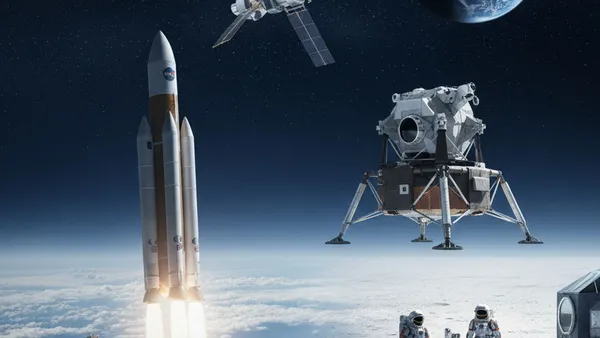
Getting back to the Moon requires a tag-team of some of the most powerful machines ever built by humanity. The Artemis program relies on a unique blend of NASA engineering and commercial innovation to make the journey possible.
The backbone of the trip is NASA’s Space Launch System (SLS)—a mega-rocket designed to push the Orion spacecraft out of Earth's gravity. Orion serves as the astronauts' home, life support system, and command center during the multi-day trip to lunar orbit.
But Orion wasn't built to land on the Moon. That is where the Human Landing System (HLS) comes in. Built by private companies like SpaceX and Blue Origin, these massive landers will launch into space separately.
The plan requires Orion and the HLS to meet and dock perfectly in space. The astronauts then transfer into the lander, ride it down to the lunar dirt, and eventually use it to blast back up to Orion for the ride home. It is a brilliant, high-stakes orbital relay race!
Key Takeaway
The missions rely on NASA's Orion spacecraft for the journey and commercial landers to reach the surface.
Test Your Knowledge
Which spacecraft is responsible for carrying the astronauts from Earth to lunar orbit?
Track your progress, earn XP, and compete on leaderboards. Download NerdSip to start learning.