Humans are finally heading back to the moon in 2026. Want a front-row seat?
Prompted by A NerdSip Learner
Master the rockets, route, and records of Artemis 2.
Have you ever looked up at the night sky and wondered what it would be like to visit the moon? For the first time in over 50 years, humanity is packing its bags and heading back!
In 1972, the famous Apollo missions came to an end. Since then, astronauts have stayed relatively close to home, orbiting Earth on the International Space Station. But the Artemis 2 mission is changing the game.
Targeted to launch in 2026, this historic mission is the epic sequel to the Apollo program. But Artemis isn't just about repeating history—it is about pushing boundaries. It will be the first time in half a century that humans travel beyond low Earth orbit.
Think of Artemis 2 as the ultimate test drive. NASA wants to make sure their brand-new space vehicles are safe for humans in deep space. While the crew won't actually land on the lunar surface this time, they are paving the exact path future astronauts will take. It is a giant leap toward making the moon our second home!
Key Takeaway
Artemis 2 is a 2026 test mission that will send humans beyond low Earth orbit for the first time since 1972.
Test Your Knowledge
What is the main purpose of the Artemis 2 mission?
To blast humans all the way to the moon, you need some seriously heavy lifting. Enter the Space Launch System (SLS) and the Orion spacecraft.
Imagine a skyscraper packed with explosive energy! The SLS is NASA’s newest mega-rocket. It is one of the most powerful rockets ever built for human spaceflight, designed specifically to push massive amounts of weight completely out of Earth's gravity.
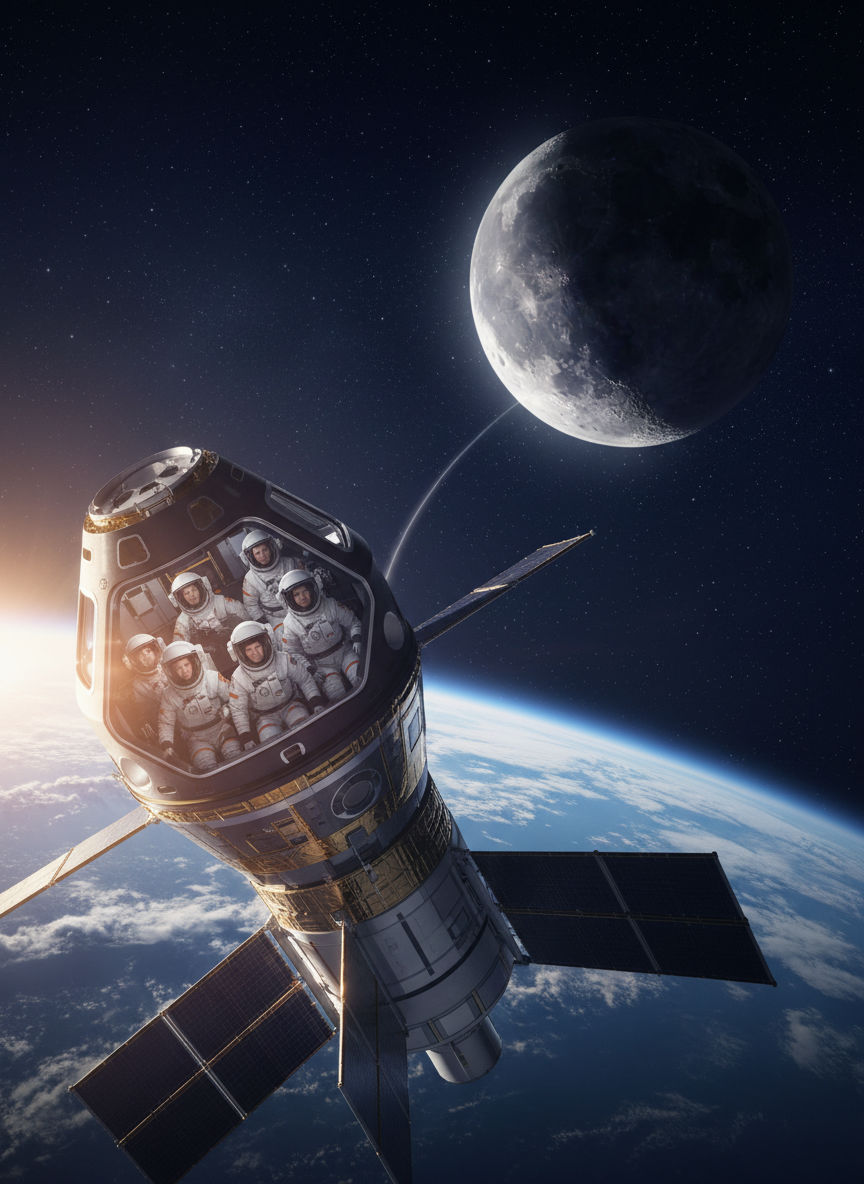
Sitting right at the very top of this giant rocket is the Orion capsule. This is the astronauts' home, command center, and lifeboat all rolled into one. Unlike the cramped capsules from the 1960s, Orion is packed with modern technology and advanced life-support systems.
During the Artemis 2 mission, the crew will live inside Orion for about ten days. They will test everything from the air conditioning to the navigation systems, making sure the spacecraft can safely keep humans alive in the harsh environment of deep space. It’s the ultimate zero-gravity road trip!
Key Takeaway
The astronauts will ride the massive SLS rocket and live inside the advanced Orion capsule during their journey.
Test Your Knowledge
What is the name of the capsule where the astronauts will live during the Artemis 2 mission?
You can't have a historic space mission without a trailblazing crew! The Artemis 2 team consists of four incredibly talented astronauts who are about to make history.
The crew includes Commander Reid Wiseman, Pilot Victor Glover, and Mission Specialists Christina Koch and Jeremy Hansen. But this isn't just any group of explorers. They are shattering records that have stood for decades!
Victor Glover will become the first person of color to travel beyond low Earth orbit. Christina Koch will make history as the first woman to make the journey. And Jeremy Hansen, who represents the Canadian Space Agency, will be the first non-American to ever fly toward the moon!
These four astronauts represent a new era of space exploration. The Apollo missions were amazing, but they only featured American men. The Artemis generation is all about showing that space belongs to all of humanity. When they look back at Earth, they'll be representing all of us!
Key Takeaway
The Artemis 2 crew is incredibly diverse, featuring the first woman, person of color, and Canadian to travel to the moon.
Test Your Knowledge
Why is the Artemis 2 crew considered historic compared to the Apollo missions?
So, where exactly is the Artemis 2 crew going? They are going on a 10-day journey using something called a hybrid free-return trajectory.
Here is how it works: the spacecraft won't actually go into a permanent orbit around the moon, and it definitely won't land. Instead, it will use the moon's gravity like a giant slingshot! The Orion capsule will loop behind the moon and then naturally coast right back toward Earth.
This is an incredibly smart flight path because it is safe. If the engines were to fail in deep space, gravity alone would naturally pull the astronauts back home without needing extra fuel.
During this epic loop, the crew will travel approximately 4,700 miles beyond the far side of the moon. That means they will fly further out into deep space than any human beings in history! After this incredible scenic route, they will zoom back to Earth and safely splash down in the ocean.
Key Takeaway
The mission uses a safe 'free-return trajectory,' acting like a gravity slingshot to send the crew farther into space than anyone before.
Test Your Knowledge
What is the main advantage of a 'free-return trajectory'?
You might be wondering: if we aren't landing on the moon during Artemis 2, what is the point of the whole trip?
Artemis 2 is the crucial "dress rehearsal" for everything that comes next. By proving that the SLS rocket and the Orion capsule are safe for humans, this crew is unlocking the door to the future.
The very next mission, Artemis 3, aims to actually land astronauts on the lunar surface—specifically near the moon’s South Pole, where scientists believe there is frozen water.
But the moon is just a stepping stone. NASA's ultimate goal is to build a permanent lunar base and a space station orbiting the moon. Astronauts will use the moon as a practice ground to learn how to live on another world. Once we master living on the moon, we will use that knowledge for the greatest adventure of all: sending humans to Mars!
Key Takeaway
Artemis 2 is a stepping stone toward landing on the moon, building a lunar base, and eventually sending humans to Mars.
Test Your Knowledge
How does Artemis 2 connect to the broader goals of space exploration?
Track your progress, earn XP, and compete on leaderboards. Download NerdSip to start learning.