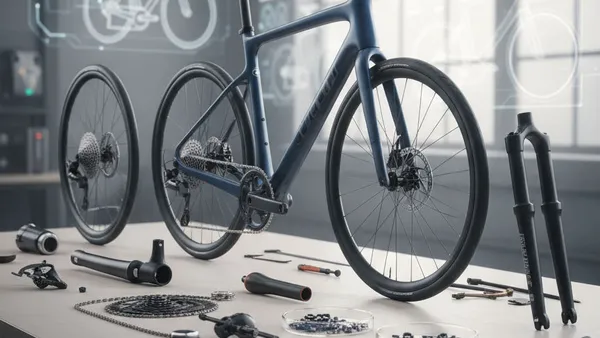
Ready to unlock the elite physics hiding inside your bicycle?
Prompted by NerdSip Explorer #9682
Master the physics of advanced cycling mechanics.
Modern mountain bike suspension is a marvel of mechanical engineering. To truly understand how a bike behaves on the trail, we have to look past the shock itself and analyze the kinematics of the linkage system.
One of the most critical concepts is anti-squat. When you accelerate, your body weight naturally shifts backward, which would normally compress the rear shock—a frustrating phenomenon known as 'pedal bob.'
Engineers combat this by designing the suspension linkage so that the tension of the chain pulling on the rear cassette creates a mechanical force that actively resists this compression. The frame's instantaneous center of rotation is manipulated so chain tension pulls the rear wheel down, counteracting your weight shift.
A bike with 100% anti-squat will theoretically remain perfectly level under acceleration. However, designers carefully tune this curve throughout the travel, as too much anti-squat can cause pedal kickback over harsh bumps!
Key Takeaway
Anti-squat utilizes drivetrain chain tension to counteract suspension compression during acceleration.
Test Your Knowledge
What primary force does anti-squat leverage to prevent pedal bob?
A perfectly built wheel relies on balancing radial, lateral, and torsional loads. Spoke tension isn't just about tightness; it's about tension equalization to maximize the wheel's fatigue life and structural integrity.
Lateral stiffness is heavily dictated by the bracing angle—the angle at which the spoke leaves the hub flange to meet the rim. Because modern rear wheels must accommodate a wide cassette, the drive-side flange is pushed closer to the centerline. This creates asymmetrical bracing angles, requiring a process called dishing.
Because of dishing, drive-side spokes must carry significantly higher tension than non-drive-side spokes to keep the rim centered. Furthermore, elite mechanics know to account for tension drop during tubeless tire inflation. The air pressure compresses the rim radially, dropping overall spoke tension, which must be anticipated during the build!
Key Takeaway
Rear wheel dishing creates asymmetrical bracing angles, demanding unequal spoke tensions between the drive and non-drive sides.
Test Your Knowledge
Why do tubeless tires cause a drop in spoke tension upon inflation?
Bicycle hydraulic brakes operate on Pascal's Principle, which states that pressure exerted on a confined fluid is transmitted equally in all directions. This allows the system to multiply the mechanical force from your finger at the lever into massive clamping force at the caliper.
The industry is split between two fluid types: DOT fluid and mineral oil. DOT fluid is hygroscopic, meaning it absorbs ambient moisture over time. This lowers its boiling point but prevents water from freezing in the lines. Mineral oil is hydrophobic; it repels water, meaning any moisture entering the system pools at the lowest point (the caliper).
The ultimate enemy of hydraulics is heat fade. When kinetic energy converts to thermal energy during heavy braking, the fluid can exceed its boiling point. This creates vapor bubbles. Unlike liquid, gas is compressible, leading to a terrifyingly 'spongy' brake lever.
Key Takeaway
Hydraulic brakes rely on incompressible fluid, and boiling that fluid creates compressible gas bubbles that cause lever fade.
Test Your Knowledge
What is the primary difference in how DOT fluid and mineral oil handle moisture?
Mechanical efficiency in high-end bicycle drivetrains is remarkably high—often exceeding 97%—but frictional losses still occur. Surprisingly, the primary source of drivetrain drag isn't found in the ceramic or steel bearings of the bottom bracket.
The dominant source of friction is chain articulation—the physical bending of the chain links as they pivot to engage and disengage the cogs and chainrings. Every time a link bends, the inner plates rub against the pins and rollers.
This is the core physics behind Oversized Pulley Wheel Systems (OSPW). A larger pulley wheel has a gentler radius, which significantly reduces the angle of chain articulation. Less bending means less frictional drag. Additionally, severe cross-chaining increases lateral friction between the chain plates and cassette teeth, massively accelerating wear and sapping your wattage.
Key Takeaway
Minimizing chain articulation angles through larger cogs and pulleys significantly reduces drivetrain frictional losses.
Test Your Knowledge
What is the primary source of frictional drag in a bicycle drivetrain?
Unlike isotropic metals like steel, aluminum, or titanium—which exhibit identical mechanical properties in all directions—carbon fiber reinforced polymer (CFRP) is inherently anisotropic. Its strength and stiffness are strictly directional, aligning perfectly with the axis of the carbon filaments.
Frame engineers view this anisotropy not as a flaw, but as a superpower. By optimizing the layup schedule, engineers meticulously layer pre-preg carbon sheets at specific angles (such as 0°, 45°, and 90°).
This precise orientation allows a frame to be deeply customized. For instance, the bottom bracket zone can be constructed with fibers aligned to create massive torsional rigidity for power transfer, while the seat stays utilize a different fiber orientation to remain vertically compliant, purposefully flexing to absorb road buzz.
Key Takeaway
Carbon fiber's anisotropic nature allows engineers to independently tune directional stiffness and compliance through the layup schedule.
Test Your Knowledge
What does it mean for carbon fiber to be 'anisotropic'?
For decades, cyclists believed that pumping tires to maximum pressure resulted in the fastest ride. Modern physics has proven this false, and the reason lies in a concept called hysteresis.
Rolling resistance is fundamentally driven by hysteresis—the energy lost as heat when the tire casing and tread compound deform under a load and fail to return 100% of that stored elastic energy.
Wider tires run at lower pressures often exhibit lower rolling resistance on real-world, imperfect surfaces. Instead of the entire bicycle and rider deflecting upward over every microscopic bump (wasting forward momentum as vertical suspension losses), a supple tire deforms over the imperfection. High thread-count (TPI) casings minimize hysteretic losses because their thinner threads bend and rebound more efficiently, turning less of your hard-earned pedaling wattage into waste heat.
Key Takeaway
Supple casings lower rolling resistance by reducing hysteresis, turning less of your pedaling energy into heat.
Test Your Knowledge
Why do high pressures sometimes increase rolling resistance on rough roads?
The evolution of bottom brackets from threaded systems (like BSA) to press-fit standards (like PF30 or BB86) was driven by the engineering desire for wider, stiffer frame shells and weight reduction. However, press-fit systems became notoriously famous for one flaw: maddening creaks.
This creaking is fundamentally a tolerance stack issue. When the frame shell diameter, the bearing cup diameter, and their concentricity (perfect alignment) deviate by mere micrometers, the bearing cups no longer fit perfectly.
Under heavy pedaling loads, the frame flexes, causing micro-movements between the mismatched cup and the carbon frame shell. This friction generates the audible creak. Thread-together press-fit bottom brackets solve this elegantly by mechanically locking the left and right cups to each other via an internal sleeve, completely bypassing the frame's microscopic dimensional imperfections.
Key Takeaway
Press-fit creaking is caused by micro-movements resulting from compounding manufacturing tolerances between the frame and bearings.
Test Your Knowledge
How do thread-together press-fit bottom brackets solve creaking?
Electronic shifting systems replace traditional mechanical Bowden cables with precision servomotors and digital communication protocols. When systems like Shimano Di2 first launched, they utilized a wired CAN bus (Controller Area Network).
The CAN bus is a robust vehicle communication standard originally designed for automotive applications. It allows microcontrollers to communicate directly without a host computer, ensuring shifting commands are executed with extreme reliability despite intense physical vibration or moisture.
Modern iterations have transitioned to proprietary wireless protocols operating on the 2.4 GHz band. These systems face immense engineering challenges: they must wake up instantly from sleep to preserve battery, execute encoded shifting packets with near-zero latency, and actively reject cross-talk or interference from dozens of other ANT+ and Bluetooth devices in the peloton.
Key Takeaway
Electronic shifting relies on sophisticated encoded digital protocols to guarantee precise, interference-free derailleur actuation.
Test Your Knowledge
What is the primary advantage of the CAN bus system originally used in wired electronic shifting?
Bicycle stability is a complex interplay of geometry and physics. While many believe the gyroscopic force of spinning wheels keeps a bike upright, advanced physics models prove that steering geometry and mass distribution are the dominant factors.
The primary determinant of how a bike handles is trail—the horizontal distance between the front tire's contact patch and the point where the steering axis intersects the ground.
Trail acts like the caster wheels on a shopping cart. A larger amount of trail creates a strong self-centering force, making the bike incredibly stable at high descents but slightly sluggish at low speeds. Conversely, reducing the trail makes the steering highly responsive and twitchy, a trait favored in pure criterium racing frames. Frame builders tune this perfectly by balancing the head tube angle and the fork rake (offset).
Key Takeaway
Trail, dictated by the head tube angle and fork offset, is the primary geometric factor creating a bicycle's self-centering stability.
Test Your Knowledge
What effect does increasing the 'trail' of a bicycle have on its handling?
In high-end bicycle mechanics, a bolt is best understood as a very stiff spring. When tightened to a specific torque, the bolt stretches microscopically, creating preload. This clamping force is what binds components (like a stem to a steerer tube) together securely.
If the preload is insufficient, the joint experiences micro-movements under cyclical loading, rapidly leading to fatigue failure and snapping of the bolt. Conversely, excessive torque pushes the bolt past its elastic limit into plastic deformation, permanently weakening the metal.
Crucially, a torque wrench doesn't measure tension directly; it measures friction. This is why thread preparation is paramount. Applying grease, anti-seize, or threadlocker drastically alters the friction coefficient of the threads, meaning the actual preload achieved at a specific torque setting can change by up to 30%!
Key Takeaway
Proper torque establishes elastic preload, while thread preparation heavily dictates the actual tension achieved by a torque wrench.
Test Your Knowledge
Why does adding grease to a bolt affect the torque reading?
Track your progress, earn XP, and compete on leaderboards. Download NerdSip to start learning.