What sets Aliplast's architectural aluminum apart?
Prompted by NerdSip Explorer #9682
Master Aliplast's high-performance window and sliding systems.
When designing high-performance building facades, raw aluminum presents a massive challenge: it is inherently a highly conductive metal. Left untreated, it acts as a thermal bridge, rapidly transferring interior heat to the cold exterior.
Aliplast circumvents this physical limitation through complex, multi-chamber extrusion engineering. Modern Aliplast profiles are split into interior and exterior shells, connected by engineered thermal breaks—typically made of glass fiber-reinforced polyamide. This breaks the conductive chain, isolating the indoor climate.
Their portfolio spans a wide spectrum of structural needs. From standard windows to ultra-heavy sliding doors and steel-look minimalist frames, Aliplast systems transform highly conductive raw aluminum into energy-efficient, structurally robust architectural solutions that meet the strictest modern building codes.
Key Takeaway
Aliplast systems use multi-chamber designs and glass fiber-reinforced polyamide thermal breaks to achieve high energy efficiency.
Test Your Knowledge
What material is typically used to create thermal breaks in modern aluminum profiles?
The Star 90 is Aliplast's flagship system for passive and ultra-low-energy construction. To meet these rigorous standards, the system relies on a massive 90 mm frame depth and incorporates a 45 mm deep thermal separator made of solid, proven insulating materials.
Because of this deep profile, the Star 90 can easily accommodate thick, triple-glazed units. When combined with specialized warm-edge spacers and inert gas fillings, the overall window thermal transmittance (Uw) can drop to approximately 0.8 W/(m²K), easily qualifying for passive building standards.
Architecturally, it features an innovative rainwater drainage system where all plug elements are entirely invisible, maintaining a sleek, harmonious appearance. It can also support heavy sashes up to 150 kg with concealed hinges, marrying top-tier energy efficiency with minimalist aesthetics.
Key Takeaway
The Star 90 is optimized for passive houses, utilizing a 90 mm frame and a 45 mm thermal break for exceptional insulation.
Test Your Knowledge
What is the depth of the thermal break in the Aliplast Star 90 system?
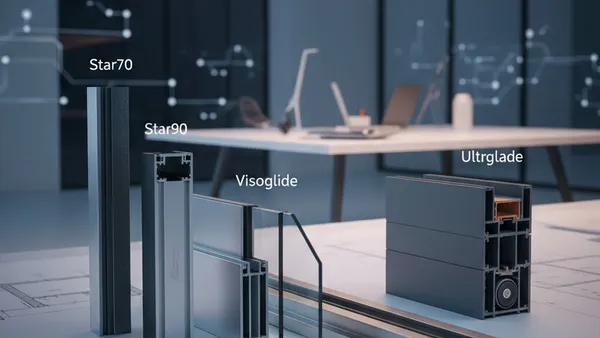
In the architectural fenestration industry, professionals frequently search for a "Star 70" system. However, understanding precise nomenclature is critical to preventing specification errors on architectural blueprints.
Aliplast's premium Star line is fundamentally a 90 mm deep system. When architects look for a roughly 70 mm-class Aliplast system, they should actually specify the Genesis 75 (which features a 75 mm frame) or older, non-passive systems like the Imperial (65 mm).
The "70" designation is most famously associated with a direct competitor's product, the Aluprof MB-70. Understanding this exact distinction is crucial for procurement and structural engineering, as mixing up system depths by even 5 to 20 mm can completely derail the installation tolerances of a building's facade.
Key Takeaway
The "Star 70" is typically a misnomer; Aliplast covers the 75 mm segment with the Genesis 75, while "Star" denotes their 90 mm line.
Test Your Knowledge
If an architect needs an Aliplast system with roughly a 75 mm frame depth, which product should they specify?
For standard residential terraces and patios, Visoglide Plus is the go-to thermally insulated sliding system. Available in both traditional sliding and lift-and-slide variants, it utilizes a highly efficient three-chamber aluminum profile to ensure thermal stability.
A standout structural feature of Visoglide Plus is its exceptionally narrow central labyrinth post, measuring just 34 mm wide. This minimizes visual barriers between the indoors and outdoors, preserving a sleek aesthetic while still supporting heavy glass sashes up to 250 kg in the sliding configuration.
From a layout perspective, it can be configured in 2, 3, 4, or 6-element setups on a multi-track frame. Moving elements are equipped with specialized roller mechanisms that distribute weight evenly, reducing the risk of structural sagging over decades of use.
Key Takeaway
Visoglide Plus is a versatile sliding system prized for its ultra-slim 34 mm central post and flexible multi-track configurations.
Test Your Knowledge
How wide is the central labyrinth post in the Visoglide Plus system?
When architectural plans call for monumental, heavy glazing, the Ultraglide system takes over. This premium lift-and-slide solution boasts massive frame depths ranging from 153 mm up to 239 mm (for three-track systems).
Ultraglide is engineered for extreme loads, comfortably supporting single sashes weighing up to 400 kg. Despite this massive weight, the specialized lift-and-slide hardware allows the doors to operate with minimal physical effort.
One of its most impressive architectural applications is the 90-degree corner opening without a fixed mullion. When the doors slide back, the structural corner completely disappears, seamlessly merging indoor and outdoor spaces. It also offers a flat threshold option, providing barrier-free access suitable for high-end residential and commercial public buildings.
Key Takeaway
Ultraglide handles extreme structural loads up to 400 kg per sash and enables stunning mullion-free 90-degree corner openings.
Test Your Knowledge
What unique architectural feature can be achieved with the Aliplast Ultraglide system?
The Max Light system was engineered for architects craving the industrial, post-industrial "steel look" without sacrificing the thermal performance and weather resistance of modern aluminum profiles.
Its most striking feature is its ultra-slim profile with a minimal visible external width—starting at just 35 mm. This delicate appearance mimics traditional steel framing found in historic loft renovations and modern barn-style architecture.
Despite this slender frame, Max Light achieves rigorous structural integrity. It meets a wind load resistance of Class C5 and a watertightness rating of E1650. This means it can withstand intense environmental pressures while maximizing natural light penetration and offering excellent thermal parameters (Uw from approximately 0.97 W/(m²K)).
Key Takeaway
Max Light mimics traditional steel frames with a mere 35 mm visible profile while maintaining superior modern weather resistance.
Test Your Knowledge
What aesthetic style is the Max Light system primarily designed to emulate?
To give architects maximum design freedom without complicating structural calculations, the Max Light system is split into four distinct stylistic variants: Design, Modern, Steel, and Invisible.
Crucially, all four variants share the identical technical base, frame depths, and thermal parameters. This allows builders to mix and match aesthetics across different facades of the same building while utilizing a single, coherent ecosystem of aluminum profiles.
The Invisible variant is particularly revolutionary. It utilizes a concealed sash technology where the openable window sash is completely hidden behind the frame from the outside. To an observer on the exterior, an openable window looks completely identical to a fixed glass pane, resulting in ultimate architectural minimalism.
Key Takeaway
Max Light offers four interchangeable aesthetic variants, including an 'Invisible' option with a fully concealed openable sash.
Test Your Knowledge
What is the defining feature of the Max Light 'Invisible' variant?
At an advanced engineering level, thermal transmittance (U-values) dictates system selection. Engineers track three metrics: Uf (frame), Ug (glass), and Uw (the whole window). The lower the number, the better the insulation.
Systems like the Star 90 manipulate Uf by inserting multi-chambered polyamide breaks and central thermal gaskets. However, in heavily glazed systems like Ultraglide or Visoglide, the Ug parameter plays an outsized role because glass makes up the vast majority of the surface area.
To prevent perimeter heat loss where the glass meets the aluminum, high-end installations mandate a warm edge spacer (rather than a highly conductive aluminum spacer) inside the glazing unit. This combination prevents interior condensation and drives the total Uw value below strict passive house thresholds.
Key Takeaway
Advanced Aliplast systems optimize Uw values by combining complex Uf frame engineering with warm edge spacers and thick Ug glazing units.
Test Your Knowledge
Which metric specifically measures the thermal transmittance of the aluminum frame itself?
Beyond insulation, architectural fenestration must withstand extreme dynamic weather loads. Aliplast grades their systems using rigorous European standards (EN).
For instance, the Max Light system boasts a watertightness rating of E1650. In European classification, this means the window resists water penetration at wind pressures of 1650 Pascals—equivalent to hurricane-force winds pushing rain horizontally against the glass.
On the security front, these systems achieve RC2 (Resistance Class 2) burglary resistance. They do this by integrating specialized hardware: mushroom cams, multi-point locking mechanisms, and anti-lift devices embedded in the heavy sliding tracks of Ultraglide. This ensures absolute safety without compromising the sleek, minimalist aesthetic.
Key Takeaway
Aliplast systems undergo rigorous European testing, achieving exceptional weather ratings like E1650 watertightness and RC2 security.
Test Your Knowledge
What does a watertightness rating of E1650 indicate?
When should an architect specify Visoglide Plus over Ultraglide? At the master level, it comes down to structural limits, spatial function, and budget.
Visoglide Plus is perfect for standard residential patios. Its ultra-slim 34 mm central post offers superior elegance, and it easily handles sashes up to 250 kg. It is highly cost-effective for typical dimensions.
However, if the design demands 3-meter tall glass panels weighing 400 kg, or requires a flat threshold with a mullion-free 90-degree corner, Ultraglide is absolutely mandatory. Proper specification ensures the structural integrity of the facade; placing a 350 kg pane in a Visoglide frame would cause critical sagging and hardware failure. Choosing the right system optimizes both thermal efficiency and long-term durability.
Key Takeaway
Specify Visoglide for elegant residential sliders, but mandate Ultraglide for monumental, ultra-heavy glazing and architectural corners.
Test Your Knowledge
If an architectural plan requires a sliding glass panel that weighs 380 kg, which system MUST be specified?
Track your progress, earn XP, and compete on leaderboards. Download NerdSip to start learning.