Ready to unlearn the biggest lie about how planes fly?
Prompted by A NerdSip Learner
Master advanced aerodynamics and flow mechanics.
You probably learned the Equal Transit Time theory: air splitting at the front of a wing must meet at the trailing edge simultaneously. Because the top is curved, air must move faster to catch up, lowering pressure. But here is the truth: that theory is fundamentally false. Airflow over the top does not just catch up; it arrives significantly *ahead* of the air traveling underneath.
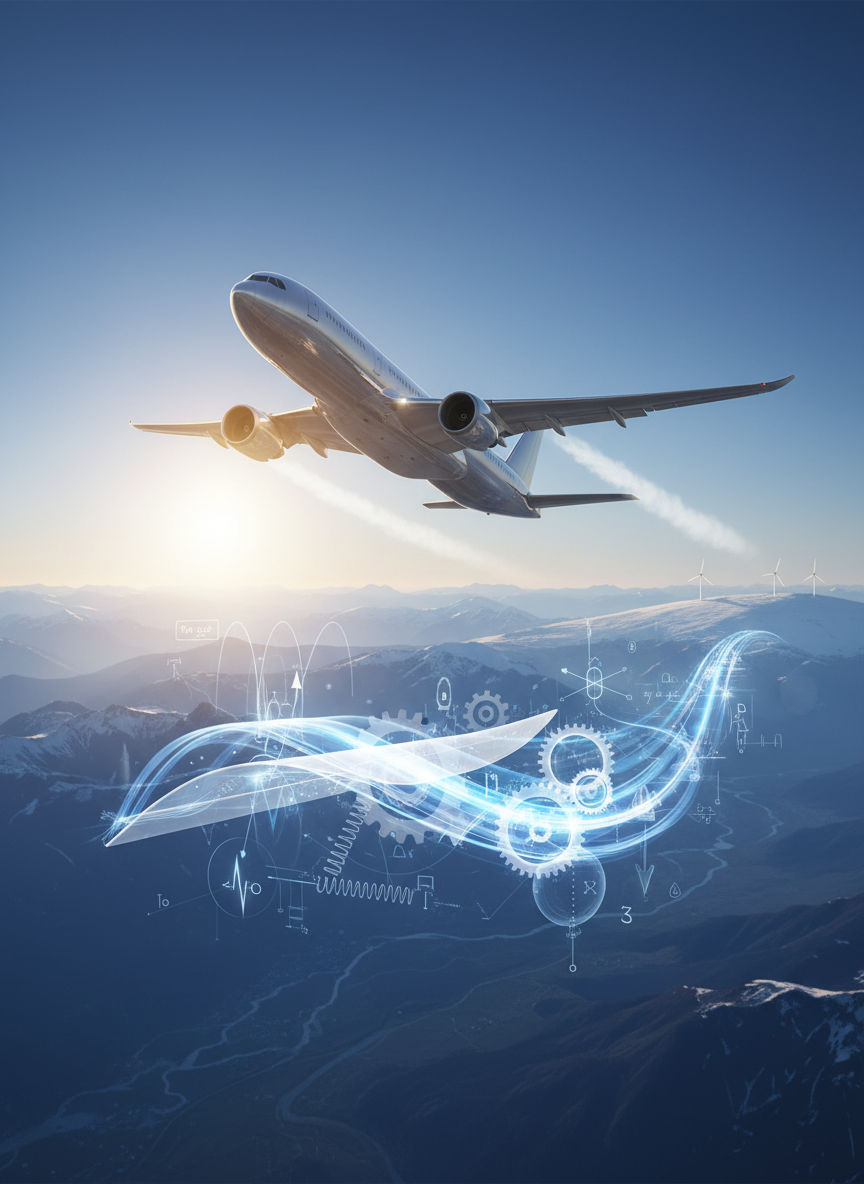
The real hero of lift is Circulation. As a wing moves, air viscosity drags the fluid along, creating a complex flow field. The sharp trailing edge of the wing enforces the Kutta Condition, forcing the airflow to leave smoothly rather than curling around the back. This physical constraint induces a net 'circulation' of air around the entire airfoil.
When combined with the freestream velocity, this circulation dramatically accelerates the air over the top and slows it on the bottom. The math defining this—the Kutta-Joukowski theorem—proves that lift is directly proportional to this fluid circulation. The true picture is far more elegant, and mathematically rigorous, than the simple textbook lie!
Key Takeaway
Air over the top of a wing moves much faster than required by the equal transit theory, driven by flow circulation and the Kutta Condition.
Test Your Knowledge
Why is the Equal Transit Time theory incorrect?
To truly grasp lift at a microscopic level, we must look at the boundary layer—the ultra-thin layer of air hugging the wing's skin. Due to air's natural viscosity, the molecules directly touching the wing do not move at all relative to the surface. This is known in fluid dynamics as the no-slip condition.
As you move millimeters away from the skin, the air velocity sharply increases to match the freestream. This boundary layer can be smooth and organized (laminar flow) or chaotic and tumbling (turbulent flow). Aerospace engineers obsess over managing this microscopic layer because it dictates a critical phenomenon: flow separation.
As air moves toward the back of the wing, it encounters an adverse pressure gradient, meaning pressure is increasing towards the trailing edge. If the boundary layer lacks the kinetic energy to push through this gradient, it detaches from the wing. This destroys lift and causes a catastrophic stall. Advanced aircraft use vortex generators to inject high-energy turbulent air into the boundary layer to keep the flow attached!
Key Takeaway
The ultra-thin boundary layer dictates whether air stays attached to the wing, and its detachment causes a catastrophic loss of lift called a stall.
Test Your Knowledge
What is the primary cause of an aerodynamic stall?
Lift is never free; it produces a costly, unavoidable byproduct known as induced drag. Because the air pressure beneath the wing is higher than the pressure above it, the fluid naturally tries to equalize. It cannot do this through the solid wing, but it *can* escape around the wingtips.
At the ends of the wings, the high-pressure air spirals upward over the edge into the low-pressure zone. As the plane flies forward, these spirals stretch out behind the aircraft into massive, horizontal tornados called wingtip vortices. These violent vortices alter the local airflow around the wing, effectively tilting the overall lift vector slightly backward.
This backward-pointing component of lift is induced drag. It is incredibly punishing at slow speeds and high angles of attack, burning massive amounts of fuel. This is exactly why modern airliners feature winglets—those vertical fins at the wingtips. By physically blocking the airflow from curling over, winglets weaken the vortices, drastically reducing drag and saving millions of gallons of fuel.
Key Takeaway
High-pressure air curling around the wingtips creates drag-inducing vortices, which modern aircraft mitigate using vertical winglets.
Test Your Knowledge
How do winglets reduce induced drag?
At low speeds, air behaves like water—it is essentially incompressible, flowing smoothly out of the plane's way. But as an aircraft approaches the speed of sound, the physics of flight violently change. The air molecules cannot get out of the way fast enough, causing them to compress and jam together.
Even if a plane is flying at Mach 0.8 (80% the speed of sound), the airflow accelerating over the curved top of the wing might hit Mach 1.0 locally. This specific velocity is called the Critical Mach Number. When this happens, a localized shock wave forms right on top of the wing.
Shock waves cause a massive spike in resistance called wave drag and can violently separate the boundary layer, causing high-speed stalls and loss of control. To delay this, engineers use swept wings. Angling the wings backward means the airflow only 'sees' the perpendicular component of the velocity, effectively tricking the wing into thinking it is flying slower than it really is!
Key Takeaway
Nearing the speed of sound causes localized shock waves and massive drag, which is why fast jets utilize swept wings to delay these effects.
Test Your Knowledge
What happens when an aircraft exceeds its Critical Mach Number?
Historically, planes were designed with positive static stability. If a gust of wind knocked an older plane off course, its aerodynamic design would naturally pull it back to level flight. While safe, stability naturally fights maneuverability. A highly stable plane requires immense force and large control surfaces to turn, creating significant drag.
Modern fighter jets—and increasingly, commercial airliners—flip this paradigm completely. They are designed with relaxed static stability or are inherently aerodynamically unstable. Without constant input, a modern jet fighter would violently flip out of control in seconds. By moving the center of gravity behind the center of lift, the plane constantly *wants* to pitch up aggressively.
To make these aircraft flyable, aerospace engineers rely on Fly-by-Wire systems. High-speed computers read the pilot's inputs, calculate the exact aerodynamics, and adjust the control surfaces thousands of times per second to artificially maintain stability. This intentional instability results in unmatched agility, reduced drag, and drastically smaller tail surfaces!
Key Takeaway
Many modern aircraft are designed to be aerodynamically unstable to maximize maneuverability and efficiency, relying on computers to keep them flying.
Test Your Knowledge
Why are modern fighter jets often designed to be aerodynamically unstable?
Track your progress, earn XP, and compete on leaderboards. Download NerdSip to start learning.