Running out of things to say is a supply problem, not a personality problem. Three moves carry most of the weight: ask a follow-up question instead of a fresh one, let the other person talk about themselves, and keep feeding yourself new material so you always have something to trade. The research is unusually encouraging. People systematically underestimate how much strangers like them, only about 2 percent of conversations end at the moment both people want, and in a Harvard speed-dating study the people who asked more follow-up questions were the ones who got asked out again.
You are at a work event. It opens fine. Weather, job, weekend plans. Then it stops, and the silence is loud enough that you can hear yourself thinking.
So you ask another question. They give another one-line answer. Someone checks their phone. Later, in the car, you replay the whole thing and decide you are boring.
Part of the difficulty is that nobody states the rules out loud: the unspoken social rules governing these exchanges are learned by trial and error, if they are learned at all.
You are not boring. You are out of fuel, and the tank has been empty for years.
This page is the diagnosis: the five reasons the tank runs dry, and the research behind each one. If you want the method instead, go straight to how to never run out of things to say.
Prefer to watch? Here are the five rules in five minutes:
The Short Version
Five things cause the blank. Each has a fix that takes seconds, not months.
| Why you run dry | What to do instead |
|---|---|
| You ask a brand new question every time | Ask one more question about the answer you just got |
| You are performing instead of handing over the floor | Let them talk about themselves; the brain treats it as a reward |
| You stay on the shallow rung out of fear | Go one level deeper than feels safe; it lands better than you expect |
| Your mental library is empty outside your job | Learn one new thing for five minutes a day |
| You read every pause as failure | Let the silence sit, then use it to pivot |
First, the Reassuring Part
Almost everything you believe about how those conversations went is wrong, and wrong in your favor.
In 2018, Erica Boothby and colleagues published a study in Psychological Science on what they named the liking gap. After conversations between strangers, people rated how much they liked their partner and how much they thought their partner liked them. The second number was consistently lower than the truth. People walk away from conversations underestimating the impression they left, and the gap persists for months among people who see each other regularly.
Then there is the awkward ending. Adam Mastroianni and colleagues asked both people in a conversation when they would have preferred it to stop. Their answers matched in fewer than 2 percent of conversations. Roughly half wanted out sooner, a third wanted more. Almost nobody can read where their partner is, which means the stiff goodbye you have been blaming yourself for is close to universal. The paper ran in PNAS in 2021.
One more. Nicholas Epley and Juliana Schroeder asked Chicago commuters to talk to a stranger on the train. Riders predicted it would be unpleasant. It was the most positive commute of the study, more enjoyable than sitting in silence, which is what almost everyone chooses.
The numbers worth remembering
- Fewer than 2 percent of conversations end at the moment both people want (Mastroianni et al., 2021)
- People underestimate how much a new conversation partner liked them, for months (Boothby et al., 2018)
- Asking follow-up questions predicted second dates in a Harvard speed-dating study (Huang et al., 2017)
- People will give up money for the chance to talk about themselves (Tamir & Mitchell, 2012)
- A silence of just four seconds is enough to make people feel rejected (Koudenburg et al., 2011)
So the problem is not that you are unbearable. The problem is mechanical, and the mechanics are fixable.
Reason 1: You Ask New Questions Instead of Follow-Ups
Watch a conversation die and you will usually see the same pattern. Question, answer, new question, answer, new question. It is an interview, and interviews end when the questions run out.
Karen Huang and colleagues at Harvard tested this properly in 2017, published in the Journal of Personality and Social Psychology. Across live conversations and a speed-dating study, people who asked more questions were rated as more likeable. One type did most of the work: the follow-up question, the one that shows you were listening to the last answer rather than waiting to deploy your next line. In the speed-dating data, follow-up questions predicted who got asked on a second date.
Here is the useful part. Every answer someone gives you contains at least three new threads. You are not supposed to invent a topic. You are supposed to pull one.
Someone says: "I just got back from Lisbon."
- Dead end: "Nice. Do you travel a lot?"
- Thread: "What made you pick Lisbon?"
- Thread: "What was the thing you did not expect?"
- Thread: "Would you go back, or is it a once thing?"
You will never run out of topics if you stop treating each answer as a closed box. The answer is the topic.
Reason 2: You Are Not Letting Them Talk About Themselves
Roughly 30 to 40 percent of everything people say is about their own experience. That number comes from Diana Tamir and Jason Mitchell, who in 2012 put people in a scanner at Harvard and gave them a choice: answer a question about themselves, or answer a factual question about someone else and earn slightly more money. People gave up real earnings to talk about themselves. In the scanner, self-disclosure lit up the mesolimbic dopamine system, the same circuitry that responds to food and money.
Talking about yourself is pleasurable at a neural level. Which means the single most generous thing you can do in a conversation is hand someone the floor and keep it there.
This is why the people everyone finds fascinating often say the least. They are not performing. They are asking, then listening, then asking again about the thing that made the other person light up. Everyone leaves the conversation feeling good and credits it to them.
There is a limit, and it matters. Pure interrogation feels like a job screening. A meta-analysis by Nancy Collins and Lynn Miller in 1994 found that disclosure runs both ways: we like people who open up to us, and we like people more after we open up to them. So trade. They give you something, you give something back at roughly the same depth, then you ask again.
Reason 3: You Are Stuck on the Shallow Rung
Small talk is not the enemy. Staying in small talk forever is.
Michael Kardas, Amit Kumar and Nicholas Epley ran a series of experiments published in 2022 in the Journal of Personality and Social Psychology under a title that gives the finding away: "Overly Shallow?" Participants expected deeper conversations with strangers to be awkward. The deep conversations were consistently less awkward, more enjoyable and more connecting than predicted. People kept the conversation shallow to avoid a discomfort that mostly did not arrive.
The habit shows up in wellbeing data too. Matthias Mehl's team recorded people's daily conversations and found that the happiest participants had roughly twice as much substantive conversation and about a third less small talk than the least happy. A 2018 pooled replication in Psychological Science with 486 people confirmed the substantive-conversation link and found no reliable effect for small talk. So the evidence is not that small talk is bad. It is that depth is what moves the needle, and most of us never get there.
You do not need to open with childhood trauma. You need one rung up:
| Shallow rung | One rung deeper |
|---|---|
| "What do you do?" | "What part of it would you keep if you could drop the rest?" |
| "How was your weekend?" | "What is the best thing you did in the last month?" |
| "Where are you from?" | "What do you miss about it, and what do you not miss at all?" |
| "Busy at work?" | "What are you working on that you actually care about?" |
Same effort. Completely different conversation.
Reason 4: Your Mental Library Is Empty
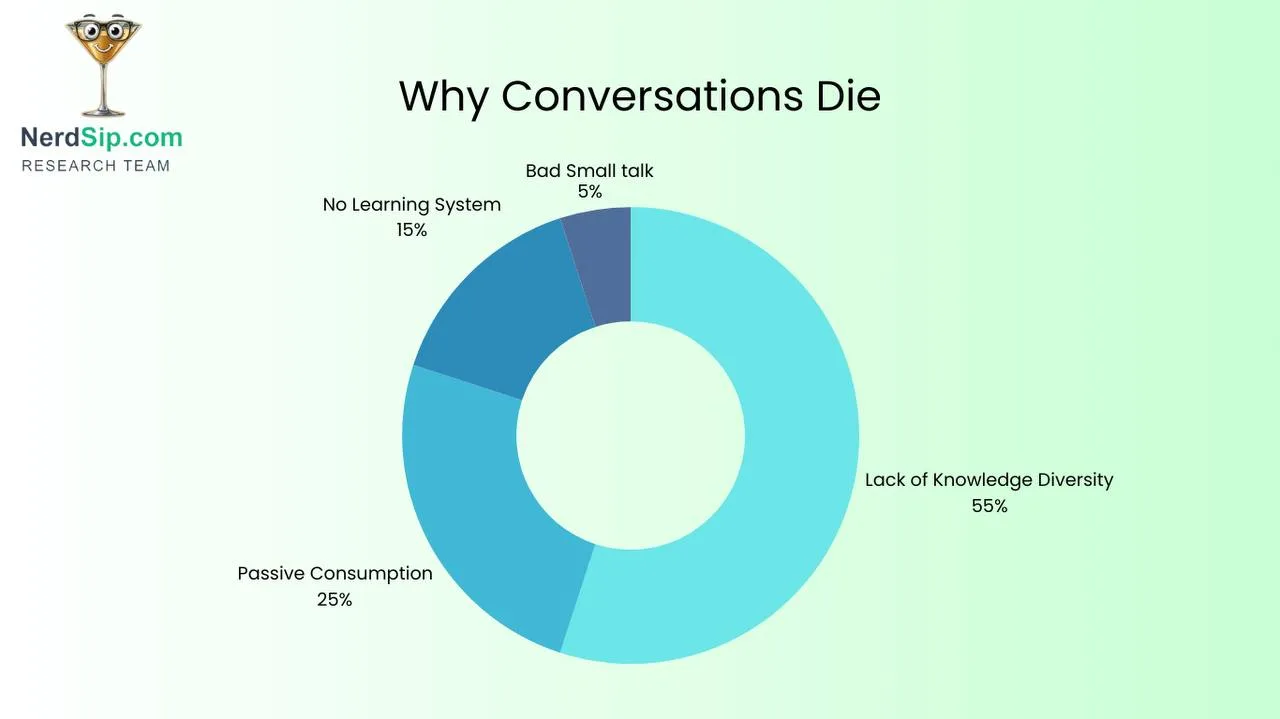
The techniques above steer a conversation. They do not fuel one. Fuel is material, and most adults stopped acquiring it the day they left school.
You spent twelve to sixteen years in an education system optimized for recalling specific facts under exam conditions. It was not optimized for conversational utility. The result is a familiar shape: deep knowledge in one narrow area, which happens to be your job, and almost nothing anywhere else. When the conversation drifts outside that area you nod, smile, and go get another drink.
Here is the mercy in it. The bar for contributing is far lower than you think.
You do not need expertise. You need roughly eight minutes of decent knowledge on a topic. Eight minutes on Stoicism gives you the core idea, two names, one modern application and one surprising detail. That is enough to join in, ask a real question, connect it to something else and sound like a person who has thought about it.
Most people never reach eight minutes on anything outside their job. Not on behavioral economics, sleep science, climate policy, modern art or any of the topics that actually come up.
Breadth also changes what you notice. Psychologists call it the cocktail party effect: your attention locks onto information your brain already has a slot for. Learn something about dopamine on Tuesday, and on Friday you will genuinely tune in when someone mentions their phone habit. When you know nothing about a topic, it is boring. When you know a little, it is interesting. Curiosity is downstream of knowledge, not the other way around.
And it compounds. Know a bit of philosophy, a bit of psychology and a bit of neuroscience, and you start seeing that Stoicism is essentially ancient cognitive behavioral therapy. Those connections are what people mean when they call someone insightful. You cannot connect what you do not have.
Reason 5: You Treat Silence as Failure
Namkje Koudenburg and colleagues found in 2011 that a silence of about four seconds in a group conversation was enough to make people feel less accepted and more anxious. Four seconds. That is roughly how long it takes to think of a decent question.
So the panic is real and it is fast. But the response most people choose, filling the gap with anything, is what makes the conversation worse. A rushed non-sequitur reads as nervous. A pause reads as thoughtful.
Use the pause instead of fearing it:
- Go back. "Wait, go back to the thing you said about your sister."
- Name it. "I have completely lost my train of thought." Honesty is disarming and buys you five seconds.
- Zoom out. "Totally different question, but what have you been into lately?"
- Hand it over. "You know more about this than I do. What am I missing?"
The Six Habits That Fix It
This is the short version of the fix. The full method, including what to do over text and what to say when your mind goes completely blank, lives in our guide on how to never run out of things to say.
Six habits. The first four cost nothing, the fifth costs five minutes a day, and the sixth is the one that makes the rest permanent.
- Ask one more question than you want to. After an answer, resist the new topic. Pull a thread from what they just said.
- Pass the ball back. Give something about yourself at the same depth they gave you, then ask again. Trade, do not interrogate.
- Go one rung deeper. Swap one default question for a version that asks about preference, opinion or feeling. Deep talk is less awkward than you predict.
- Bank the pause. When you blank, go back to something they said earlier instead of inventing a new subject.
- Learn one thing a day for five minutes. One concept, one story, one surprising number. This is the fuel. Everything else is steering.
- Rotate your topics on purpose. Science on Monday, history on Tuesday, money on Wednesday. Breadth is built by rotation, not by following whatever the algorithm hands you.
Five minutes a day is not a real cost. It is less time than you spend choosing what to watch. In a month it is twenty to thirty new topics. In a year it is a mental library most people never build.
What Does Not Work
Worth naming, because these are the popular answers and they all backfire.
- Memorizing conversation starters. A list of 50 questions gets you through the first ninety seconds. The problem was never the opening. It was the middle.
- Rehearsing your next line while they talk. You cannot ask a follow-up question about an answer you did not hear. This is the single most common cause of the blank.
- Waiting to feel confident first. Confidence follows repetitions. Epley and Schroeder's commuters were confident it would go badly, right up until it went well.
- Trying to be impressive. Interesting people ask; impressive people announce. Announcing ends conversations, because there is nowhere for the other person to go.
- Consuming without retrieval. Skimming a Wikipedia page is not learning it. If you cannot say the idea out loud tomorrow, it will not be available on Friday night.
The Dinner Party, Revisited
Eight people at a table. Someone mentions a book on Stoicism. Someone else brings up AI regulation in Europe. Then intermittent fasting, then habits, then Picasso's Blue Period.
The old you contributes to one of those, badly, and spends the rest of the evening nodding.
The new you has eight minutes on four of them. You mention that Marcus Aurelius was writing notes to himself, not a book. You ask a real question about how the AI rules get enforced, and someone who knows more answers at length and enjoys it. You pull the thread when a stranger admits fasting made them irritable. You say the thing about Picasso being broke and grieving a friend, then admit that is all you know, and ask what they know.
You did not dominate anything. You did not perform. You brought fuel and you passed the ball.
That is the whole trick. Interesting people are not born with better material. They just refill more often.
This is what NerdSip is for. Five-minute lessons on whatever you are curious about, built around retrieval rather than passive reading, so the thing you learn on Tuesday is still there on Friday. It turns dead time into material.
NerdSip is live in the App Store and on Google Play.
Want the complete map? We built a dedicated hub for this topic: How to Never Run Out of Things to Say. It brings together small talk, FORD, active listening, better follow-ups, and the deeper habit of becoming a more curious person.
Keep reading
- The Conversation Framework: How to Talk to Anyone About Anything
- 50 Conversation Starters That Aren't "What Do You Do?"
- Active Listening: The Soft Skill That Makes People Trust You
- How to Become More Interesting Without Pretending to Be Someone Else
- How to Make Small Talk: The Complete Guide
References
- Boothby, Cooney, Sandstrom & Clark (2018), The Liking Gap in Conversations: Do People Like Us More Than We Think?, Psychological Science
- Mastroianni, Gilbert, Cooney & Wilson (2021), Do Conversations End When People Want Them To?, PNAS
- Huang, Yeomans, Brooks, Minson & Gino (2017), It Doesn't Hurt to Ask: Question-Asking Increases Liking, Journal of Personality and Social Psychology
- Tamir & Mitchell (2012), Disclosing Information About the Self Is Intrinsically Rewarding, PNAS
- Epley & Schroeder (2014), Mistakenly Seeking Solitude, Journal of Experimental Psychology: General
- Kardas, Kumar & Epley (2022), Overly Shallow? Miscalibrated Expectations Create a Barrier to Deeper Conversation, Journal of Personality and Social Psychology
- Milek et al. (2018), Eavesdropping on Happiness Revisited, Psychological Science
- Mehl, Vazire, Holleran & Clark (2010), Eavesdropping on Happiness: Well-Being Is Related to Having Less Small Talk and More Substantive Conversations, Psychological Science
- Koudenburg, Postmes & Gordijn (2011), Disrupting the Flow: How Brief Silences in Group Conversations Affect Social Needs, Journal of Experimental Social Psychology
- Collins & Miller (1994), Self-Disclosure and Liking: A Meta-Analytic Review, Psychological Bulletin
Frequently Asked Questions
Why do I run out of things to say?
Usually for one of five reasons: you ask a brand new question after every answer instead of a follow-up, you do most of the talking rather than handing over the floor, you stay in safe small talk, you have no recent material outside your job, or you panic at the first pause and fill it badly. Only the fourth one takes time to fix. The others change the moment you change what you do next in the conversation.
Is it normal to run out of things to say?
It is close to universal. In a 2021 PNAS study, both people's preferred stopping points matched in fewer than 2 percent of conversations, so almost every conversation ends at a moment that feels wrong to at least one person. Research on the liking gap also shows that people consistently underestimate how much their conversation partner enjoyed talking to them. The awkwardness you remember is usually not the awkwardness they experienced.
What is the fastest way to never run out of things to say?
Ask a follow-up question about the answer you just received. It requires no preparation and no new material, and it is the single change with the best evidence behind it. In Huang and colleagues' 2017 research, published in the Journal of Personality and Social Psychology, people who asked more questions were rated more likeable, and follow-up questions in particular predicted who got a second date in a speed-dating study.
What do I say when my mind goes completely blank?
Go backwards, not forwards. Say "wait, go back to the thing you said about your sister" and let them keep talking. If nothing surfaces, name it honestly: "I have completely lost my train of thought." That is disarming and buys you a few seconds. A third option is to hand the topic over: "you know more about this than I do, what am I missing?"
How much knowledge do I need about a topic to join the conversation?
About eight minutes' worth. That is enough for the core idea, a name or two, one modern application, and one surprising detail. You do not need expertise to contribute, ask a real question, or connect the topic to something else. Most people never reach eight minutes on anything outside their job, which is why conversations stall so often.
Should I memorize conversation starters?
They help with the first ninety seconds and do nothing for the rest. The problem is almost never the opening; it is the middle, where you need to keep pulling threads out of what the other person says. A list of starters can get you into the room, but follow-up questions and fresh material are what keep you there.
Is small talk bad?
No, it is just a starting rung. Matthias Mehl's team found that the happiest people had roughly twice as much substantive conversation as the least happy, and a 2018 pooled replication in Psychological Science with 486 participants confirmed the substantive-conversation link while finding no reliable downside to small talk itself. The problem is not starting shallow. The problem is never climbing.
How do I get better if I am shy or introverted?
Lower the stakes and raise the reps. Epley and Schroeder's commuter experiments found that people predicted talking to a stranger would be unpleasant and then rated it as the most positive version of the trip. Confidence follows repetitions rather than preceding them. Start with one follow-up question per conversation and one five-minute learning session per day, and let the evidence accumulate.
Every NerdSip course clears a four-layer fact-checking pipeline before it reaches the app: grounded in live sources, scored nightly, gated on failure, and reviewable by a person at one tap. Articles on this blog are drafted with AI assistance, then researched, verified, and edited by our team.
Editorial responsibility: ai51 UG (haftungsbeschränkt). Responsible editor named in the imprint.
📚 Keep Learning
Explore the NerdSip learning hubs
The blog is our editorial layer. When you want to move from reading into doing, these hubs organize the rest of NerdSip by format, including the app itself and the press that has written about it.
Never Show Up Empty-Handed
NerdSip gives you one five-minute lesson a day on whatever you are curious about, built around recall so it is still there on Friday night. Fuel for the conversation, not another feed.
4.7 stars from 380 reviews · 10,000+ learners