You're at a networking event. Someone walks up to you. You exchange pleasantries. Then... nothing. Silence. Your mind goes blank. You panic internally. You excuse yourself to get a drink.
This happens to you everywhere. Parties. Meetings. Coffee dates. Social situations.
You think the problem is that you're boring. Or that you don't have anything interesting to say. Or that you're not good at socializing.
You're wrong on all counts.
The problem isn't you. The problem is you don't have a framework for conversation. You're winging it. And winging it fails because conversations aren't random. They follow a pattern. A learnable pattern.
Once you understand the pattern, something shifts. You stop running out of things to say. You stop feeling awkward. You start enjoying conversations because you know how they actually work.
This article teaches you the framework that transforms you from someone who dreads small talk into someone who genuinely enjoys connecting with people.
The Four Pillars of Good Conversation
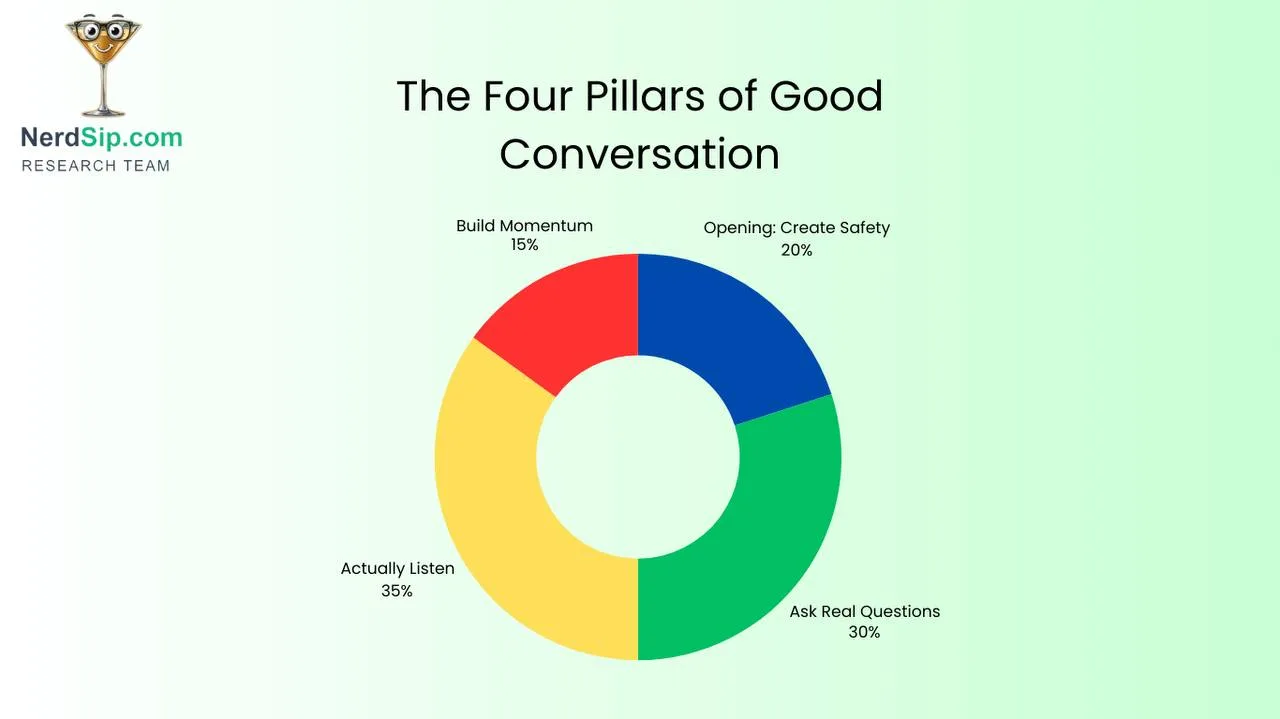
Good conversations aren't magical. They're structured. And the structure is always the same.
Pillar 1: The Opening (Create Safety)
A conversation starts the moment you make eye contact. The opening 30 seconds determine whether this person feels safe talking to you or wants to escape.
The mistake people make: trying to be interesting. Telling a story. Making a joke.
What actually works: making the other person feel safe and welcome.
How? Smile. Make eye contact. Show genuine interest. Ask an open-ended question about them.
"Hey, how's your evening going?" is better than "Did you hear about that thing on the news?"
The opening is about creating safety, not showing off. People will relax if they feel like you're genuinely interested in them, not trying to impress them.
Pillar 2: The Discovery (Ask Real Questions)
Once they feel safe, they'll share. Your job now is to ask questions that go deeper than surface level.
The mistake: asking yes/no questions. "Do you like this event?" They answer yes or no. Dead end.
What works: asking open-ended questions that require them to think and share.
"What brought you here tonight?" "What's been keeping you busy lately?" "What do you love about what you do?"
Notice the difference. These questions make people think. They make people share something real.
And when someone shares something real with you, you've created connection.
Pillar 3: The Listening (Actually Listen)
This is where most people fail. They ask a question, then think about what they're going to say next instead of actually listening to the answer.
Real listening means:
- No phone
- Eye contact
- Nodding to show you're present
- Not interrupting
- Pausing before responding
When someone feels truly heard, they feel valued. And people want to be around people who make them feel valued.
People differ in which signals of warmth actually register. The love language test measures that preference, and undivided attention is one of the five.
Pillar 4: The Extension (Build Momentum)
Once they've answered your question, your job is to extend the conversation naturally. Not by talking about yourself. By asking a follow-up question that shows you were listening.
They said: "I'm working on starting a business."
Bad response: "Oh cool. I started a business once. Here's my story..." (You've taken over)
Good response: "That's exciting. What kind of business? What's the hardest part so far?" (You're extending their story)
This is how conversations flow. One person shares. You ask a follow-up. They share more. You ask deeper. Connection builds.
The FORD Method: A Conversation Starting Kit
If you need a structure for starting conversations, use FORD. It's simple and it works.
F = Family: "Do you have family in the area?" "How many siblings do you have?"
O = Occupation: "What do you do?" "How did you get into that?"
R = Recreation: "What do you like to do in your free time?" "Any hobbies?"
D = Dreams: "What's something you're working toward?" "What would you do if money wasn't an issue?"
These four categories cover everything. And they're all open-ended. They require people to think and share.
If you ever run out of things to say, you can literally go through FORD and keep the conversation flowing.
The Mistake That Kills Conversations
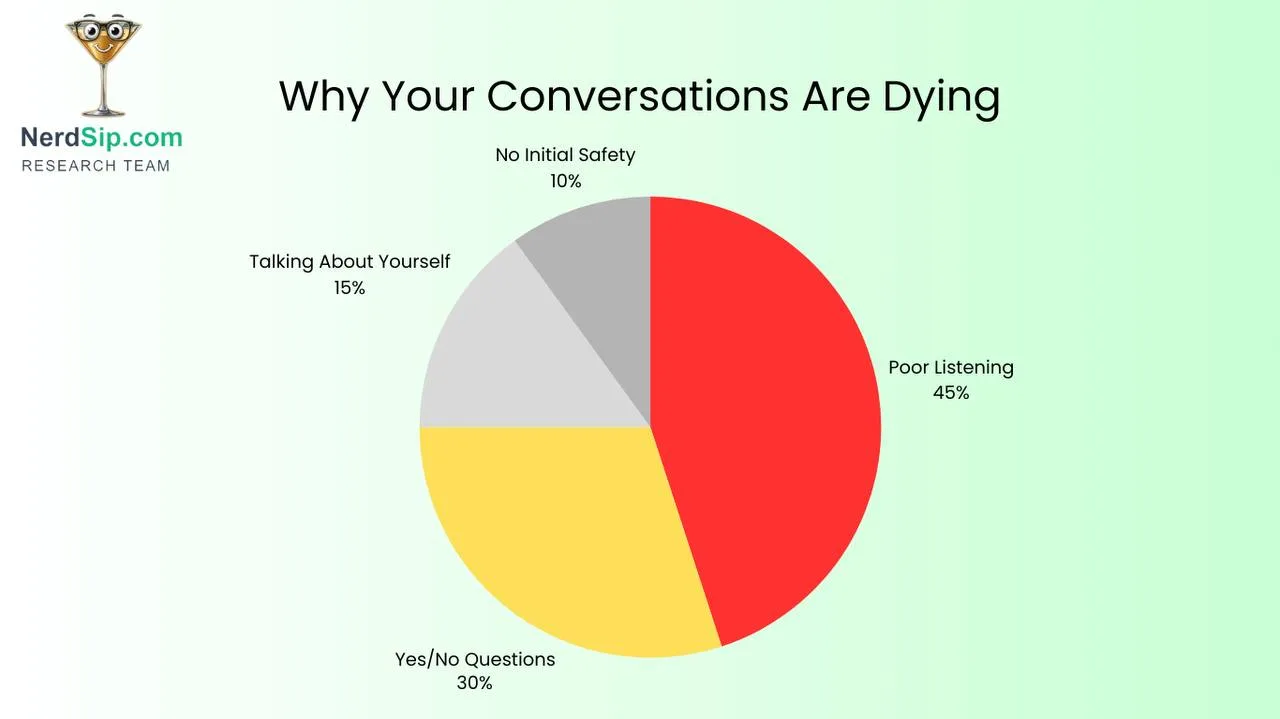
Most people think conversations die because they run out of things to say. Actually, conversations die because someone stops listening.
They ask a question, the other person answers, and instead of asking a follow-up, they switch topics or start talking about themselves.
The other person feels: "They don't actually care. They just wanted to talk about themselves."
Real conversations don't die. They deepen. Because you keep the focus on understanding the other person, and they keep sharing because they feel heard.
The Micro-Learning Conversation Mastery Path
Here's what's interesting: you can build conversation confidence through daily micro-lessons on specific techniques.
Instead of trying to be better at conversation in general, you focus on one technique per day. Day one: practice open-ended questions. Day two: practice eye contact and listening. Day three: practice follow-up questions. Day four: practice the FORD method.
This is where platforms like NerdSip work perfectly. Daily 5-minute lessons on conversation techniques. You learn one. You practice it that day. The next day, you learn the next one.
Read more: How to Turn Scroll Addiction Into Learning or You're Not Lazy, You're Misaligned.
Want the complete map? We built a dedicated hub for this topic: How to Never Run Out of Things to Say. It brings together small talk, FORD, active listening, better follow-ups, and the deeper habit of becoming a more curious person.
Every NerdSip course clears a four-layer fact-checking pipeline before it reaches the app: grounded in live sources, scored nightly, gated on failure, and reviewable by a person at one tap. Articles on this blog are drafted with AI assistance, then researched, verified, and edited by our team.
Editorial responsibility: ai51 UG (haftungsbeschränkt). Responsible editor named in the imprint.
📚 Keep Learning
Explore the NerdSip learning hubs
The blog is our editorial layer. When you want to move from reading into doing, these hubs organize the rest of NerdSip by format, including the app itself and the press that has written about it.
Keep going: five-minute courses on this
Pick one and finish it before your coffee cools. Every lesson ends with a quick question, so it sticks instead of scrolling past.
Courses on this topic
4.7 stars from 380 reviews · 10,000+ learners