Generalists are winning because the work that survives automation is connective work: noticing that a problem in one field was already solved in another. A 2013 study in Science that examined 17.9 million research papers found that work pairing a conventional foundation with one unusual outside reference was twice as likely to become a top 5 percent citation hit. Breadth is not a distraction from expertise. It is what makes expertise pay.
What Is the Generalist Advantage?
The generalist advantage is the ability to solve a problem in one field using knowledge borrowed from another. It comes from breadth rather than depth. A specialist optimizes inside a known system. A generalist recognizes that the system resembles a different one they already understand, and imports the answer.
The useful shape is not pure breadth. It is T-shaped: genuine depth in one area, working literacy across many others. The vertical stroke buys credibility, because nobody hires a person who knows a little about everything and enough about nothing. The horizontal stroke is where the unusual combinations come from. If you are still deciding which shape fits your career right now, our side-by-side guide to generalist vs specialist lays out when each one wins.
| Specialist | T-shaped generalist | |
|---|---|---|
| Solves problems by | Going deeper into the known method | Importing a method from another field |
| Effect of AI | Compresses the routine part of the job | Raises the value of judgment and framing |
| Fails when | The field itself changes shape | Depth never gets deep enough to be trusted |
| Best environment | Stable rules, fast feedback | Shifting rules, slow or noisy feedback |
Are Specialists Actually Being Replaced?
No, and the most repeated version of this claim has already been tested in public. In 2016 Geoffrey Hinton said we should stop training radiologists because deep learning would beat them within five years. A decade later radiology is one of the most competitive residencies in American medicine and hospitals are short of radiologists, not drowning in spare ones. The AI reads the scan. Someone still has to decide what the reading means for the patient in front of them.
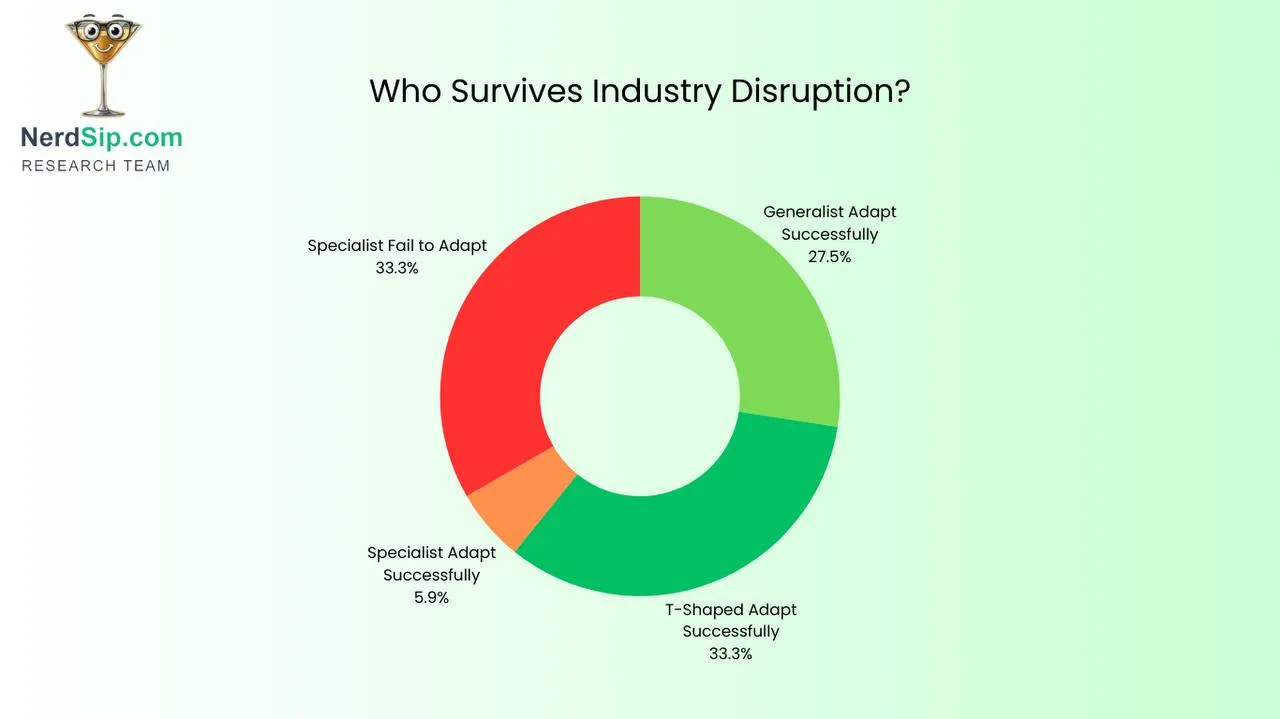
What automation actually does is narrower and more uncomfortable than replacement. It compresses the routine middle of a job and leaves the two ends: the judgment at the top and the messy human context at the bottom. If your entire role sits in that routine middle, the ground moves under you. If your role spans several fields, the compression frees time rather than taking your seat.
The World Economic Forum's Future of Jobs Report 2025 puts a number on the churn: employers expect 39 percent of workers' core skills to change or become outdated between 2025 and 2030. Meanwhile US Bureau of Labor Statistics data puts median employee tenure at 3.9 years. Nobody is spending forty years inside one narrow specialty anymore, because the specialty will not last forty years.
What Does the Research Say About Breadth?
The evidence for breadth is stronger than most career advice admits, and it comes from four independent directions.
Unusual combinations produce the biggest hits
Uzzi, Mukherjee, Stringer and Jones analyzed 17.9 million papers across every field for a 2013 paper in Science. The highest impact research was not the most conventional or the most exotic. It was work built on a conventional base with one atypical combination bolted on. That pattern was twice as likely to land in the top 5 percent of citations. Pure novelty underperformed. Pure convention underperformed. The winning move was mostly familiar plus one strange ingredient.
Nobel laureates have more hobbies
Root-Bernstein and colleagues compared Nobel laureates in the sciences with typical scientists in a 2008 study. The laureates were substantially more likely to have serious artistic pursuits: roughly twice as likely to play music, seven times as likely to make visual art, twelve times as likely to write creatively, and twenty-two times as likely to perform. The correlation does not prove causation, but it is a strange thing to find in the group we assume is the most single-minded.
Founders are jacks of all trades
Edward Lazear's 2005 study of Stanford business school alumni found that the people who became entrepreneurs had held more varied roles and studied a wider spread of subjects than those who stayed on a single track. He called it the jack-of-all-trades theory. Starting something requires you to be the finance person, the sales person, and the product person until you can afford to hire each one.
Elite performers sample before they commit
David Epstein's Range gathered the sampling-period research: across sports, the athletes who reach the top typically play several games before choosing one. Roger Federer is the standard example, having gone through soccer, skiing, wrestling, swimming and skateboarding before tennis took over. The breadth did not cost him years. Movement patterns, spatial reading and competitive temperament all transferred.
When Does Specializing Actually Win?
Sometimes. This is the part the generalist pitch usually skips, and it has a clean rule behind it.
Psychologist Robin Hogarth split learning environments into two kinds. In a kind environment the rules are stable, patterns repeat, and feedback arrives fast and accurate. Chess, golf, classical music and surgical technique are kind. Practice compounds cleanly, so early specialization wins and the ten thousand hours story holds.
In a wicked environment the rules shift, patterns do not repeat, and feedback is slow, noisy or actively misleading. Careers, markets, hiring, strategy and most modern knowledge work are wicked. Experience in a wicked environment can make you more confident without making you more accurate, which is worse than useless.
So the honest version is this: specialize if your field is kind and stable. Almost nobody's is. If you cannot describe what accurate feedback in your job looks like, you are in a wicked environment and breadth is your hedge.
Five Things Generalists Do That Specialists Cannot
1. Transfer a solution across an unrelated field
Japan's 500 Series Shinkansen had a problem: at 300 kilometers an hour, entering a tunnel compressed the air into a shockwave that cracked out of the far end like a gunshot, loud enough to violate noise law in residential areas. The engineer leading the redesign, Eiji Nakatsu, was a serious birdwatcher. He knew that a kingfisher enters water at speed with almost no splash because of the shape of its beak. He gave the train a kingfisher nose. The tunnel boom went away, and the train also used less power and ran faster. That solution does not exist inside railway engineering. It exists inside ornithology.
2. Learn the twenty-first thing faster than the first
Every topic you learn leaves behind a reusable structure: how to find the core of a subject, how to tell a load-bearing idea from a decorative one, how to sit in the discomfort of not understanding yet. People who have learned twenty unrelated things have practiced that meta-skill twenty times. They start a new field at a real advantage over someone entering their second field ever.
3. Translate between teams
Most organizational failure is a translation failure. Engineering says a thing, design hears a different thing, finance approves a third thing. The person who can hold all three vocabularies is disproportionately valuable, and they are almost never the deepest expert in any one of the rooms.
4. Survive the death of a field
Deep expertise in video rental logistics, print classifieds or travel agency booking systems was genuinely valuable, right up until it was worth nothing. A generalist recombines. A specialist restarts.
5. Make a combination nobody else can make
Your specific mix of interests is close to unique. That is not a fun fact, it is the actual asset. Hedy Lamarr knew film production and, through her first marriage to an arms dealer, torpedo guidance. In 1942 she and composer George Antheil patented frequency-hopping spread spectrum, US Patent 2,292,387, using a mechanism modeled on player piano rolls. Actress plus arms dinners plus player pianos is not a career path. It is a combination, and it sits underneath modern Bluetooth and Wi-Fi.
Who Are the Famous Generalists?
Gunpei Yokoi
Yokoi joined Nintendo as a maintenance engineer for the machines that made playing cards. He built a toy on his own time, the company noticed, and he ended up designing the Game Boy. His stated design philosophy was lateral thinking with withered technology: take components that are cheap, old and thoroughly understood, then use them somewhere nobody expected. The Game Boy shipped with a monochrome screen while competitors had color, and the Game Boy line sold roughly 118.7 million units. Cheap old parts plus long battery life plus an understanding of what children actually do beat better hardware.
Steve Jobs
After dropping out of Reed College, Jobs sat in on a calligraphy class with no plan for it whatsoever. He told the 2005 Stanford graduating class that the Macintosh got proportionally spaced fonts because of that class. A single elective in letterforms became a decade of design advantage in an industry that had been thinking about clock speed.
Leonardo da Vinci
The obvious one, and still the clearest. His anatomy studies made his painting better. His observation of water and birds fed his engineering. He did not run separate careers in parallel. He ran one investigation that happened to cross every field.
Yokoi, Jobs and Leonardo are three examples. For thirty more, from Hypatia and Ibn Sina to Hedy Lamarr, see our list of famous polymaths and the one habit worth stealing from each.
How Do You Become a Valuable Generalist?
Being a generalist is not the absence of a plan. Random consumption produces trivia, not leverage. Five steps turn breadth into an advantage. If your goal is real depth in several fields rather than one, the long version is our guide on how to become a polymath.
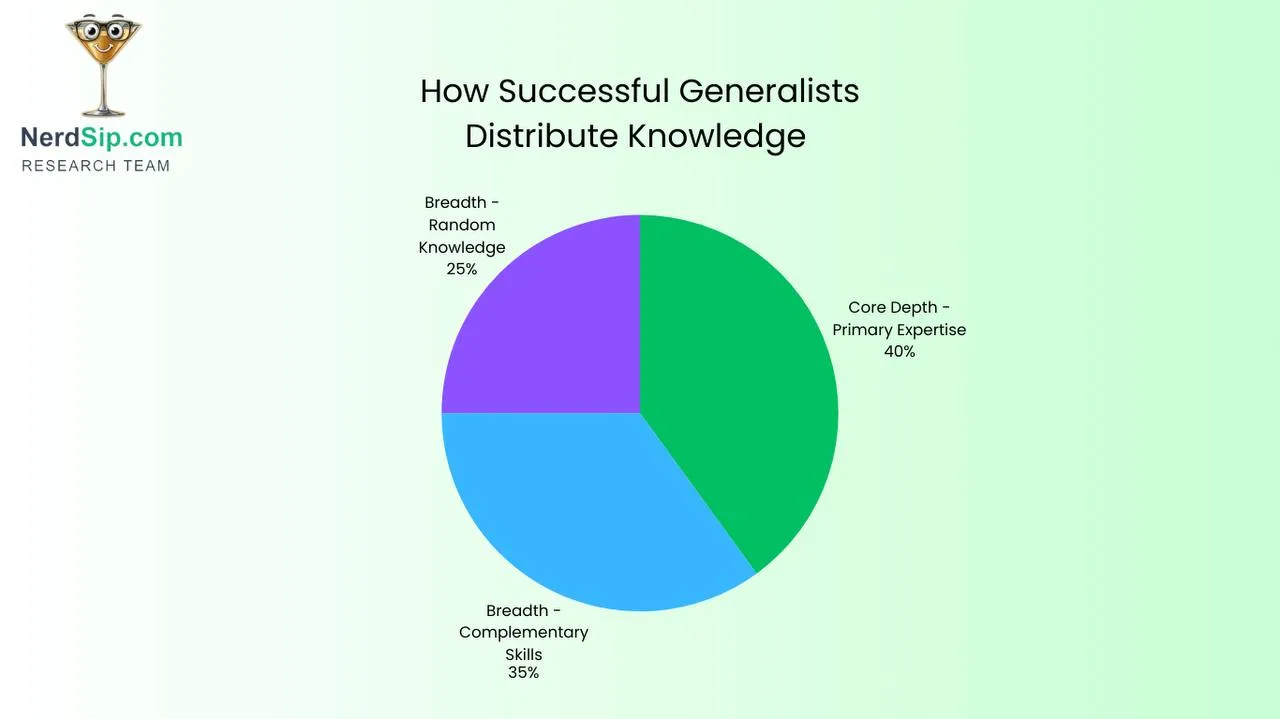
- Build a T, not a line. Pick one area to go genuinely deep in, deep enough that people ask you specifically. Then go wide on everything adjacent. A marketer with depth in marketing and literacy in psychology, statistics, design and basic code is far more dangerous than either a pure marketer or a pure dabbler.
- Follow real curiosity, not obligation. You will not retain a subject you are forcing. Interest is the cheapest form of study energy there is, and the odd topics are the ones that make your combination unusual.
- Learn in small units, daily. Breadth fails when each new subject demands a semester. Ten focused minutes a day covers more ground over a year than three abandoned online courses.
- Connect every new thing to something you already know. After learning something, answer one question: what does this resemble? Compound interest resembles bacterial growth resembles viral spread resembles habit formation. That is the same curve wearing four costumes, and spotting it is the entire skill.
- Put the combinations into the world. Write it, say it, use it in a meeting. Knowledge you never express stays a hobby. Knowledge other people associate with you becomes a reputation.
What Should You Actually Learn?
Some subjects transfer further than others. If you want breadth that pays, weight your reading toward the fields that explain other fields:
- Statistics and probability. Lets you read any claim in any field and know whether to believe it.
- Human psychology. Every product, election, negotiation and argument runs on it.
- How money actually moves. Incentives explain behavior that looks irrational from the outside.
- Systems and feedback loops. The same dynamics govern ecosystems, supply chains, addiction and traffic.
- How AI models work under the hood. Not prompt tricks. What they are actually doing, so you can tell what they will fail at.
- The history of one technology you use daily. Every technology repeated the same adoption fight. Knowing one round tells you how the next goes.
Then let genuine curiosity handle the rest. Medieval siege engineering, how anesthesia works, why tardigrades survive vacuum, the economics of coffee. These look useless individually. They are the strange ingredient in the Uzzi finding.
Where This Leaves You
If you have ever been told you lack focus because you read about volcanoes on Monday and monetary policy on Thursday, the research is not on the side of the person who said it. Focus was the right advice for a stable field with fast feedback. Most fields are neither.
The specialist gets very good at answering the question. The generalist notices the question came from the wrong field. Machines are getting extremely good at the first job.
Now go learn something that has nothing to do with your job.
Frequently Asked Questions
What is the generalist advantage?
The generalist advantage is the ability to solve a problem in one field using knowledge borrowed from another. Specialists optimize inside a known system. Generalists recognize that the system resembles a different one they already understand and import the answer. A 2013 Science study of 17.9 million research papers found that work pairing a conventional foundation with one atypical outside combination was twice as likely to land in the top 5 percent of citations.
Is it better to be a generalist or a specialist?
It depends on the feedback in your field. In kind environments, where rules are stable and feedback is fast and accurate, such as chess, golf or surgical technique, early specialization wins. In wicked environments, where rules shift and feedback is slow or misleading, which describes most careers and knowledge work, breadth wins. The strongest position is T-shaped: real depth in one area plus working literacy across several others.
Are specialists really being replaced by AI?
Not replaced, compressed. In 2016 Geoffrey Hinton argued we should stop training radiologists because AI would outperform them within five years. A decade later radiology is among the most competitive medical residencies and hospitals report shortages. Automation tends to absorb the routine middle of a job while leaving judgment at one end and human context at the other.
Does random knowledge actually help your career?
It helps when you connect it. Edward Lazear's 2005 study of Stanford business alumni found that entrepreneurs had held more varied roles and studied a wider spread of subjects than those on single-track careers. Root-Bernstein's 2008 research found Nobel laureates in the sciences were roughly seven times more likely than typical scientists to practice visual art and twenty-two times more likely to perform. Unconnected facts stay trivia. Facts you link to a problem become leverage.
What does T-shaped mean?
T-shaped describes a skill profile with one area of genuine depth, the vertical stroke, and working literacy across many adjacent areas, the horizontal stroke. Depth gives you credibility and a reason to be hired. Breadth gives you the unusual combinations that produce original solutions. Pure specialists struggle when their field changes shape, and pure generalists struggle to be trusted with anything.
How do I become a generalist without becoming shallow?
Go deep in one area first so you have something to be trusted for, then add breadth in small daily units rather than full courses. After learning anything new, ask what it resembles in a field you already know, because the transfer is the skill, not the accumulation. Weight your reading toward subjects that explain other subjects: statistics, psychology, incentives, and systems and feedback loops.
Every NerdSip course clears a four-layer fact-checking pipeline before it reaches the app: grounded in live sources, scored nightly, gated on failure, and reviewable by a person at one tap. Articles on this blog are drafted with AI assistance, then researched, verified, and edited by our team.
Editorial responsibility: ai51 UG (haftungsbeschränkt). Responsible editor named in the imprint.
📚 Keep Learning
Explore the NerdSip learning hubs
The blog is our editorial layer. When you want to move from reading into doing, these hubs organize the rest of NerdSip by format, including the app itself and the press that has written about it.
Build the Horizontal Stroke
NerdSip turns any topic you are curious about into a short course you can finish in about five minutes. Medieval siege engineering on Monday, probability on Tuesday. Breadth, without the semester.
4.7 stars from 380 reviews · 10,000+ learners