You're at a party. Someone mentions the Roman Empire. Everyone nods politely and the conversation dies.
Then someone else says, "You know, Roman concrete is actually stronger than modern concrete because they used volcanic ash. That's why their buildings are still standing 2,000 years later."
Suddenly, everyone's leaning in. Questions fly. The conversation comes alive.
That person just became the most interesting one in the room—not because they're naturally charismatic, but because they know random, fascinating things that spark curiosity.
Being interesting isn't about being the loudest or funniest person. It's about knowing things that make people think "wait, really?" and want to hear more.
Here's how to fill your brain with random knowledge that makes you genuinely interesting.
Why Random Knowledge Makes You Interesting
Most people can talk about their job, the weather, and whatever's trending on social media. That's boring.
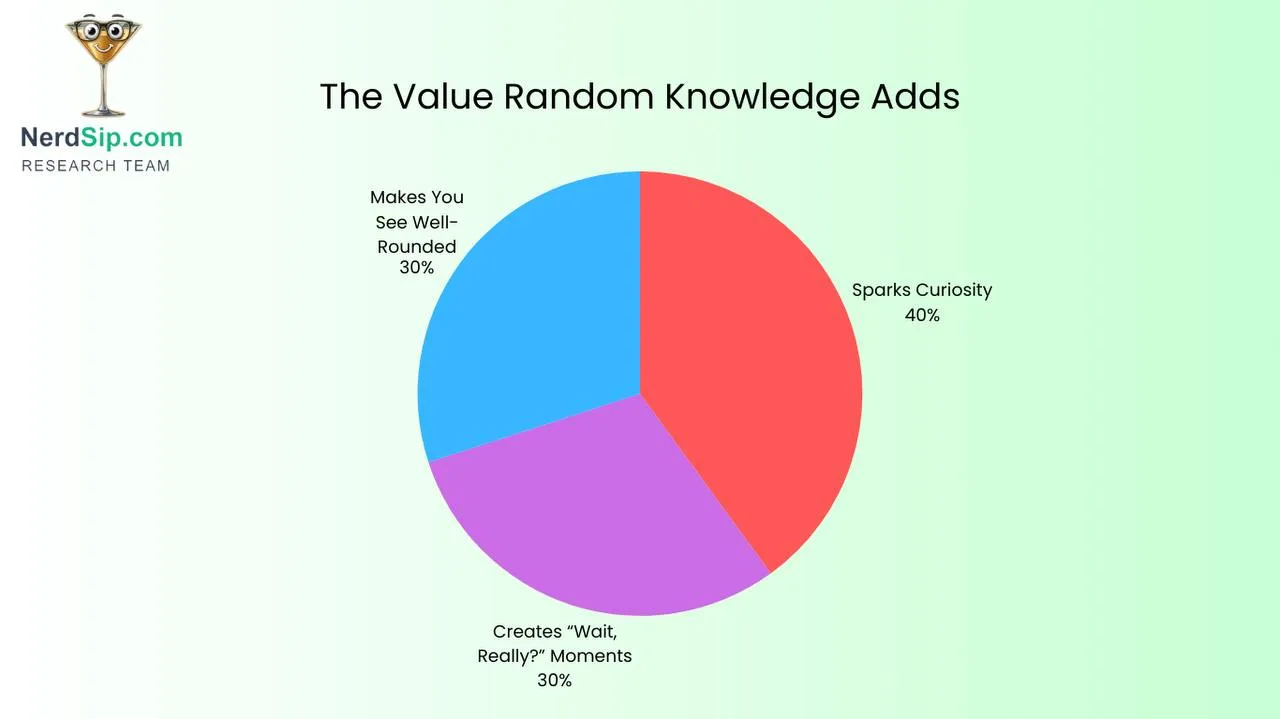
Interesting people can connect seemingly unrelated ideas. They drop fascinating facts into conversations. They make you see the world differently.
The power of unexpected knowledge:
When you know random things, you:
- Have something unique to contribute to any conversation
- Make connections others miss
- Come across as curious and thoughtful
- Give people "wait, how do you know that?" moments
- Never run out of things to talk about
You're not showing off. You're sharing genuinely interesting information that adds value to conversations.
The 7 Categories of Random Knowledge That Make You Interesting
Not all random knowledge is created equal. Some facts are forgettable. Others stick with people and make them see you as fascinating.
Here are the categories worth learning:
1. Counterintuitive Science Facts
Things that make people go "that can't be right" until you explain it.
Examples:
- Hot water freezes faster than cold water (the Mpemba effect)
- You're taller in the morning than at night (your spine compresses during the day)
- Bananas are berries but strawberries aren't (botanical classification is weird)
- The Eiffel Tower grows 6 inches taller in summer (metal expands in heat)
- There are more trees on Earth than stars in the Milky Way (3 trillion vs 100-400 billion)
Why this works: People love having their assumptions challenged. These facts create "wait, what?" moments that make conversations memorable.
2. Historical Events That Sound Made Up
Real history is often stranger than fiction.
Examples:
- Australia lost a war against emus in 1932 (they really did)
- Napoleon was attacked by rabbits (a hunting trip gone wrong)
- The shortest war in history lasted 38 minutes (Anglo-Zanzibar War, 1896)
- A Japanese soldier kept fighting WWII until 1974 because no one told him it ended
- The Oxford University predates the Aztec Empire (Oxford: 1096, Aztec: 1428)
Why this works: These stories are entertaining and give context to modern life. Plus, they're conversation gold.
3. How Everyday Things Actually Work
Most people use things daily without knowing how they function.
Examples:
- Why airplane windows have that tiny hole (pressure equalization)
- How anesthesia actually works (we still don't fully understand it)
- Why you can't hum while holding your nose (try it right now)
- How GPS works (relativity adjustments are necessary)
- Why touching your tongue to metal in winter makes it stick (saliva freezes instantly)
Why this works: These are practical enough to be relevant but surprising enough to be interesting. People immediately want to verify them.
4. Weird Animal Facts That Defy Logic
The natural world is bizarre. Use that.
Examples:
- Octopuses have three hearts and blue blood
- Crows hold grudges and can remember human faces for years
- Mantis shrimp can punch with the force of a bullet
- Turritopsis dohrnii (immortal jellyfish) can reverse its aging process
- A group of flamingos is called a "flamboyance"
Why this works: Animal facts are universally appealing and safe for any audience. Plus, they make you seem observant about the world around you.
5. Psychology and Human Behavior Patterns
Understanding why people do what they do is endlessly fascinating.
Examples:
- The Dunning-Kruger effect (incompetent people overestimate their abilities)
- Why we remember unfinished tasks better than completed ones (Zeigarnik effect)
- The mere-exposure effect (we like things more just because we see them often)
- Why groups make worse decisions than individuals (groupthink)
- The paradox of choice (more options make us less happy)
Why this works: These explain everyday behaviors people recognize but never understood. It's immediately applicable to their lives.
6. Cultural and Language Oddities
How different cultures solve the same problems differently.
Examples:
- The Inuit don't have 50 words for snow (common myth), but they do have complex ways to describe snow conditions
- Japanese has different words for "older brother" and "younger brother" with no single word for just "brother"
- Some languages have no word for "hello" (they use context-specific greetings)
- The word "set" has 430 different definitions (most in English)
- There's a word for the day after tomorrow in many languages but not standard English
Why this works: Language reveals how people think. These facts make people question assumptions about communication.
7. Modern Technology That Seems Like Magic
Explaining tech in simple terms makes you seem smart and approachable.
Examples:
- How cryptocurrency mining actually works (solving math puzzles to verify transactions)
- Why streaming services recommend what they do (collaborative filtering algorithms)
- How noise-canceling headphones create silence (anti-noise)
- What happens when you hit "delete" (it doesn't actually delete immediately)
- Why your phone knows you're walking vs. driving (accelerometer patterns)
Why this works: Everyone uses technology, but few understand it. Explaining it simply makes you seem knowledgeable without being condescending.
How to Actually Learn Random Interesting Things
Knowing you should learn random stuff is easy. Actually doing it requires a system.
The 10-Minute Daily Learning Habit
You don't need hours. You need consistency.
The method:
- Pick one topic category from above
- Spend 10 minutes learning about it
- Same time every day
- Use your phone during dead time (commute, waiting rooms, lunch breaks)
Why this works: 10 minutes × 365 days = 60+ hours of learning per year. That's enough to become genuinely knowledgeable about dozens of topics.
Best Sources for Random Knowledge
Not all sources are equal. Here's what actually works:
For quick daily learning:
- NerdSip - AI generates custom courses on literally any random topic you're curious about. Want to learn about the history of pizza? Medieval siege weapons? How cryptocurrency works? Type it in, get a structured 5-10 minute lesson. The gamification keeps you coming back daily.
- Wikipedia's "Random Article" feature - Genuinely random, hit or miss but occasionally gold
- TED-Ed YouTube channel - 5-minute animated explanations of fascinating topics
- Reddit's "Today I Learned" (r/TIL) - Crowdsourced interesting facts, pre-filtered by upvotes
For deeper dives:
- Podcasts like "Stuff You Should Know" or "Radiolab"
- Books like "A Short History of Nearly Everything" by Bill Bryson
- YouTube channels like Vsauce, Kurzgesagt, or Veritasium
The key: Find one source you actually enjoy and use it daily. Consistency beats intensity.
The Note-Taking System That Makes Facts Stick
Learning random things is useless if you forget them immediately.
Simple system:
- Learn something interesting
- Write it in your own words (this forces understanding)
- Note why it's interesting (the "so what?")
- Review your notes monthly
Example:
- Fact: Bananas are radioactive
- Why: They contain potassium-40, a radioactive isotope
- So what: You'd need to eat 10 million bananas at once for a lethal dose
- Interesting angle: We literally measure radiation exposure in "banana equivalent doses"
This framework turns facts into stories you can actually tell.
The Conversation Integration Method
Learning facts doesn't make you interesting. Using them in conversations does.
The rule: If you can't naturally work it into a conversation within 48 hours, you don't actually understand it well enough.
Good integration:
Someone: "I hate waiting in lines."
You: "I read that Disney engineers studied how people perceive waiting time. They found that occupied time feels shorter, so they added entertainment to their queues. Now the wait feels faster even though it's the same length."
Bad integration:
Someone: "I hate waiting in lines."
You: "Did you know octopuses have three hearts?"
Context matters. Random facts should feel relevant, not forced.
The 30-Day Random Knowledge Challenge
Want to become noticeably more interesting in one month? Here's the plan:
Week 1: Science and Nature
- Day 1-2: Counterintuitive physics facts
- Day 3-4: Weird animal behaviors
- Day 5-7: How everyday things work
Week 2: History and Culture
- Day 8-10: Historical events that sound fake
- Day 11-13: Cultural differences in language
- Day 14: Review and find connections
Week 3: Psychology and Tech
- Day 15-17: Human behavior patterns
- Day 18-20: How modern technology works
- Day 21: Review and practice explanations
Week 4: Integration and Practice
- Day 22-25: Tell one new fact per day in conversations
- Day 26-28: Find connections between different facts
- Day 29-30: Teach someone else the most interesting things you learned
By the end: You'll have 30+ conversation-worthy facts and the habit of continuous learning.
Topics That Never Fail to Interest People
Some topics are universally fascinating. When in doubt, learn about these:
Space and Astronomy
People love space. It's naturally awe-inspiring.
- Black holes warp time so much that you'd age slower near one
- The observable universe has a diameter of 93 billion light-years
- We're moving through space at 1.3 million mph (but don't feel it)
The Human Body
Everyone has one, so everyone's curious.
- Your brain uses 20% of your body's energy but is only 2% of your weight
- You share 50% of your DNA with bananas
- Your stomach gets a new lining every 3-4 days (otherwise stomach acid would digest it)
Food Origins and Science
People eat multiple times daily but rarely think about it.
- Ketchup was sold as medicine in the 1830s
- Honey never spoils (archaeologists found edible honey in ancient Egyptian tombs)
- Pineapples take 2 years to grow
Money and Economics
Financial topics grab attention.
- Credit cards exist because of a forgotten wallet in 1949
- The average person spends 6 months of their life waiting for red lights
- Warren Buffett still lives in the house he bought in 1958 for $31,500
What Makes a Random Fact Actually Interesting
Not every fact is worth learning. Here's the filter:
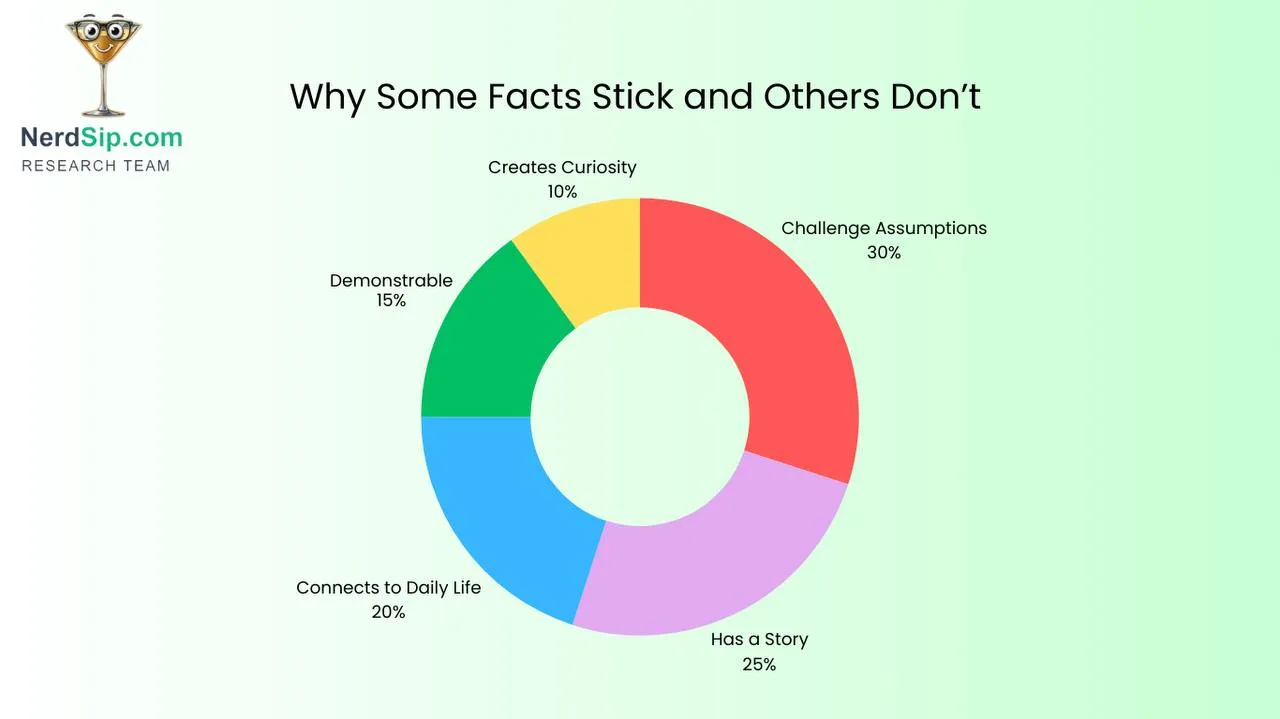
A fact is interesting if it:
- Challenges assumptions - "Wait, that's not how I thought it worked"
- Has a story - Context makes facts memorable
- Is verifiable - You can prove it or demonstrate it
- Connects to daily life - Relevant facts stick
- Makes people curious - Leads to questions, not just "cool"
A fact is boring if it:
- Is just a number without context (population statistics, GDP figures)
- Requires extensive background to understand
- Is depressing without offering insight
- Is overly technical jargon
The test: If you can't explain why it's interesting in one sentence, skip it.
Common Mistakes People Make Learning Random Things
Mistake 1: Learning Without Context
Knowing Mount Everest is 29,029 feet tall is boring.
Knowing that there are 14 mountains taller than where commercial planes fly, and people climb them without oxygen—that's interesting.
Context transforms data into stories.
Mistake 2: Only Learning Things in Your Field
If you're a software engineer who only learns about coding, you're not interesting—you're specialized.
Interesting people connect different domains. A developer who knows about Renaissance art or medieval siege warfare stands out.
Mistake 3: Never Testing Your Knowledge in Conversations
Learning privately doesn't make you interesting. Sharing what you know does.
Practice working facts into natural conversations. It's a skill that requires repetition.
Mistake 4: Collecting Facts Without Understanding Them
You need to understand WHY something is true, not just THAT it's true.
"Bananas are radioactive" is a fact. "Bananas contain potassium-40 which emits radiation, but you'd need 10 million at once for danger" is understanding.
Understanding lets you explain, answer questions, and have actual conversations instead of just dropping facts.
Advanced Strategy: Developing Your Knowledge Signature
Once you have random knowledge, develop areas you're known for.
Pick 2-3 topics you find genuinely fascinating and go deeper. Become the person people associate with those topics.
Examples:
- "She always knows the weirdest historical facts"
- "He can explain any technology in simple terms"
- "They have the best animal stories"
This gives you an identity beyond "smart person" to "the one who knows about [specific thing]."
How to pick your signature topics:
- What do you already find yourself reading about?
- What topics make you lose track of time?
- What areas combine multiple interests?
Then use apps like NerdSip to systematically learn about those areas. The AI can generate custom courses on any niche topic, letting you develop genuine expertise in your signature areas.
The Bottom Line
Being interesting isn't about being born charismatic or naturally witty. It's about filling your brain with random, fascinating knowledge and learning to share it naturally.
The formula:
- Learn something random daily (10 minutes using NerdSip, podcasts, or quality YouTube)
- Write it down in your own words (forces understanding)
- Work it into conversations naturally (practice makes perfect)
- Develop signature topics (become known for specific knowledge areas)
- Stay genuinely curious (fake interest shows)
What to learn:
- Counterintuitive science
- Weird historical events
- How everyday things work
- Strange animal facts
- Human psychology patterns
- Cultural oddities
- Technology explained simply
Where to learn:
- NerdSip for structured daily microlearning on any topic
- TED-Ed for quick video explanations
- Reddit's TIL for crowdsourced interesting facts
- Wikipedia rabbit holes for deep dives
- Quality science YouTube channels
The people you find most interesting aren't smarter than you. They've just systematically filled their brains with fascinating information and learned to share it well.
Start today. Pick one category. Learn one interesting thing. Tell someone about it.
Then tomorrow, do it again.
In 30 days, people will start asking "how do you know all this stuff?"
That's when you know you've become interesting.
Now go learn something random. Your conversations will thank you.
Links you may find useful:
- 50 Random Interesting Topics Anyone Can Learn
- 10 Study Techniques That Actually Work
- How to Learn Any Skill on Your Phone in 5 Minutes a Day
- The Self-Awareness Gap: Why You Are Not as Self-Aware as You Think
Want the complete map? We built a dedicated hub for this topic: How to Never Run Out of Things to Say. It brings together small talk, FORD, active listening, better follow-ups, and the deeper habit of becoming a more curious person.
Every NerdSip course clears a four-layer fact-checking pipeline before it reaches the app: grounded in live sources, scored nightly, gated on failure, and reviewable by a person at one tap. Articles on this blog are drafted with AI assistance, then researched, verified, and edited by our team.
Editorial responsibility: ai51 UG (haftungsbeschränkt). Responsible editor named in the imprint.
📚 Keep Learning
Explore the NerdSip learning hubs
The blog is our editorial layer. When you want to move from reading into doing, these hubs organize the rest of NerdSip by format, including the app itself and the press that has written about it.
Keep going: five-minute courses on this
Pick one and finish it before your coffee cools. Every lesson ends with a quick question, so it sticks instead of scrolling past.
Courses on this topic
4.7 stars from 380 reviews · 10,000+ learners