Everyone's obsessed with learning "practical" skills. How to code. How to use AI. Digital marketing. Excel wizardry. Skills that'll make you money or advance your career.
And sure, those matter. But here's what nobody talks about: the most valuable thing you can learn isn't a specific skill. It's the ability to connect ideas across completely different domains.
Steve Jobs didn't become a billionaire because he learned to code better than everyone else. He learned calligraphy, Zen Buddhism, design, and business—then connected them in ways nobody else saw. Elon Musk studied physics, economics, and taught himself rocket science. The innovation came from the intersections, not the depths.
The question isn't "what's the most practical skill to learn?" It's "what makes you more interesting, more creative, and harder to replace by AI?"
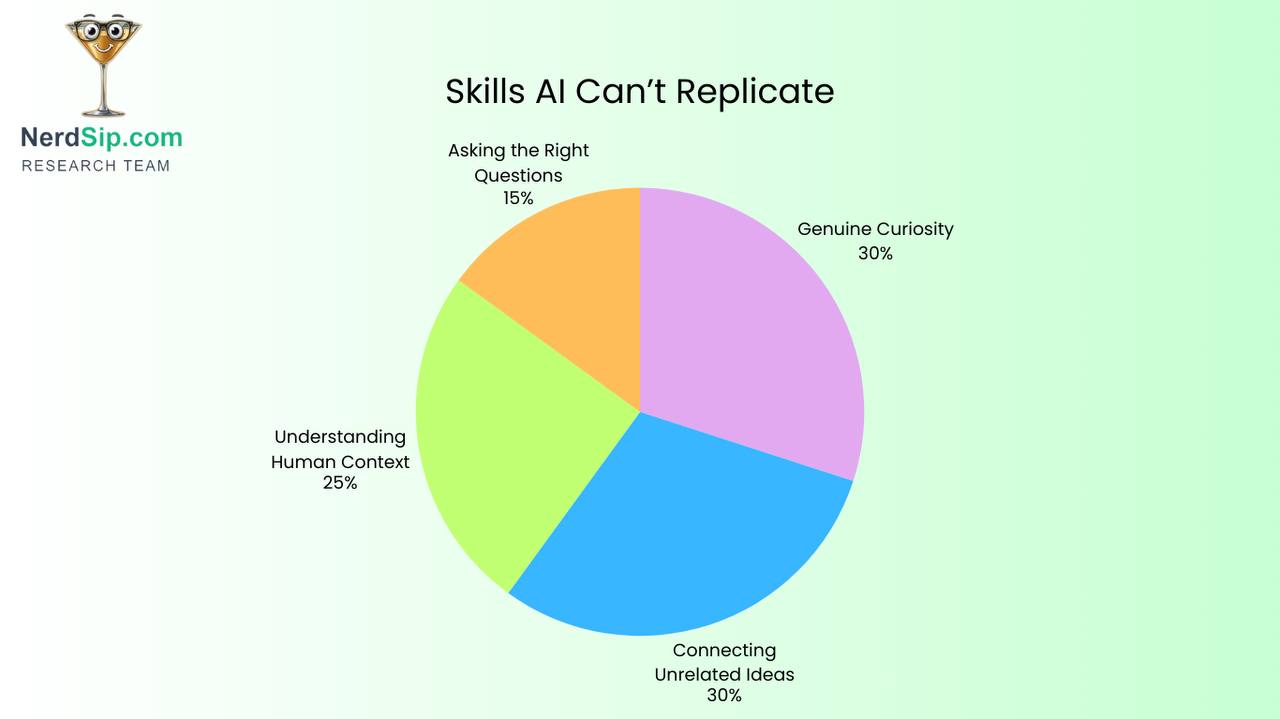
And the answer might surprise you: learn things you're genuinely curious about, even if they seem "useless." That curiosity is what AI can't replicate. Your weird knowledge combinations are what make you valuable.
Here's what's actually worth learning in 2026 if you're someone who loves knowing things.
The Shift: From Specialists to Sense-Makers
For decades, the career advice was simple: specialize. Become the world's best at one narrow thing.
That worked when knowledge was scarce and hard to access. If you knew something nobody else knew, you were valuable.
But in 2026, AI knows everything. ChatGPT can write code, analyze data, explain quantum physics, and draft marketing copy better than 80% of professionals.
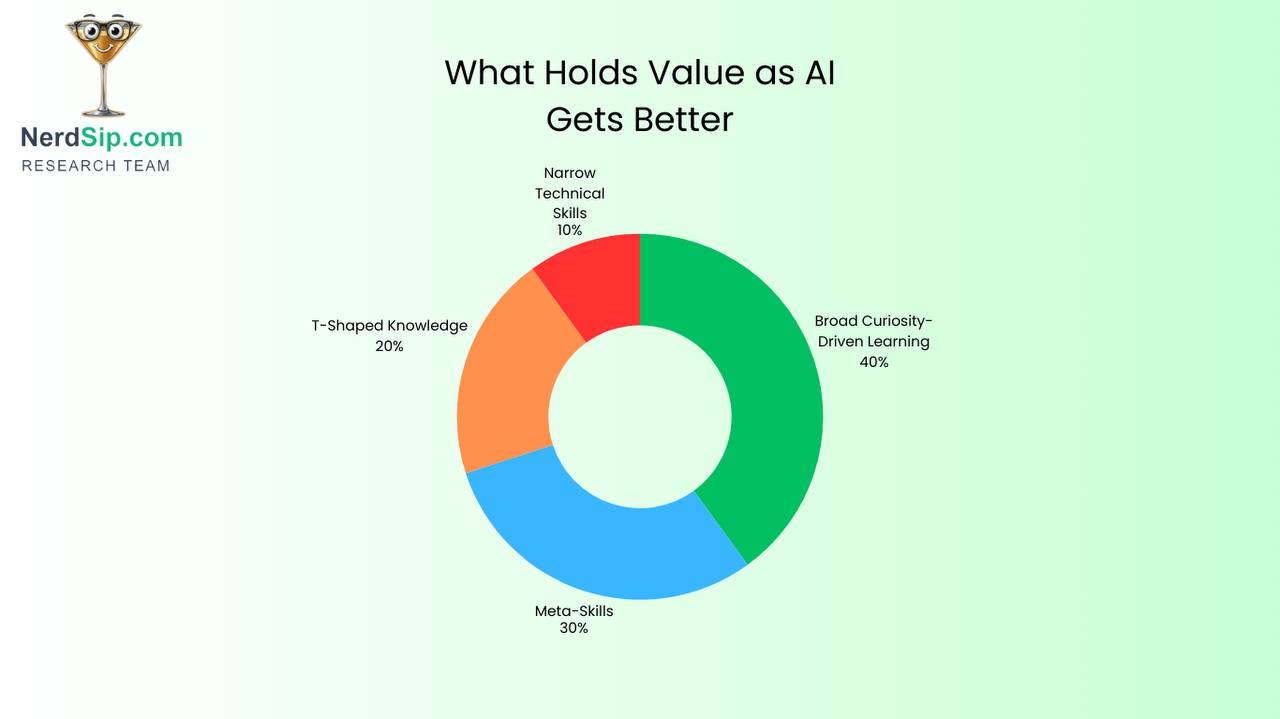
Narrow expertise is being automated. What's not being automated? The ability to:
- Ask the right questions
- Connect ideas from different fields
- Understand what's true vs what's plausible
- Recognize patterns AI doesn't see
- Apply knowledge in novel contexts
These are generalist skills. And they come from broad, curious learning—not narrow specialization.
People who push this furthest end up with real depth in several fields at once. If that is where you are heading, start with our guide on how to become a polymath.
What Curious People Should Actually Learn
1. How to Think, Not What to Think
The meta-skill that unlocks everything else: learning how knowledge works.
What this means:
- Understanding cognitive biases and how your brain tricks you
- Recognizing when you're reasoning from first principles vs social proof
- Knowing the difference between correlation and causation
- Spotting logical fallacies in arguments (including your own)
- Understanding how scientific research actually works (and when to trust it)
Why it matters: You live in an era of infinite information and sophisticated misinformation. The ability to think clearly about what's true is more valuable than knowing specific facts.
Where to learn it: Psychology courses on cognitive bias, philosophy (especially logic and epistemology), statistics basics, and how science actually works.
Apps like NerdSip have AI-generated courses on these exact topics—cognitive biases, logical thinking, how to evaluate evidence. You can learn how your brain works in 5-10 minute chunks instead of taking a semester-long course.
2. Enough About Everything to Connect the Dots
You don't need to be an expert in everything. You need enough foundational knowledge across domains to recognize patterns and connections.
The T-shaped knowledge approach:
- Go moderately deep in one area (your "vertical" expertise)
- Go wide across many areas (your "horizontal" breadth)
What this looks like:
- Learn basic psychology (how humans make decisions)
- Learn basic economics (incentives, trade-offs, systems thinking)
- Learn basic biology (evolution, systems, adaptation)
- Learn basic physics (energy, momentum, thermodynamics)
- Learn basic statistics (probability, distributions, significance)
You're not trying to become a psychologist or economist. You're building a mental toolkit of frameworks that apply everywhere.
Example: Understanding evolution helps you recognize how markets evolve, why certain social behaviors exist, and how systems adapt over time. That knowledge transfers across business, culture, technology, and biology.
Where to learn it: Microlearning apps (NerdSip lets you explore any topic in bite-sized lessons), YouTube channels (Kurzgesagt, Veritasium), and broad non-fiction books.
3. The History of Ideas (Why Things Are the Way They Are)
Most people learn facts without context. They know WHAT happened but not WHY it matters.
Learning intellectual history—how ideas evolved over time—gives you context that makes everything else make sense.
What this includes:
- History of science (how did we figure out the Earth orbits the Sun?)
- History of technology (why does the internet work the way it does?)
- History of political ideas (where did democracy, capitalism, socialism come from?)
- History of art and culture (why do aesthetic preferences change?)
Why it matters: When you understand how ideas evolved, you can predict how they'll evolve next. You see the patterns AI doesn't because AI has no sense of historical trajectory.
Example: Understanding how the printing press changed society helps you understand how the internet is changing society now. Same pattern, different technology.
4. Human Nature and Behavior
AI can process data. It can't truly understand why humans do irrational things.
Learning about human psychology, behavioral economics, and social dynamics makes you valuable in any field that involves people (which is all of them).
What to learn:
- Cognitive biases (availability heuristic, confirmation bias, sunk cost fallacy)
- Behavioral economics (loss aversion, anchoring, framing effects)
- Social psychology (conformity, authority, social proof)
- Evolutionary psychology (why we crave status, fear rejection, form tribes)
Why it matters: Every business, product, and organization ultimately depends on understanding human behavior. AI can tell you what people did. You can understand why they did it.
Where curious people excel: This stuff is endlessly fascinating. You're not studying it for a job—you're studying it because humans are weird and you want to understand them.
5. Systems Thinking (How Complex Things Actually Work)
Most people think linearly: A causes B causes C.
The world doesn't work that way. Everything is interconnected systems with feedback loops, emergent properties, and unintended consequences.
What systems thinking teaches:
- Feedback loops (reinforcing and balancing)
- Emergent properties (how simple rules create complex behavior)
- Second-order effects (what happens after the obvious thing happens)
- Leverage points (small changes that create big impacts)
Real examples:
- Why solving traffic by adding lanes makes traffic worse (induced demand)
- Why killing predators can destroy ecosystems (trophic cascades)
- Why "more features" often makes products worse (complexity tax)
- Why trying to control complex systems often backfires
Why it's valuable: Systems thinking helps you see problems others miss and find solutions in unexpected places.
6. How to Learn Anything Quickly
The ultimate meta-skill: getting good at getting good.
Once you know how to learn effectively, every other skill becomes easier.
What this includes:
- Spaced repetition (reviewing at optimal intervals)
- Active recall (testing yourself instead of re-reading)
- Deliberate practice (working at the edge of ability)
- The Feynman Technique (explaining to test understanding)
- Interleaving (mixing topics instead of blocking)
Why it's the ultimate multiplier: Every skill you learn after this becomes 2-3X faster to acquire.
Apps like NerdSip build these principles in automatically—spaced repetition schedules your reviews, active recall questions test your memory, and microlearning keeps practice in digestible chunks.
7. Your Genuine Curiosities (Even If They're "Useless")
Here's the controversial one: learn whatever genuinely fascinates you, even if it seems impractical.
Quantum physics. Medieval siege warfare. The history of coffee. How sourdough fermentation works. Why tardigrades survive in space.
Why "useless" knowledge is valuable:
Creativity comes from unexpected connections. Your brain links ideas from different domains subconsciously. The more diverse your knowledge, the more creative connections you make.
Passion sustains learning. You'll learn 10X more about something you find fascinating than something you "should" learn.
It makes you interesting. In a world where everyone knows the same "practical" stuff, weird knowledge makes you memorable.
AI can't replicate genuine curiosity. Your specific combination of interests is unique. That uniqueness is valuable.
What NOT to Learn (The Traps)
Skip the Hyped Skills That'll Be Automated Soon
Everyone's learning "prompt engineering" and basic AI tool usage. By next year, those skills will be table stakes—or automated entirely.
Don't chase the hot trend. By the time you're competent, it's already commoditized.
Skip Surface-Level "Productivity Hacks"
Time management systems, inbox zero, the perfect note-taking app—these feel productive but add minimal value.
The real productivity multiplier? Learning deeply enough about something that you can think clearly about it.
Skip Credentials for Things You Can Self-Learn
Don't pay $50K for a bootcamp to learn something you could teach yourself in 6 months with $200 worth of resources and discipline.
Formal education makes sense for:
- Fields requiring certification (medicine, law)
- Deep theoretical knowledge (physics, mathematics)
- Network/credential value (top MBA programs)
For most curious learning? Self-directed beats formal education in speed, cost, and retention.
The Microlearning Approach: 10 Minutes Daily, Infinite Topics
You don't need to quit your job and go back to school to become broadly knowledgeable.
You need 10 minutes daily and the right system.
The math:
- 10 minutes/day × 365 days = 3,650 minutes = 60+ hours per year
- Enough to get functionally literate in several new domains annually
How this works in practice:
- Morning coffee: 5-minute lesson on cognitive biases
- Lunch break: 10-minute lesson on evolutionary psychology
- Before bed: 5-minute lesson on how the internet works
By year end, you've learned about psychology, biology, technology, economics, and whatever else you got curious about.
Apps designed for this: NerdSip generates courses on literally any topic in 5-10 minute lessons. Want to understand blockchain? Quantum physics? The Roman Empire? Type it in, get structured lessons, built-in spaced repetition ensures you retain it.
Traditional education says "dedicate months to one thing." Microlearning says "dedicate 10 minutes daily to many things."
For curious generalists, the second approach builds broader, more creative knowledge faster.
The Bottom Line: Learn What Makes You Unreplaceable
AI will continue getting better at specific tasks. What it can't replicate:
- Genuine curiosity about seemingly unrelated things
- The ability to connect ideas from different domains
- Understanding human irrationality and context
- Asking questions nobody thought to ask
- Having a unique combination of knowledge
The most valuable thing you can learn isn't "the skill employers want most" or "the hottest technology."
It's how to think clearly, connect ideas broadly, and stay endlessly curious about how things work.
Ready to learn what actually matters?
Stop chasing "practical" skills that'll be automated by next year. Start learning what genuinely fascinates you.
Use apps like NerdSip to explore literally any topic—psychology, physics, history, how things work, why people behave the way they do. Five to ten minutes daily. Follow your curiosity.
In five years, the specialists will be competing with AI.
You'll be connecting ideas AI can't imagine.
Now go learn something that makes you more interesting.
Every NerdSip course clears a four-layer fact-checking pipeline before it reaches the app: grounded in live sources, scored nightly, gated on failure, and reviewable by a person at one tap. Articles on this blog are drafted with AI assistance, then researched, verified, and edited by our team.
Editorial responsibility: ai51 UG (haftungsbeschränkt). Responsible editor named in the imprint.
📚 Keep Learning
Explore the NerdSip learning hubs
The blog is our editorial layer. When you want to move from reading into doing, these hubs organize the rest of NerdSip by format, including the app itself and the press that has written about it.
Ready to Level Up?
Turn your screen time into knowledge. Download NerdSip and start learning in just 5 minutes a day.
4.7 stars from 380 reviews · 10,000+ learners