Crows hold funerals.
When a crow dies, other crows gather around the body — sometimes 60 or 70 of them — alternating between complete silence and loud, urgent calls. It lasts about 15 to 20 minutes. Then they all fly away at once.
For decades people assumed this was mourning. Turns out it's something stranger. Researcher Kaeli Swift at the University of Washington spent years studying these gatherings and found that when crows encounter a dead member of their species, the part of their brain that activates isn't the emotional centre — it's the equivalent of the human prefrontal cortex. The decision-making region. They're not grieving. They're investigating. Learning what killed the bird so they can avoid the same fate. Post-mortem risk assessment.
And here's where it gets properly weird. Swift also found that if you associate your face with a dead crow — if the birds see you holding one — they'll remember your face and actively warn other crows about you. Crows have been documented mobbing and dive-bombing people they associate with danger for years afterward, and teaching their offspring to do the same.
A group of crows is called a murder. That's not just a cool name.
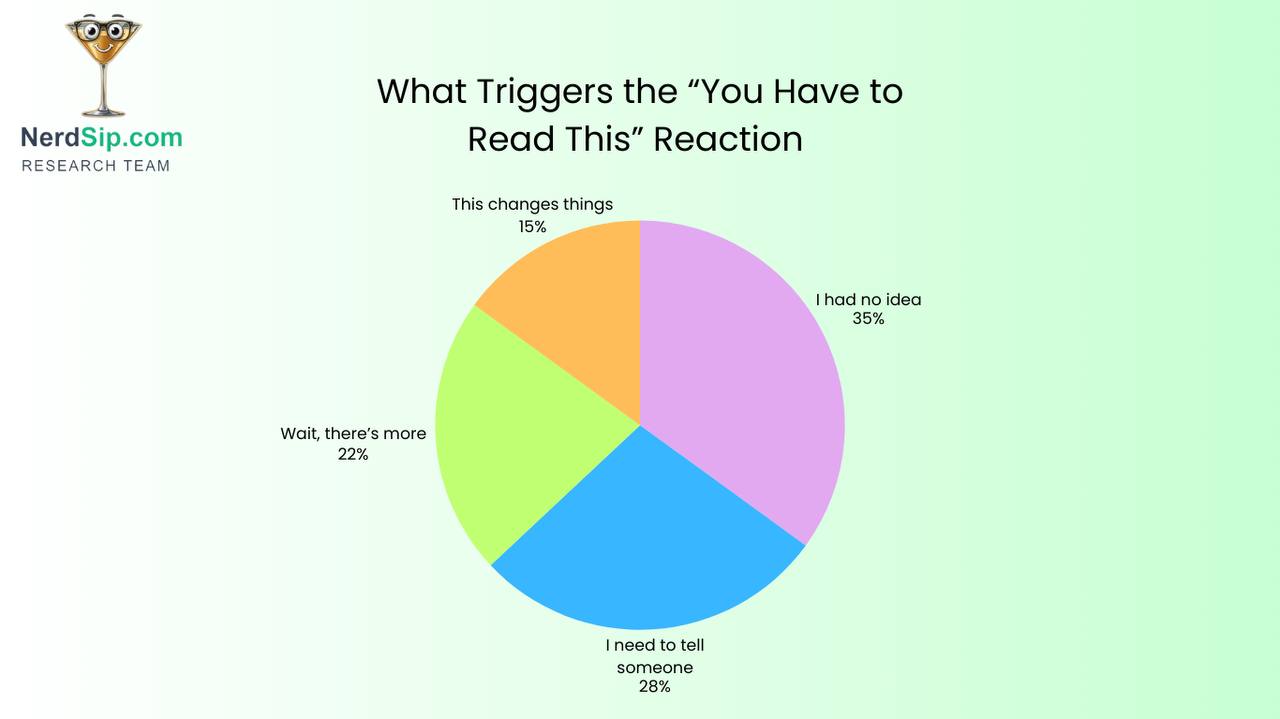
If you just felt that pull — that "wait, I need to know more about this" feeling — you're exactly who this article is for. You're the person who starts reading about crows and ends up at 3AM on a Wikipedia article about octopus cognition wondering how you got there.
That's not a problem. That's how curious people are wired. And there are rabbit holes deeper and weirder than crow funerals waiting for you.
The Secret Life of Trees
Here's the thing about forests that changes everything once you know it: they're not a collection of individual trees competing for resources. They're a network. A community. Possibly something stranger.
Underground, trees are connected through a vast web of mycorrhizal fungi — a network so extensive scientists informally call it the "Wood Wide Web." Through these fungal threads, trees exchange nutrients, water, and chemical warning signals. Forest ecologist Suzanne Simard spent decades documenting that old, large trees at the centre of the network — she calls them "mother trees" — recognise their own seedlings and direct extra carbon toward them.
When trees are attacked by insects or disease, they release airborne chemical signals and also transmit warnings through the fungal network. Neighbouring trees pick up the signal and begin producing defensive compounds before the threat even reaches them.
The forestry industry spent decades dismissing Simard's research because it complicated their clear-cutting practices — destroying the very networks she was studying. Her book "Finding the Mother Tree" reads like a scientific thriller: one ecologist fighting an entire industry that didn't want her findings to be true.
The mycelium networks connecting trees are extraordinary in their own right. One honey fungus in Oregon's Malheur National Forest covers an estimated 2,385 acres and is thought to be somewhere between 2,000 and 8,000 years old. It may be one of the largest single organisms on Earth by area. You'd walk through it without knowing.
The Manuscript Nobody Can Read
Somewhere in the early 15th century, someone wrote a book. 240 pages, careful illustrations, dense text throughout.
The problem: nobody has ever read it.
The Voynich Manuscript — named after the bookseller who acquired it in 1912 — is written in an entirely unknown script, in an entirely unknown language, using an alphabet that appears nowhere else in recorded history. The illustrations show plants that don't match any known species, astronomical diagrams that don't correspond to any documented system, and sequences of human figures in elaborate bathing or medical scenarios that have never been explained.
The statistical patterns of the text look like a real language — word frequency distributions, internal grammatical structure, consistent use. It's clearly not random gibberish. But despite over a century of analysis by professional cryptographers, linguists, AI systems trained on every documented language, and dedicated scholars, nobody has extracted a single confirmed word of meaning.
Carbon dating places the vellum in the early 15th century, most likely northern Italy. Beyond that: nothing. Nobody knows who wrote it, who it was written for, or what it says. Every few years someone announces they've cracked it. Within weeks, other scholars demonstrate why they haven't.
It sits in Yale's Beinecke Rare Book Library. The full manuscript has been digitised and is viewable online. It has been completely unreadable for at least 600 years. It may be unreadable forever.
Your Gut Has a Brain (And It Has Opinions)
Your gut contains approximately 500 million neurons — your spinal cord has around 100 million by comparison. This isn't a metaphor. The enteric nervous system, the network of neurons lining your gastrointestinal tract, can function completely independently of your brain. If you sever the vagus nerve connecting gut to brain, your gut keeps going — continuing to digest, continuing to make decisions about what to absorb and what to expel, entirely on its own.
About 90% of your serotonin is produced in your gut, not your brain. The neurotransmitter most associated with mood regulation is mostly manufactured by your digestive system. The signals along the vagus nerve run in both directions, but roughly 80-90% of the fibres carry information from the gut up to the brain, not the other way around.
The trillions of bacteria comprising your microbiome produce neurotransmitters, metabolise compounds the body can't process alone, and send chemical signals that measurably influence brain function. Research has linked microbiome composition to depression, anxiety, Parkinson's disease, and immune function. The field studying the connection — the gut-brain axis — is now one of the most active frontiers in medicine.
You are not a single organism. You are a community of organisms. The non-human members of that community are not passengers. They are participating in how you feel and function, right now.
The Experiment That Ran for 97 Years (And Nobody Has Seen the Point of It)
In 1927, a physicist named Thomas Parnell at the University of Queensland set up a demonstration for his students. He heated a lump of pitch — a derivative of tar, so brittle at room temperature that it shatters if you hit it with a hammer — poured it into a glass funnel with a sealed stem, and let it settle for three years. In 1930, he cut the seal.
The pitch began to flow. Very, very slowly.
The experiment is now the Guinness World Record holder for longest continuously running laboratory experiment. Nine drops have fallen since 1930. The last fell in April 2014. The tenth is currently forming and is expected sometime in the 2020s.
Nobody has ever watched a drop fall. Parnell died without seeing one. His successor, Professor John Mainstone, cared for the experiment for 52 years and missed every drop. He missed one to a thunderstorm cutting the live feed in 2000. He died in August 2013 — eight months before the ninth drop finally fell in April 2014, captured on camera for the first time in history. Even then, the drop didn't freefall — it slowly contacted the accumulated drops below and separated during a routine beaker change.
The pitch, by the way, is approximately 100 billion times more viscous than water. The thing that shatters like glass is flowing right now, in a display case in the foyer of the Parnell Building at the University of Queensland. You can watch it live on their webcam. Thousands of people check in every year, hoping to witness the next drop. Almost certainly nobody will be watching at the exact moment it happens.
The Animal That Shouldn't Exist
The mantis shrimp is roughly finger-sized. It lives in shallow tropical waters. It does not run from threats.
Its two club-like appendages can accelerate at speeds comparable to a .22 calibre bullet. The strike is so fast it creates cavitation bubbles — pockets of near-vacuum that collapse with a shockwave powerful enough to emit a flash of light and kill prey even when the club itself misses. Aquarium keepers refer to them as "thumb splitters" because a strike to a human finger means a hospital visit. They routinely break through aquarium glass.
Their eyes are stranger still. Humans have three types of colour receptors and experience the world as a blend of those three channels. Mantis shrimp have between 12 and 16. Scientists initially assumed this meant they saw an incomprehensibly richer colour world. Then they actually tested mantis shrimp colour discrimination and found something nobody expected: they perform worse than humans at distinguishing similar colours.
The 12-16 receptors don't work by blending signals like ours do. Each fires independently at a specific wavelength. Rather than comparing channels to discriminate between similar colours, the mantis shrimp essentially runs a rapid barcode scan of its visual field — categorising objects by wavelength at high speed without the neural processing we use. It's optimised for fast recognition rather than fine discrimination. Scientists have described the closest human-made equivalent as satellite remote sensing technology.
We have no way of imagining what that visual experience is like from the inside. There is no frame of reference. Their visual world is not "more colourful" than ours — it's differently structured in a way that may have no human analogy at all.
The Animal That Can't Die
Somewhere in your garden, or on the nearest patch of moss, there are almost certainly tardigrades. You cannot see them — they're about half a millimetre long, roughly the size of the period at the end of this sentence.
They are the most resilient animals ever documented.
Tardigrades survive temperatures from -272°C (one degree above absolute zero, where all molecular motion stops) to 150°C. They survive pressure six times greater than the deepest ocean trench. They survive radiation doses thousands of times beyond what would kill a human. They have survived open exposure to the vacuum of space — confirmed on a 2007 mission that sent dehydrated tardigrades outside a spacecraft for 10 days, with the majority surviving to produce viable embryos on return.
They do all this by entering a state called cryptobiosis: they expel almost all water from their bodies, reduce metabolic activity to 0.01% of normal, and essentially stop being alive in any conventional sense. In this state, called a "tun," they can remain for decades. Possibly longer — the outer limit hasn't been established. When conditions improve, they rehydrate and resume normal activity within minutes.
In 2019, a lunar lander called Beresheet crashed onto the moon's surface. Among its cargo: thousands of tardigrades in cryptobiotic tun states. There is a reasonable scientific debate about whether they survived the impact. Nobody knows for certain. There may be living animals on the surface of the moon right now, waiting.
Tardigrades have survived all five major mass extinction events, including the one that killed the dinosaurs. They have been on Earth for approximately 600 million years. They will almost certainly outlast us.
The City Lost for 400 Years
In 1911, a Yale professor named Hiram Bingham III was searching for a different Inca city entirely — a place called Vilcabamba — when a local farmer offered to show him something up the mountain.
What he found at 2,430 metres was Machu Picchu.
The stones are cut and fitted without mortar, with a precision that has occupied engineers for over a century. In more than 600 years on a site sitting directly above two intersecting fault lines, nothing has collapsed. The construction is designed to flex slightly during earthquakes and resettle — achieved without iron tools, without wheels for transport, using human labour, rope, and engineering knowledge we still cannot fully account for.
We don't know what Machu Picchu was for. It was occupied for less than a century before the Spanish conquest of the Inca Empire in the 1530s, then abandoned and never mentioned to European colonisers. The Spanish documented the Inca civilisation in considerable detail — and somehow missed an entire city. Its function remains contested: royal estate, religious centre, astronomical observatory, or some combination. The architecture aligns with solstices and equinoxes with an accuracy that required either sophisticated instrumentation or accumulated observational knowledge far beyond what we've documented.
Bingham took approximately 46,000 artefacts back to Yale, where they remained for nearly a century before Peru successfully negotiated their return in the 2010s. The site now receives over 1.5 million visitors annually — substantially more than it was designed to sustain. UNESCO has been attempting to manage access for years. The stone that survived conquest, abandonment, and six centuries of Andean weather is now threatened primarily by foot traffic.
The City at the Bottom of the Ocean
In 1977, a research submersible called Alvin descended into the Pacific near the Galapagos Islands to study something called hydrothermal vents — cracks in the ocean floor where superheated water escapes from the Earth's interior.
The scientists expected barren rock. At 2,500 metres depth there is no sunlight, crushing pressure, and near-freezing water surrounding vents hot enough to melt lead. Nothing should be alive.
Instead they found an ecosystem — dense colonies of tube worms up to two metres long, clusters of blind shrimp and white crabs, fields of mussels and clams, an entire living community thriving in conditions previously considered incompatible with life.
The key was chemosynthesis: instead of photosynthesis, which powers virtually every ecosystem on Earth through sunlight, the bacteria at the base of these food chains extract energy from the hydrogen sulphide in the vent water. The whole ecosystem runs on chemistry rather than light. It has no connection to the sun whatsoever.
This discovery quietly dismantled a foundational assumption of biology — that all complex life on Earth ultimately depends on sunlight. If it doesn't, then the search for extraterrestrial life transforms completely. Life doesn't need a planet in the "habitable zone" receiving adequate light. It needs liquid water and chemical gradients. Europa, Jupiter's moon, has a liquid ocean beneath its ice shell. So does Enceladus, which orbits Saturn and actively vents that water into space. Both are now considered serious candidates in the search for life.
The giant tube worms discovered in 1977 have no mouth and no digestive system. They absorb nutrients directly through a specialised organ housing the chemosynthetic bacteria. They can live for over 200 years. The ones found in 1977 are probably still there.
Where to Go from Here
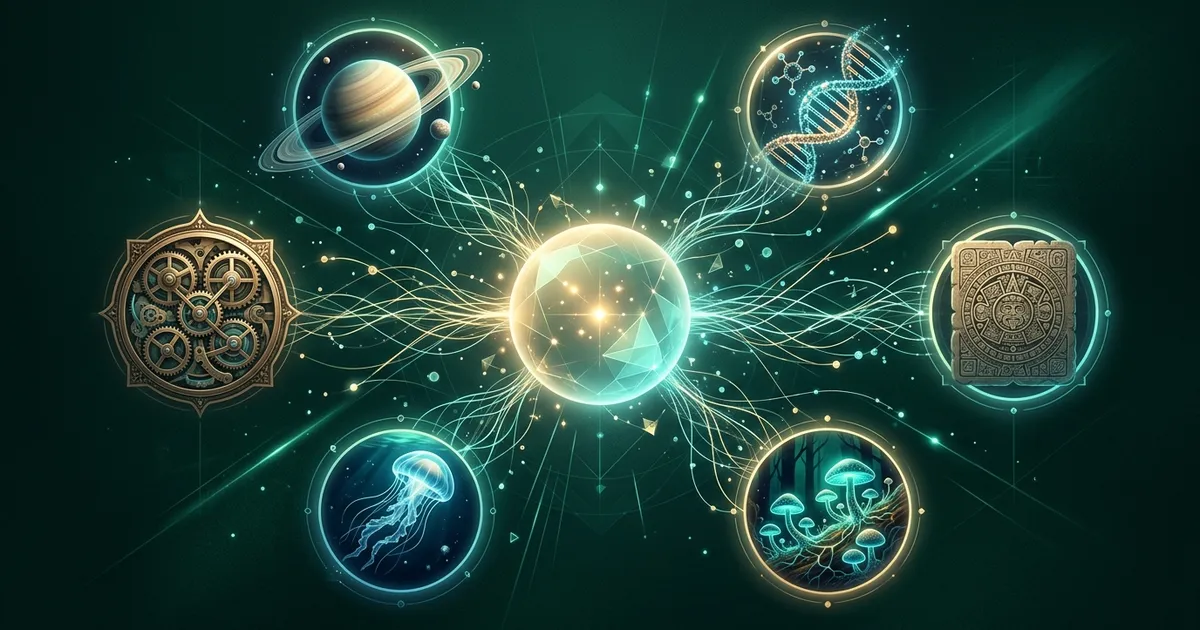
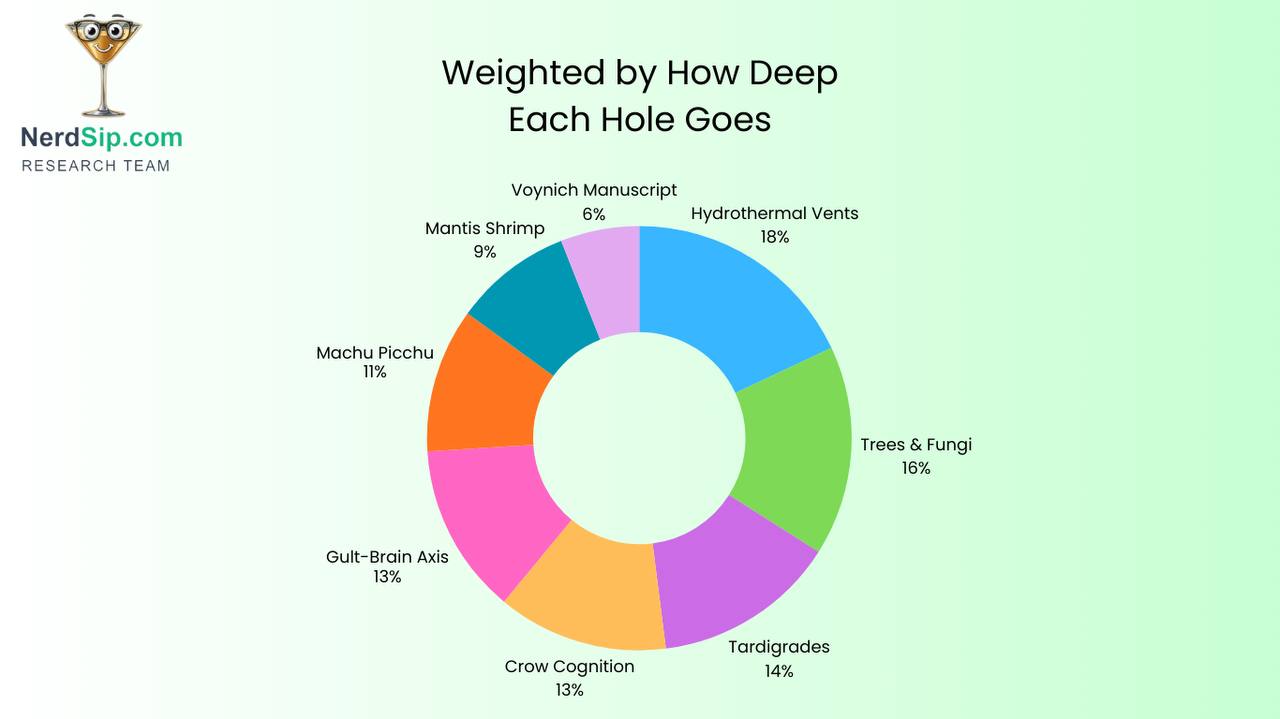
These are eight doorways. Each leads somewhere stranger.
Crows lead to corvid cognition broadly — tool manufacture, theory of mind, whether other animals have something we'd recognise as culture — which connects to the much larger question of what consciousness actually requires and which species might have some version of it.
Trees and fungi lead to Paul Stamets, mycologist and genuine eccentric, who argues that fungal networks are a kind of intelligence, that fungi can decompose oil spills and nerve agents, and that the mycelium connecting forest ecosystems may have been the original internet — a distributed information network predating the internet by 600 million years.
The Voynich Manuscript leads into cryptography history: the Enigma machine, the Navajo code talkers, the invention of public key encryption, and how the secure communication underlying every online transaction on Earth works — one of the most consequential and least understood stories of the 20th century.
The pitch drop leads into materials science and the genuinely strange behaviour of matter at different scales: superconductors that conduct electricity with zero resistance, quantum materials that change properties based on observation, graphene that is simultaneously the thinnest and one of the strongest materials ever documented.
Mantis shrimp lead into sensory biology and the philosophy of perception: whether two people experiencing "red" are having the same experience, what a bat's echolocation experience is like from the inside, what it would mean for a species to possess a sense that humans have no reference point for at all — one of the oldest unresolved questions in philosophy of mind.
Tardigrades lead into astrobiology and the genuine scientific debate about whether we'll find evidence of life elsewhere in the solar system within the next 50 years, and what the implications of that finding would actually be for every philosophical, religious, and scientific framework humans have built.
Machu Picchu leads into the Inca Empire broadly: a civilisation that built roads spanning 40,000 kilometres, performed successful brain surgery, developed a sophisticated recording system using knotted strings (quipus) that may encode information we still can't interpret, and was largely destroyed within a generation — leaving behind more questions than answers.
Hydrothermal vents lead into the origin of life itself: the leading current hypothesis is that life on Earth began at these vents, with the chemical gradients providing the energy for the first self-replicating molecules. If life began in the dark at the bottom of the ocean, it almost certainly began elsewhere too.
This is what being curious actually means. Every answer generates three questions. The rabbit holes don't close — they connect to tunnels you didn't know existed, and those connect to more.
Apps like NerdSip are built for exactly this. Crow cognition, mycorrhizal networks, the Voynich Manuscript, tardigrade biology, hydrothermal vents, Inca engineering — generate a structured course on any of it in seconds. Five to ten minute lessons. Follow whatever pulls you. Go as deep as you want on anything.
Want a longer menu of doorways? Browse our list of 50 random interesting topics anyone can learn — each one is another rabbit hole waiting to open.
Every NerdSip course clears a four-layer fact-checking pipeline before it reaches the app: grounded in live sources, scored nightly, gated on failure, and reviewable by a person at one tap. Articles on this blog are drafted with AI assistance, then researched, verified, and edited by our team.
Editorial responsibility: ai51 UG (haftungsbeschränkt). Responsible editor named in the imprint.
📚 Keep Learning
- 50 Random Interesting Topics Anyone Can Learn (And Sound Brilliant Talking About)
- Best Rabbit Holes in 2026: 10 Places to Fall Into Wonder Online
- How to Learn Faster: The Science-Backed Method
- The Best App for Curious People Who Actually Want to Learn (Not Just Scroll)
- 10 Study Techniques That Actually Work (2026 Guide)
Explore the NerdSip learning hubs
The blog is our editorial layer. When you want to move from reading into doing, these hubs organize the rest of NerdSip by format, including the app itself and the press that has written about it.
Ready to Level Up?
Turn your screen time into knowledge. Download NerdSip and start learning in just 5 minutes a day.
4.7 stars from 380 reviews · 10,000+ learners