You learn faster by making studying harder in the right places. Pull information out of memory instead of pushing it back in, spread your reviews across days, mix topics rather than blocking them, and sleep on it. In 2013 a team led by John Dunlosky rated ten popular study techniques for Psychological Science in the Public Interest. Only two earned a high utility rating: practice testing and distributed practice. Highlighting and rereading, the two things almost everyone does, came in low.
How Do You Learn Faster?
Nine techniques carry almost all the weight. The first three do most of the work, and the rest compound on top of them.
| Technique | What it replaces | Evidence |
|---|---|---|
| Active recall | Rereading notes | Very strong |
| Spaced repetition | Cramming | Very strong |
| The Feynman technique | Highlighting | Strong |
| Interleaving | One topic for hours | Strong |
| Sleep after learning | The all-nighter | Very strong |
| Chunking | Memorizing item by item | Strong |
| Dual coding | Text only | Moderate to strong |
| Desirable difficulty | Easy practice questions | Strong |
| The generation effect | Passive consumption | Strong |
There is one idea underneath all nine. Robert and Elizabeth Bjork call it desirable difficulty: conditions that slow you down during practice often produce better long-term retention, while conditions that feel smooth produce fast forgetting. Fluency feels like learning. It usually is not.
Prefer to watch first? Neuroscientist Dr. Lila Landowski covers the biology in her TEDxHobart talk:
1. Active Recall: Test Yourself Instead of Rereading
Active recall is the practice of retrieving information from memory without looking at the source. It is the single highest-return change most people can make, and it costs nothing.
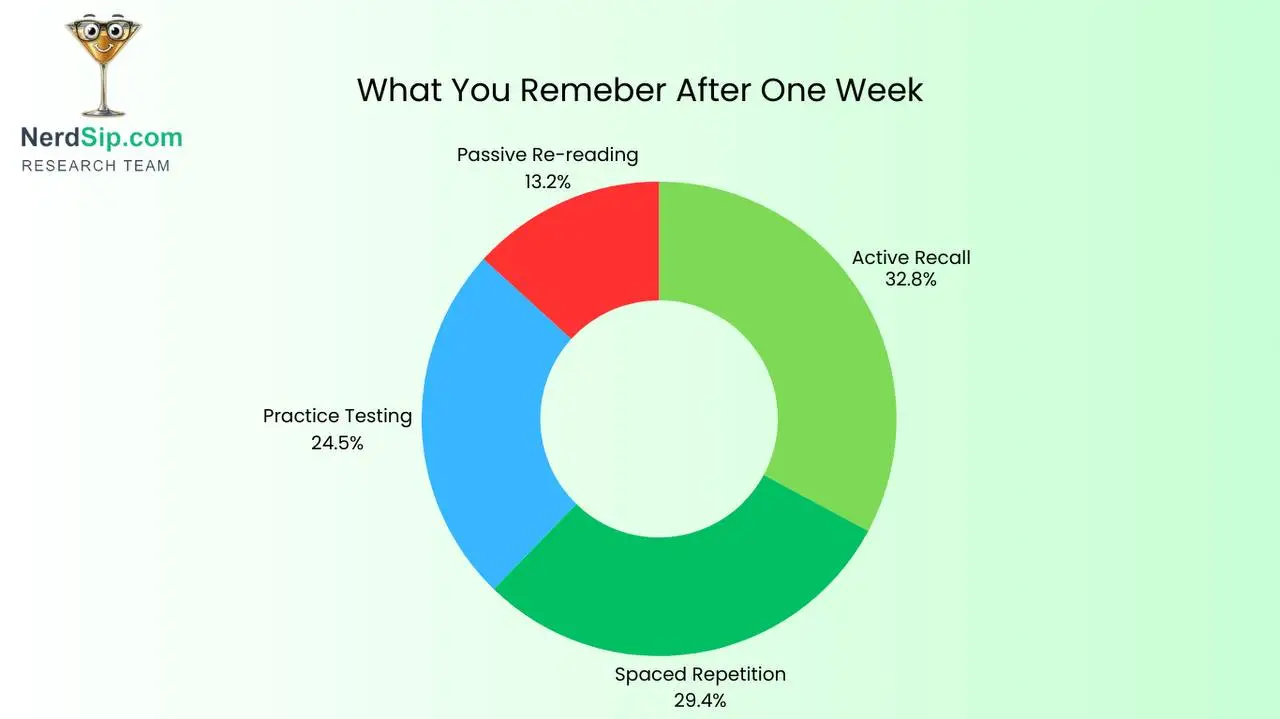
The evidence. Henry Roediger and Jeffrey Karpicke ran the definitive experiment in 2006. Students read a passage, then either studied it again or tested themselves on it. On a test one week later, the retrieval group recalled about 61 percent of the material and the rereading group about 40 percent. The twist matters more than the numbers: immediately after studying, the rereading group felt more confident and predicted they would do better. They were wrong by a wide margin.
Why it works. Retrieving a memory is not a neutral readout. The act of pulling something out makes it easier to pull out next time. Rereading only strengthens recognition, and recognition is not what an exam, a conversation or a job asks for.
How to run it.
- Read one section.
- Close the book or the tab.
- Write or say everything you can remember.
- Open the source and find only what you missed.
- Relearn the gaps, not the whole section.
The step people skip is closing the source. Recall with the page still visible is rereading wearing a costume.
2. Spaced Repetition: Review Before You Forget
Spaced repetition means spreading reviews across days instead of stacking them into one session. Same total study time, arranged differently, better result.
The evidence. Nicholas Cepeda and colleagues synthesized 254 studies covering more than 14,000 participants in 2006. Spaced practice produced better final recall than massed practice, roughly 47 percent against 37 percent, at identical total study time. A later Cepeda experiment found that the best gap between reviews scales with how long you need to remember: aim for a gap of roughly 10 to 20 percent of your target retention interval.
A schedule that works for most material:
- Review 1: one day after learning
- Review 2: three days later
- Review 3: one week later
- Review 4: one month later
Why cramming fails. Cramming produces a real spike in performance that decays fast. It is optimized for a test tomorrow and terrible for a skill you want next year. If the exam is in eighteen hours, cram. For anything else, space it.
3. The Feynman Technique: Explain It Simply
The Feynman technique is explaining a concept in plain language, as if to someone with no background, and using the points where you stumble as a map of what you do not actually understand.
The evidence. John Nestojko and colleagues at Washington University in St. Louis ran a clean version of this in 2014. Students studied a passage. Half were told they would be tested, half were told they would have to teach it. Everyone was tested. The expecting-to-teach group recalled more, and specifically recalled more of the important points. They had not done anything differently except approach the material with a different goal.
How to run it. Write the explanation for a smart twelve-year-old. When you reach for jargon, stop, and treat that as the exact spot where your understanding runs out. Go back to the source for that one gap only.
An example.
- Jargon version: "Photosynthesis converts light energy to chemical energy in chloroplast organelles."
- Feynman version: "Plants use tiny green machines in their leaves to turn sunlight into food."
The second one is harder to write, which is the point.
4. Interleaving: Mix Topics Instead of Blocking Them
Interleaving means shuffling related topics or problem types together instead of doing one kind for hours. It feels worse and works better, which is why almost nobody does it voluntarily.
The evidence. Doug Rohrer and Kelli Taylor gave students mathematics practice in either blocked or mixed order in 2007. During practice, the blocked group looked far better. On a test one week later the mixed group scored 63 percent and the blocked group 20 percent. In a related study by Nate Kornell and Robert Bjork on learning painters' styles, interleaved practice won, and roughly 80 percent of the students still believed blocking had helped them more.
Why it works. Blocked practice lets you apply the same method on autopilot because you already know which method to use. Mixed practice forces you to first decide what kind of problem this is, which is the actual skill you need when the problems are not labeled.
How to run it. Instead of three hours of one subject, do 25 minute blocks that rotate. Instead of ten problems of one type, do thirty problems of three types shuffled.
5. Sleep: The Consolidation Step You Cannot Skip
Sleep is when the brain moves new material from fragile short-term storage into durable long-term storage. Skipping it does not just make you tired. It removes a required step.
The evidence. Seung-Schik Yoo, Matthew Walker and colleagues published the sharpest version in Nature Neuroscience in 2007. People kept awake for one night showed a roughly 40 percent deficit in forming new memories the next day compared with rested participants, with measurably reduced hippocampal activity during encoding. The deficit was in the ability to learn at all, not in effort or attention.
What happens during the night. Slow-wave sleep is when the hippocampus replays the day's patterns to the cortex, which is how facts and concepts get filed. REM sleep does more of the work on procedural and emotional material and on the loose associations that show up as insight.
How to use it. Study the hardest material in the last stretch before bed, because recently learned material gets priority during consolidation. Protect seven to nine hours. A 20 minute nap after a heavy session helps, and does not replace the night.
The brutal arithmetic: six hours of study plus eight hours of sleep beats nine hours of study plus five hours of sleep. The extra study hours are written onto a disk that never gets saved.
6. Chunking: Group Information Into Units
Chunking is grouping individual items into larger meaningful units so that working memory holds more with the same capacity.
The evidence. George Miller's 1956 paper put working memory at about seven items, and Nelson Cowan's 2001 review revised it down to roughly four when rehearsal is blocked. Either way the limit is brutally small. The classic demonstration of the workaround comes from William Chase and Herbert Simon in 1973: chess masters reproduced real game positions dramatically better than novices, but when the pieces were scattered at random the masters' advantage collapsed. They were not remembering more pieces. They were remembering fewer, larger patterns.
An example.
- Twelve items: 1, 9, 6, 9, 1, 9, 4, 5, 2, 0, 2, 6
- Three chunks: 1969, 1945, 2026 (moon landing, end of the war, this year)
How to run it. Before memorizing anything, look for the structure. Group by category, find the pattern, or attach the new items to something you already know well. Expertise is largely a library of chunks, which is why experts appear to have better memories only inside their own field.
7. Dual Coding: Combine Words With Visuals
Dual coding is learning the same idea through both verbal and visual channels so it is stored twice, through two different routes.
The evidence. Allan Paivio proposed the theory in the 1970s, and Richard Mayer's multimedia research has since found repeatedly that people learn more from words plus relevant pictures than from words alone. The strongest practical finding comes from Jeffrey Wammes and colleagues in 2016: drawing a word produced roughly twice the recall of writing it out repeatedly, and the effect held even when the drawings were terrible and time was limited to four seconds.
How to run it. Draw the process rather than reading about it. Sketch a timeline, a flow, a comparison. The value is in generating the visual yourself, not in looking at someone else's diagram, which is closer to passive reading.
8. Desirable Difficulty: Practice Harder Than the Real Thing
Desirable difficulty is deliberately making practice harder in ways that slow you down now and pay off later. Robert and Elizabeth Bjork named the principle, and it explains why most of this list feels unpleasant.
The evidence. The same pattern shows up across the research above. Retrieval beats rereading and feels worse. Spacing beats massing and feels worse. Interleaving beats blocking and feels much worse. In the Kornell and Bjork study, the technique that actually won was the one most students judged to be losing. Your sense of how well you are learning is a poor instrument, and it is biased toward whatever is easy.
How to run it. Use practice questions harder than the real ones. Work under time pressure. Answer from memory before checking. Recite standing at a whiteboard rather than reading in a chair. If a study session feels comfortable throughout, that is a warning sign rather than a good sign.
The limit. Difficulty has to be desirable, not just difficult. Material far above your level produces frustration and no encoding. The target is effortful but achievable, roughly the point where you get things right most of the time but never automatically.
9. The Generation Effect: Produce, Do Not Just Consume
The generation effect is the finding that information you produce yourself is remembered better than identical information you simply read.
The evidence. Norman Slamecka and Peter Graf demonstrated it in 1978. Participants who generated a word from a cue, such as producing "cold" from "hot and c___", remembered it substantially better than those who just read the pair. The effect has replicated across word lists, sentences, problem solving and text comprehension for nearly fifty years.
How to run it. After learning anything, close everything and make something: a summary in your own words, a diagram, three questions you would put on the exam, or an explanation posted somewhere a stranger might read it. Writing your own quiz is the cheapest version and doubles as spaced repetition material.
What Actually Kills Learning?
Highlighting and rereading
Dunlosky's 2013 review rated both as low utility. They are popular because they are easy and because they produce a strong feeling of familiarity that the brain mistakes for knowledge. Replace both with active recall.
Multitasking
The brain does not run two attention-demanding tasks in parallel, it switches between them, and each switch has a reconfiguration cost. Joshua Rubinstein and colleagues measured those costs in 2001. Put the phone in another room rather than face down on the desk.
Studying while exhausted
Given the Walker finding above, an hour of study on four hours of sleep is close to an hour spent for nothing. Sleep first and study second, even the night before.
Matching your "learning style"
Worth naming because it is so widely believed. Harold Pashler and colleagues reviewed the evidence in 2008 and found almost no properly designed studies supporting the idea that teaching to someone's preferred style improves outcomes, and the few adequate tests came out negative. People do have preferences. Matching instruction to them does not produce better learning. Match the format to the material instead: geography wants a map, a process wants a diagram, an argument wants prose.
The 15-Minute Daily System
The techniques are useless if running them takes longer than the studying. Here is the compressed version.
Morning, five minutes. Recall yesterday's material from memory before looking at anything. Note only the gaps.
While learning, no extra time. Read or watch once, close it, explain it out loud in plain language, write what you remember, then check. That is Feynman plus active recall plus generation in a single pass.
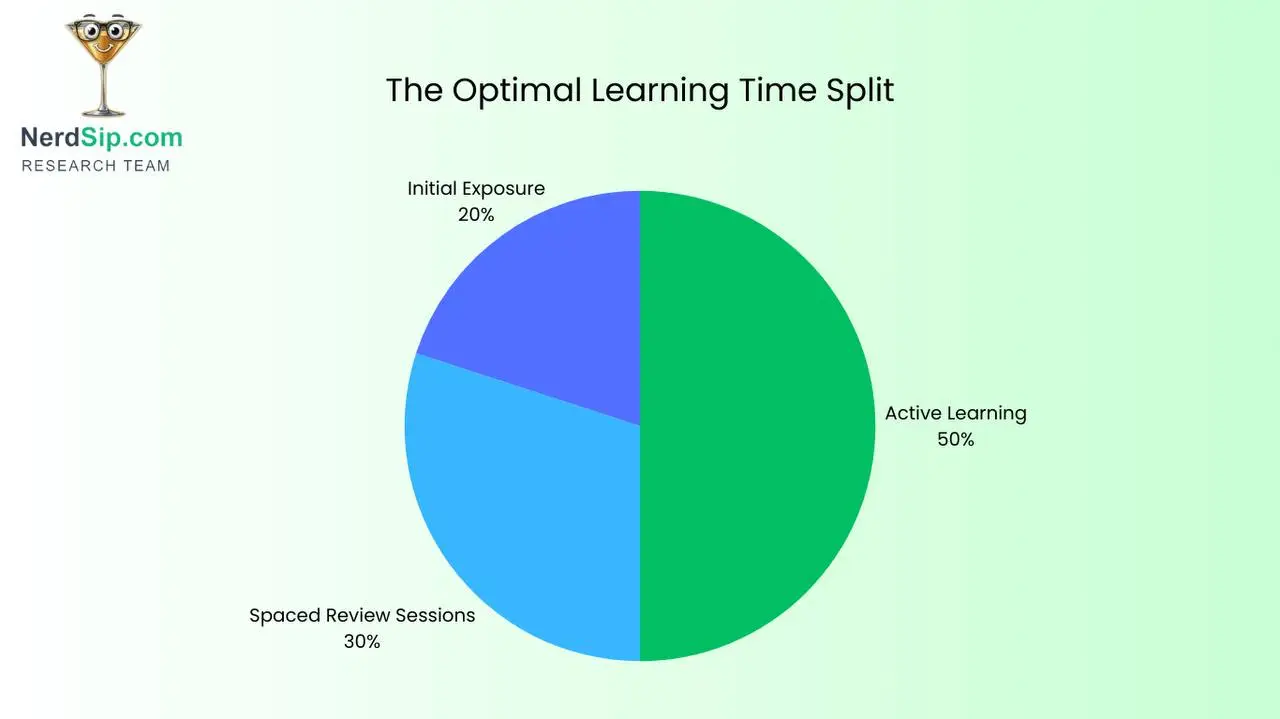
Evening, ten minutes. Review one older topic, not today's. Rotate through a one day, three day, one week, one month cycle so something old is always coming back around. Then sleep seven to nine hours and let consolidation finish the job.
Weekly. Mix subjects deliberately. If you studied three topics this week, run one session that shuffles questions from all three.
Which Apps Make This Automatic?
The techniques work. Running them by hand is the part that fails, usually within two weeks. Apps solve the scheduling and the friction, not the science.
NerdSip generates a course on anything you type in, three to ten short lessons of a couple of hundred words each, so a short course runs about five minutes end to end. Every lesson ends in a question you have to answer before moving on, which makes retrieval mandatory rather than optional. The Repetition tab builds a Memory Mix from courses you finished in the last 30 days, and anything used in a mix is held back for a week before it can come back, so the gap does its work. Streaks, XP and weekly leagues handle the part the research does not: showing up tomorrow.
Anki is the serious tool for scheduled flashcards, with a well-tested algorithm and a steep setup cost. Best if you are willing to build your own decks.
Duolingo is strong for languages specifically, and its real contribution is consistency rather than depth.
Brilliant teaches STEM through problem solving, which is generation and desirable difficulty by design.
Pick one and use it daily. An adequate system you run every day beats an optimal system you abandon in March.
The Bottom Line
Fast learners are not processing information faster. They are using methods that feel worse and work better, and they have stopped trusting the feeling of fluency as a signal.
If you change one thing, close the book and try to recall before you reread. If you change two, spread the reviews across days. Those two techniques were the only ones out of ten to earn a high utility rating in the Dunlosky review, and between them they cover most of the available gain.
Everything else on this list is optimization. The struggle you feel while doing it correctly is not a sign that it is going badly. That is what encoding feels like from the inside.
Frequently Asked Questions
What is the fastest way to learn something?
Learn it once from a short source, then close the source and recall it from memory rather than rereading. Review the same material after a day, three days, a week and a month. Of ten study techniques reviewed by Dunlosky and colleagues in 2013 for Psychological Science in the Public Interest, only practice testing and distributed practice earned a high utility rating, and between them they account for most of the available improvement.
Does active recall really beat rereading?
Yes, and by a large margin on delayed tests. Roediger and Karpicke found in 2006 that students who tested themselves recalled about 61 percent of a passage one week later, while students who reread it recalled about 40 percent. The important detail is that the rereading group predicted they would do better. Rereading builds recognition, which feels like knowledge but is not what a test or a conversation requires.
How long should I wait between study sessions?
Scale the gap to how long you need to remember the material. Cepeda and colleagues found the optimal gap is roughly 10 to 20 percent of the target retention interval, so material you need in a month wants gaps of several days, and material you need in a year wants gaps of weeks. A practical default that fits most subjects is one day, three days, one week, then one month.
Why does interleaving feel worse than studying one topic at a time?
Because blocked practice lets you apply the same method on autopilot, which feels fluent, while mixed practice forces you to first work out which method applies. Rohrer and Taylor found in 2007 that blocked practice looked better during the session but produced 20 percent on a test a week later against 63 percent for mixed practice. In a related study most students still believed blocking had helped them more.
Does sleep really affect how much you learn?
Yes, and the effect is on the ability to encode at all. Yoo, Walker and colleagues reported in Nature Neuroscience in 2007 that people kept awake for one night showed roughly a 40 percent deficit in forming new memories the next day, alongside reduced hippocampal activity during learning. Studying the hardest material shortly before sleep helps, because recently learned material gets priority during consolidation.
Are learning styles real?
Preferences are real, but matching teaching to them does not improve learning. Pashler and colleagues reviewed the literature in 2008 and found almost no studies with an adequate design supporting the idea, and the few properly designed tests produced negative results. Match the format to the material rather than to the learner: geography wants a map, a process wants a diagram, an argument wants prose.
How much time per day does this take?
About fifteen minutes of review on top of whatever learning you were already doing. Five minutes in the morning recalling yesterday's material from memory, ten minutes in the evening reviewing something older on a one day, three day, one week, one month rotation, plus seven to nine hours of sleep so consolidation can finish the work.
Every NerdSip course clears a four-layer fact-checking pipeline before it reaches the app: grounded in live sources, scored nightly, gated on failure, and reviewable by a person at one tap. Articles on this blog are drafted with AI assistance, then researched, verified, and edited by our team.
Editorial responsibility: Philip S., ai51 UG (haftungsbeschränkt) — contact via imprint.
📚 Keep Learning
Explore the NerdSip learning hubs
The blog is our editorial layer. When you want to move from reading into doing, these hubs organize the rest of NerdSip by format, including the app itself and the press that has written about it.
Make Retrieval the Default
NerdSip turns any topic into short lessons that each end in a question you have to answer, so recall is built in rather than left to willpower. About five minutes a day.