You're working 60-hour weeks. Juggling ten projects simultaneously. Responding to Slack messages at midnight. Racing through your to-do list like your life depends on it.
And yet... you're not getting ahead. You're burning out.
Welcome to the hustle culture collapse. The lie that "more hours = more success" is finally dying. And in its place? A revolutionary approach called slow productivity.
In 2026, the most successful people aren't the ones working hardest. They're the ones who figured out how to work strategically—focusing on fewer priorities, going deeper instead of wider, and producing quality work without destroying themselves in the process.
The burnout era is ending. Slow productivity is becoming the new standard of sustainable success.
What Is Slow Productivity (And Why Everyone's Talking About It)
Slow productivity isn't about being lazy. It's not about working fewer hours just for the sake of it.
It's a fundamental shift in how we define productive work: quality over quantity, depth over breadth, sustainability over sprints.
The core principles:
Do fewer things → Instead of juggling 10 projects poorly, do 3 projects exceptionally
Work at a natural pace → Respect your energy cycles instead of forcing constant output
Obsess over quality → Create work that matters instead of checking boxes
Research from 2026 confirms this shift is happening at scale. The burnout era that defined 2020-2024 is ending. People are rejecting unrealistic expectations and choosing depth, focus, and rest over the constant grind.
Companies are noticing too. More organizations are introducing flexible schedules, protected deep-work periods, and recovery-friendly workflows. Not out of generosity—out of necessity. Because burned-out employees produce mediocre work, miss deadlines, and eventually quit.
The truth nobody wanted to admit: Hustle culture didn't make us more productive. It just made us exhausted.
Why Hustle Culture Broke (And Why We Kept Pretending It Worked)
Let's talk about the lie we all believed:
"If you're not working 80-hour weeks, you're not serious about success."
Entrepreneurs wore burnout like a badge of honor. Sleep deprivation became a flex. Rest was for the weak. Grind culture influencers sold courses on "maximizing every minute" while secretly struggling with anxiety, health issues, and collapsing relationships.
And for a while, it seemed to work. Because the people preaching hustle culture were visible, loud, and successful-looking on social media.
But here's what they didn't show you:
- The unsustainable pace that led to crashes and breakdowns
- The work quality that suffered from chronic exhaustion
- The relationships destroyed by constant unavailability
- The health problems from stress and sleep deprivation
- The mental health crises hidden behind productivity theater
By 2024-2025, the cracks became impossible to ignore. Burnout rates hit all-time highs. Engagement collapsed. People started quitting en masse during the "Great Resignation." And suddenly, everyone realized: the emperor has no clothes. Hustle culture doesn't work.
The Science Behind Why Slow Productivity Actually Works
Slow productivity isn't just a feel-good philosophy. It's backed by decades of research on how humans actually produce their best work.
Your Brain Isn't Built for Constant Output
Neurological research shows that your brain operates in cycles:
Ultradian rhythms: 90-120 minute periods of high focus, followed by 20-minute recovery periods
Circadian rhythms: Natural energy peaks and valleys throughout the day
Sleep cycles: Critical for memory consolidation, creative insights, and cognitive restoration
When you ignore these natural rhythms and force constant productivity, you're fighting your biology. The result? Diminishing returns, increased errors, and eventual burnout.
Slow productivity works with your brain's design, not against it.
Quality Requires Deep Work (Which Requires Protected Time)
Cal Newport's research on deep work shows that meaningful, high-value work requires extended periods of uninterrupted focus—typically 3-4 hours at a time.
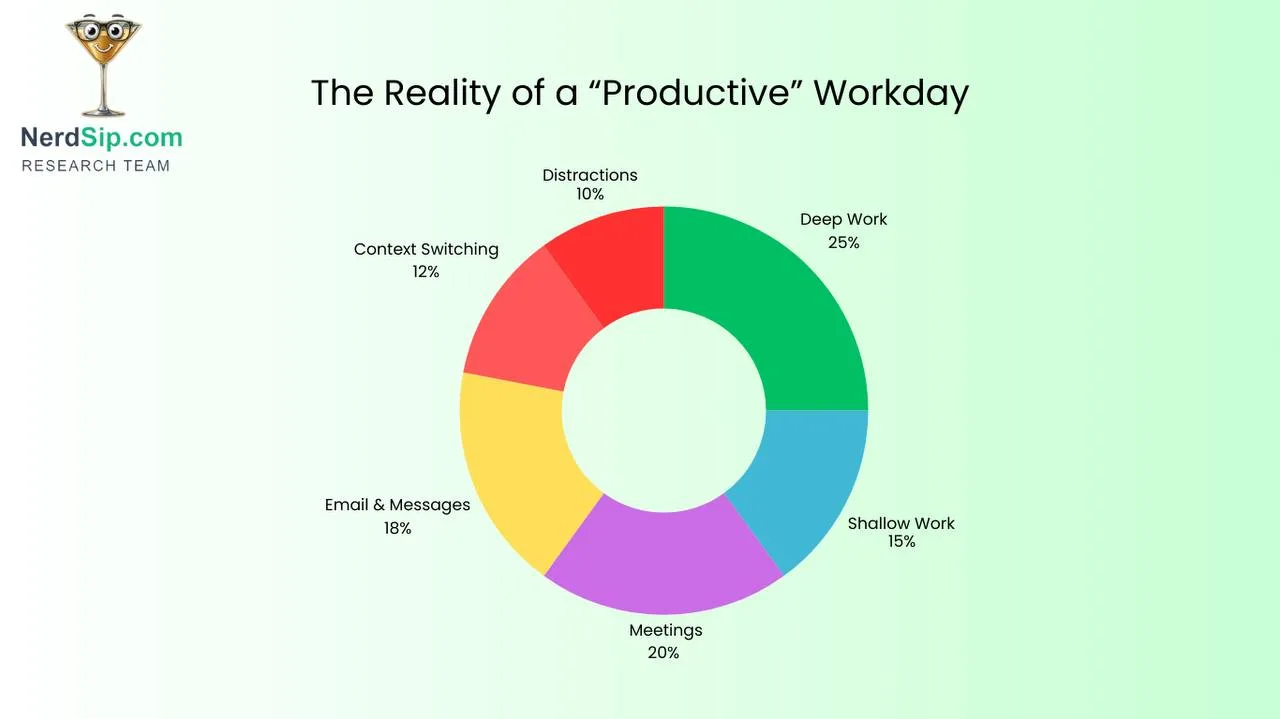
But most people's workdays look like this:
- 47 seconds on a task before switching (average attention span at work)
- 50+ interruptions daily (emails, Slack, meetings, notifications)
- Constant context-switching that destroys cognitive performance
The math is brutal: If you're interrupted every 10 minutes, and it takes 23 minutes to regain full focus after each interruption, you never actually reach deep work. Ever.
Slow productivity protects time for deep work. You do less, but what you do is exponentially better.
Burnout Destroys Long-Term Performance
Short-term, you can force high output through willpower and adrenaline. But long-term? Burnout kills productivity entirely.
Research shows that burned-out employees:
- Take 66% longer to complete tasks
- Make 50% more errors
- Experience 37% higher turnover rates
- Reduce team morale by 30%
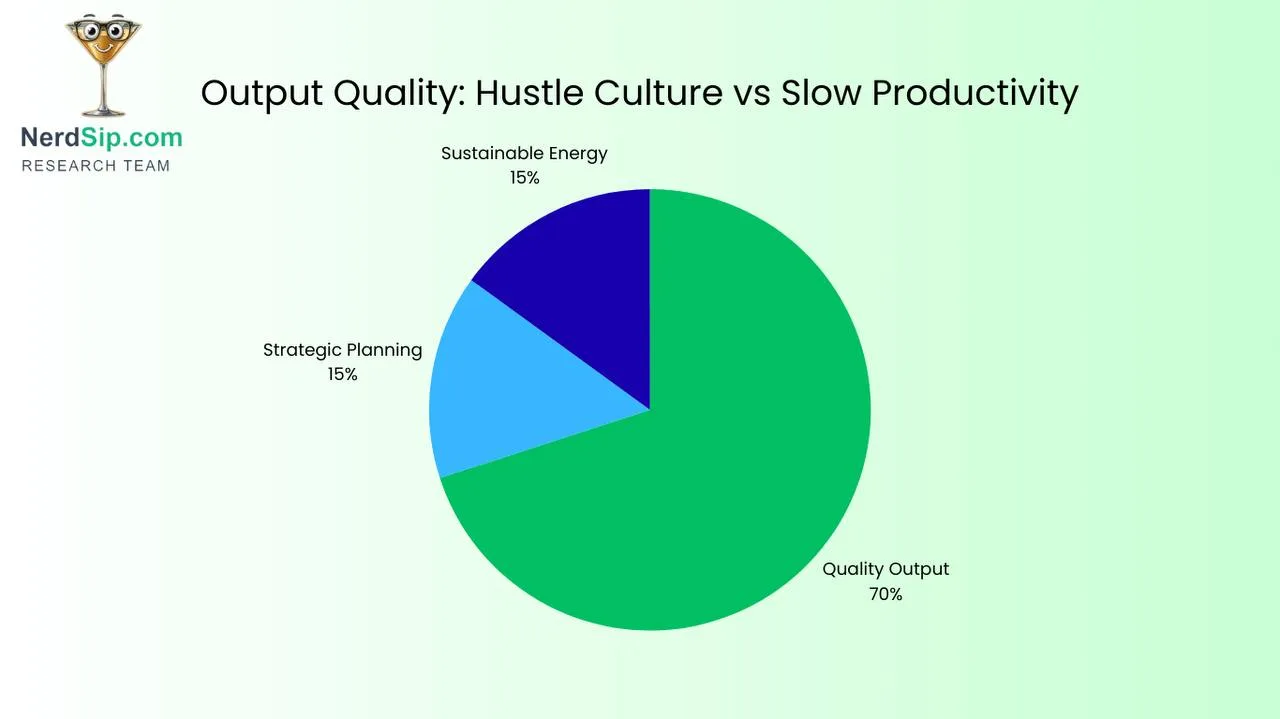
Slow productivity prioritizes sustainability. You might produce less in any single day, but you maintain high performance for years instead of crashing after months.
The Three Pillars of Slow Productivity
Pillar 1: Do Fewer Things
This is the hardest pillar for most people. Because society tells us that "busy = important."
Slow productivity flips this:
Busy = scattered. Focused = powerful.
Instead of saying yes to everything, slow productivity asks:
- What are the 3 most important things I need to accomplish this quarter?
- Which projects actually move the needle vs create busywork?
- What can I say no to, delegate, or eliminate entirely?
The Warren Buffett strategy: Write down your top 25 goals. Circle the top 5. Everything outside those top 5 is now your "avoid at all costs" list. Not "do later." Actively avoid.
Why? Because those 20 goals feel productive, but they're actually distractions from what matters most.
Practical implementation:
- Limit work-in-progress to 3 projects maximum
- Say "not right now" to new opportunities unless they're top-priority
- Batch similar tasks instead of scattering them across the week
- Protect at least 4 hours daily for deep work on your most important project
Pillar 2: Work at a Natural Pace
Hustle culture demands constant output at maximum intensity. Slow productivity respects energy cycles.
What this looks like in practice:
Morning (peak cognitive hours): Deep work on most difficult tasks
Midday (energy dip): Lighter tasks, meetings, admin work
Afternoon (second wind): Creative work, brainstorming, collaboration
Evening: Rest, recovery, disconnection
Notice what's missing? Late-night "grinding." Weekend work. Sacrificing sleep for deadlines.
Slow productivity recognizes that you have approximately 4-6 hours of high-quality cognitive work in you per day. Everything beyond that produces diminishing returns.
The data backs this:
- Studies show productivity drops 25% after 8 hours of work
- Working 60+ hours per week reduces output to the equivalent of 40 hours
- Rest and recovery are when your brain consolidates learning and generates insights
Practical implementation:
- Work in 90-minute blocks with 20-minute breaks
- Respect your natural energy patterns instead of forcing productivity
- Take actual weekends (no work email, no "quick tasks")
- Sleep 7-8 hours minimum—non-negotiable
Pillar 3: Obsess Over Quality
Hustle culture measures success by volume: How many hours did you work? How many tasks did you complete?
Slow productivity measures success by impact: Did this work actually matter? Did it move important goals forward?
The shift:
From: "I finished 20 tasks today!"
To: "I made meaningful progress on the project that will define my quarter."
From: "I worked 12 hours today!"
To: "I produced 3 hours of work I'm genuinely proud of."
From: "I'm so busy!"
To: "I'm so focused."
Quality obsession means:
- Shipping one exceptional product instead of five mediocre ones
- Spending a week perfecting a strategy instead of rushing through
- Saying no to opportunities that don't align with your highest standards
- Creating work you'd be proud to show in 10 years
How to Actually Implement Slow Productivity (Without Getting Fired)
This is where most people get stuck. The theory sounds great, but how do you actually practice slow productivity when your boss expects instant responses, your calendar is packed with meetings, and your to-do list is already overwhelming?
Step 1: Audit Your Current State
Before changing anything, understand where your time actually goes.
For one week, track:
- Every task you work on and how long it takes
- Every interruption (notifications, messages, requests)
- Every meeting and whether it was necessary
- Your energy levels throughout the day
You'll likely discover:
- 60%+ of your time goes to low-value tasks
- Most meetings could be emails
- You have far less deep work time than you thought
- Your peak productivity hours are being wasted on busywork
Step 2: Identify Your Core Work
Slow productivity requires brutal honesty: What work actually matters?
Ask yourself:
- If I could only work 4 hours per week, what would I focus on?
- Which projects, if done exceptionally, would transform my career/business/life?
- What work do only I can do (vs what can be delegated or eliminated)?
Most people discover: 80% of their "productivity" is busywork disguised as importance. The 20% that matters is buried under noise.
Step 3: Protect Your Deep Work Time
Block 3-4 hours daily for deep work. Non-negotiable. This is your most important meeting—with yourself.
Protect it like you'd protect a meeting with your CEO:
- Calendar block (mark as "busy" so others can't schedule over it)
- Turn off notifications completely
- Close email and Slack
- Work on your #1 priority during this time, nothing else
Start small: Can't block 4 hours? Start with 90 minutes. Prove to yourself (and others) that focused work produces better results than scattered busyness.
Step 4: Create Systems, Not Goals
Goals create pressure. Systems create progress.
Instead of: "Ship a major project this quarter" (goal-based, all-or-nothing)
Try: "Spend 2 hours daily on my most important project" (system-based, sustainable)
Systems compound. Do a little daily, and in 90 days, you've achieved what would've taken frantic all-nighters under hustle culture—except you're not burned out.
Step 5: Communicate Boundaries (Without Apologizing)
This is where people fear pushback. But here's the secret: When you deliver exceptional work, people care less about your methods.
How to set boundaries:
Don't say: "Sorry, I can't respond immediately. I'm trying to focus more."
Do say: "I check messages twice daily at 10am and 3pm so I can give my full attention to deep work. For urgent matters, call me directly."
Don't say: "I'm feeling overwhelmed, so I need to work less."
Do say: "I'm prioritizing quality over quantity. I'll be focusing on fewer projects to deliver exceptional results."
The key: Frame it as a strategy for better output, not a personal weakness.
Slow Productivity for Different Professions
For Knowledge Workers
Challenges: Email overload, meeting culture, always-on expectations
Solutions:
- Batch communication (check email 2-3x daily, not constantly)
- Decline meetings without clear agendas
- Use "focus mode" features to block notifications during deep work
For Creatives
Challenges: Pressure to constantly produce content, social media presence demands, inspiration cycles
Solutions:
- Seasonal work rhythms (intense creation periods followed by rest periods)
- Protect morning hours for creative work before any communication
- Quality-based metrics (impact of work) vs quantity metrics (posts per week)
For Entrepreneurs
Challenges: "If I don't work 24/7, my business will fail" mentality
Solutions:
- Focus on one core business initiative per quarter
- Delegate/automate everything that doesn't require your unique skills
- Build systems that run without constant intervention
For entrepreneurs building products, understanding the growth triad of Find, Convert, and Retain helps you focus on what actually moves the needle instead of spinning your wheels on vanity metrics.
For Students
Challenges: Multiple classes, extracurriculars, social pressure to be constantly busy
Solutions:
- Focus on truly learning 3-4 subjects deeply rather than surface-level knowledge across many
- Study in 90-minute focused blocks rather than 5-hour distracted marathons
- Protect sleep above all else (sleep deprivation tanks learning capacity)
The Results: What Happens When You Actually Try This
Most people fear that slow productivity means producing less. But the data (and countless case studies) shows the opposite.
What typically happens:
Month 1: You feel uncomfortable. Saying no feels wrong. Working less feels lazy. You worry people will judge you.
Month 2: You notice your work quality improving. Tasks that used to take hours now take 90 minutes because you're fully focused. You're less exhausted.
Month 3: Others start commenting: "Your work has been exceptional lately." You realize you're producing more valuable output while working less time.
Month 6: Slow productivity becomes your default. You can't imagine going back to hustle culture. You're more creative, less stressed, and actually enjoying your work again.
The Slow Productivity Paradox
Here's the weird part: slow productivity often leads to faster results.
How?
Hustle culture:
- Work on 10 things simultaneously
- Make scattered progress on each
- Complete nothing to a high standard
- Burn out before finishing
Slow productivity:
- Work on 3 things sequentially
- Focus entirely on one until it's exceptional
- Ship high-quality work that gets noticed
- Have energy to start the next project
The outcome: You complete fewer projects, but each one makes a bigger impact. And impact compounds far faster than volume.
Why 2026 Is the Tipping Point
Slow productivity isn't new. But 2026 is the year it becomes mainstream.
Why now?
1. Collective burnout reached crisis levels → People literally can't sustain hustle culture anymore
2. Remote work proved productivity ≠ hours at desk → Output matters, presence doesn't
3. AI is changing the game → The work that matters is deep, strategic, creative—exactly what slow productivity enables
4. Gen Z is rejecting hustle culture → The next generation refuses to sacrifice health for performance theater
5. Companies are realizing retention requires sustainability → Burned-out employees quit, costing millions in turnover
The shift is happening whether you join it or not. The question is: Will you adapt proactively, or burn out trying to maintain an unsustainable pace?
Doing less well requires choosing fewer tools carefully. Our 2026 self-improvement app list is built around that constraint: one app per problem, two to start, and a stated reason for every app we left out.
Your Next Step: One Change, Starting Tomorrow
Don't try to implement all of slow productivity overnight. That's hustle culture thinking.
Instead, choose ONE change:
Option 1: Block 90 minutes tomorrow for deep work on your most important project. Turn off everything else.
Option 2: Identify one project/commitment to say no to or delegate.
Option 3: Set a hard stop time (e.g., 6pm) and actually stop working. See what happens.
Try it for 30 days. Track the results. Then decide if slow productivity actually works for you.
This is what NerdSip enables. Slow productivity doesn't mean stop learning and growing—it means learning strategically, in sustainable doses. Five minutes of focused learning daily, integrated into your natural workflow, compounds into genuine expertise without the exhaustion. NerdSip is live in the App Store and on Google Play and build knowledge without burning out.
Because getting better every day doesn't require destroying yourself.
Related Articles
- The One Keystone Habit That Makes Self-Optimization Automatic
- Pomodoro Technique Explained: The 25-Minute Focus Guide
- How to Turn Scroll Addiction Into Learning: Break the Dopamine Loop
Every NerdSip course clears a four-layer fact-checking pipeline before it reaches the app: grounded in live sources, scored nightly, gated on failure, and reviewable by a person at one tap. Articles on this blog are drafted with AI assistance, then researched, verified, and edited by our team.
Editorial responsibility: ai51 UG (haftungsbeschränkt). Responsible editor named in the imprint.
📚 Keep Learning
Explore the NerdSip learning hubs
The blog is our editorial layer. When you want to move from reading into doing, these hubs organize the rest of NerdSip by format, including the app itself and the press that has written about it.
Keep going: five-minute courses on this
Pick one and finish it before your coffee cools. Every lesson ends with a quick question, so it sticks instead of scrolling past.
Courses on this topic
4.7 stars from 380 reviews · 10,000+ learners