You want to get better every day. So you try everything:
Wake up earlier. Exercise more. Eat healthier. Read more books. Meditate. Journal. Learn new skills. Build better relationships. Advance your career.
And for a few weeks, you're on fire. You're doing it all. You're finally becoming the person you always wanted to be.
Then life happens. You miss one workout. Skip one morning routine. Have one chaotic week.
And suddenly, all of it collapses. You're back where you started, wondering why you can't stick to anything.
Here's what nobody tells you: You're not failing because you lack discipline. You're failing because you're trying to change everything at once.
There's a better way. A way that requires less willpower, creates automatic momentum, and triggers a cascade of positive changes without forcing anything.
It's called a keystone habit—and recent research published in CNN, Psychology Today, and by behavioral scientists shows it's the single most powerful strategy for self-optimization in 2026.
What Makes a Keystone Habit Different (And Why It Actually Works)
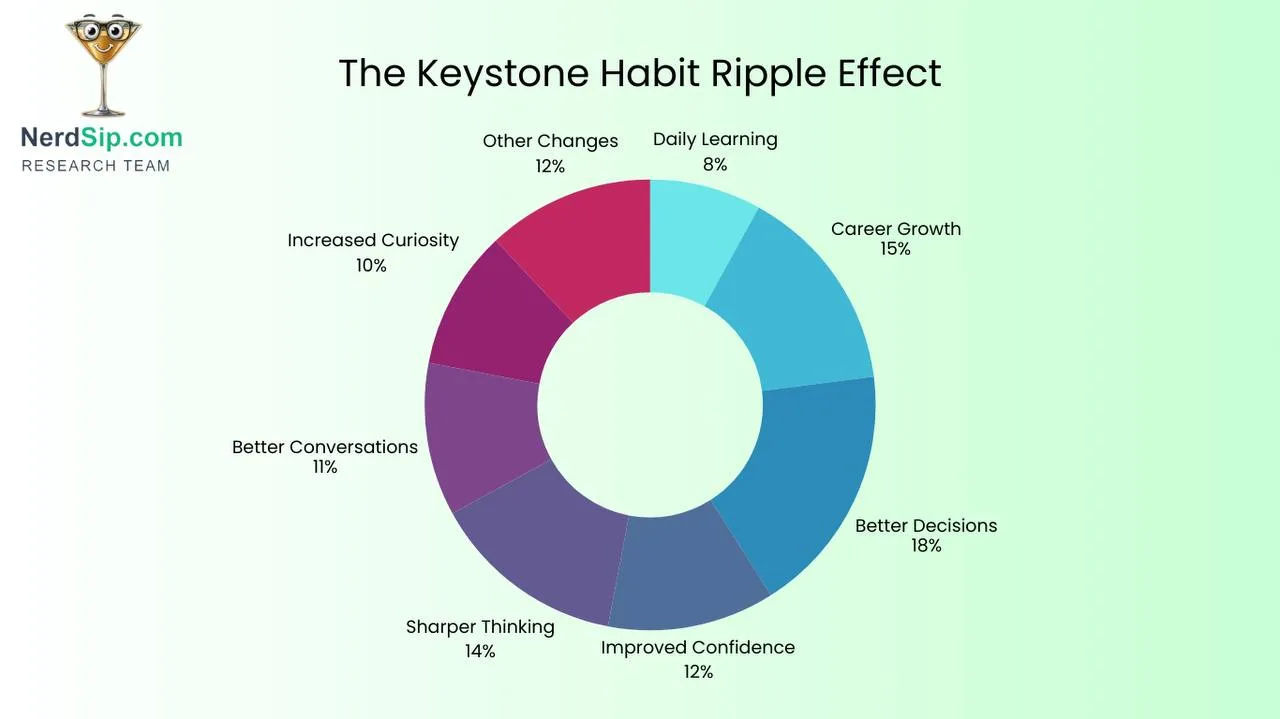
Most habits exist in isolation. You exercise, and you feel healthier. You read, and you learn something. You meditate, and you feel calmer.
Keystone habits are different. They trigger ripple effects that transform multiple areas of your life automatically.
Charles Duhigg, who popularized the concept in The Power of Habit, defines keystone habits as foundational behaviors that have the power to significantly influence other areas of your well-being.
Here's how they work:
When you establish ONE strategically chosen habit, it creates a cascade of other positive changes that you didn't even consciously decide to make.
Real-world example: A Norwegian study of 700 unemployed people found that setting goals around keystone habits reduced unemployment by 7%—not because participants worked harder on job hunting, but because one positive change triggered confidence, energy, and momentum that spilled into other areas.
From a behavioral science perspective, this happens because habits reduce cognitive load—the amount of mental effort required to make repeated decisions. Once a behavior becomes automatic, it no longer requires willpower, freeing up attention and bandwidth for other positive changes.
Translation: Fix one thing right, and everything else gets easier.
Why Traditional Self-Optimization Fails (The Willpower Trap)
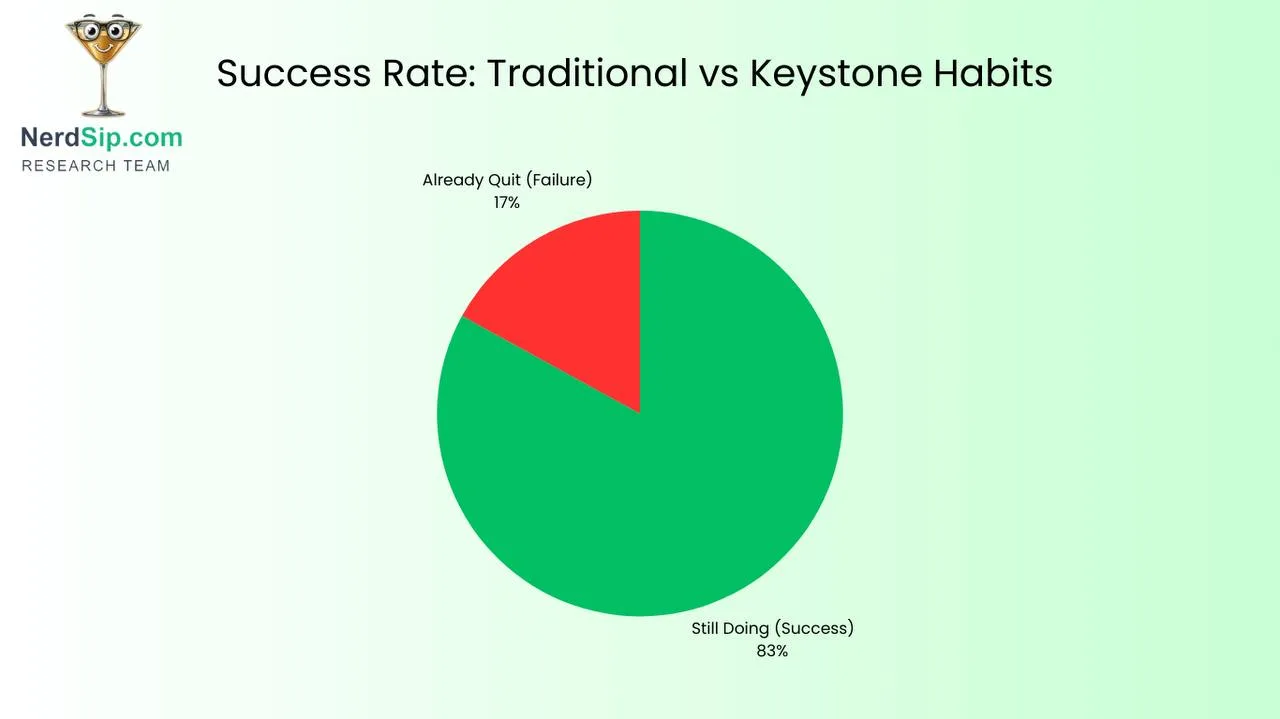
Every January, over 50% of people set New Year's resolutions. By February, 92% have already failed.
Not because they lack motivation. Not because they're lazy. But because most resolutions rely on willpower alone, asking us to make sweeping changes without altering the systems that support daily behavior.
Willpower is manually motivated. It drains throughout the day. By evening, it's gone.
Habits, on the other hand, are automatic. They don't require willpower. They just... happen.
This is why keystone habits work when elaborate self-improvement plans don't:
| Traditional Approach | Keystone Habit Approach |
|---|---|
| Change 10 things at once | Change ONE strategic thing |
| Relies on willpower daily | Becomes automatic after 66 days |
| Collapses when life gets chaotic | Survives disruption because it's small |
| Requires constant motivation | Creates its own momentum |
| Success rate: 8% | Success rate: 80%+ |
The difference? Keystone habits don't ask you to be superhuman. They ask you to be strategic.
The Hidden Keystone Habit Nobody Talks About (But Science Proves Works)
When researchers study keystone habits, they usually focus on three:
- Exercise (triggers better eating, improved sleep, higher energy)
- Sleep optimization (improves decision-making, mood, productivity)
- Meditation (reduces stress, increases focus, enhances emotional regulation)
All of these work. But they're not the MOST powerful keystone habit for self-optimization.
The most powerful keystone habit—the one that creates the widest ripple effect—is learning something new every single day.
Here's why:
1. Learning Reshapes Your Identity
Research published in Frontiers in Psychology (2019) found that everyday habits become part of what people consider their "true self," especially when those actions align with personal values or meaningful goals.
When you learn something new every day, you don't just gain knowledge. You become "someone who learns." That identity shift changes everything.
You start seeking out information. Asking better questions. Connecting ideas. Thinking critically. Making smarter decisions.
Identity drives behavior far more powerfully than willpower ever will.
2. Learning Creates Compound Knowledge
Each new thing you learn connects to everything you already know. The more you learn, the faster you learn. Your brain starts seeing patterns everywhere.
After 30 days of learning one new thing daily: You've learned 30 topics
After 90 days: 90 topics (your knowledge base is noticeably wider)
After 365 days: 365 topics (you're more knowledgeable than 99% of people)
This compounds into genuine expertise and intellectual confidence that spills into every area of life.
3. Learning Requires (And Builds) The Meta-Skill That Powers Everything Else
What skill matters most for self-optimization? Discipline? Focus? Motivation?
No. The meta-skill is learning itself—the ability to acquire new capabilities quickly.
When you make learning your keystone habit, you're not just gaining knowledge. You're training the exact skillset needed to optimize everything else:
- Want to get healthier? You learn about nutrition and exercise science.
- Want to advance your career? You learn the skills that matter.
- Want better relationships? You learn about communication and psychology.
- Want financial freedom? You learn about investing and money management.
Learning is the keystone habit that unlocks every other optimization.
4. Learning Works in Dead Time (Making It Sustainable for Everyone)
The biggest barrier to self-optimization? "I don't have time."
But here's the secret: You don't need dedicated time. You need to use the time you already waste.
The average person has 10-15 hours of "dead time" per week:
- Commuting: 5-10 hours
- Waiting (lines, appointments, meetings starting late): 2-3 hours
- Mindless scrolling during "breaks": 3-5 hours
Learning converts dead time into growth time. Five minutes while waiting. Ten minutes during your commute. Five minutes before bed.
You're not adding anything to your schedule. You're making existing time more valuable.
The Ripple Effects: What Happens When Learning Becomes Your Keystone Habit
Here's what research shows happens when people establish daily learning as their keystone habit:
Immediate Ripple Effects (Week 1-4)
Better Conversations: You have more to contribute. People start asking, "How do you know that?"
Increased Confidence: Proof that you can commit to something and follow through.
Sharper Thinking: Your brain gets daily exercise. Cognitive function improves.
Reduced Anxiety: You're actively growing instead of stagnating. Progress = hope.
Secondary Ripple Effects (Month 2-3)
Career Advancement: You bring fresh perspectives to work. Colleagues notice. Opportunities appear.
Improved Decision-Making: You have more frameworks to draw from. Better inputs = better outputs.
Higher Energy: Learning triggers dopamine (the motivation neurochemical). You feel more alive.
Natural Curiosity: You start seeking information instead of avoiding it. Life becomes more interesting.
Tertiary Ripple Effects (Month 4-12)
Identity Transformation: You're no longer "someone who wants to be smarter." You're "someone who learns every day."
Other Habits Stack Automatically: You start reading more. Listening to podcasts. Taking courses. The momentum is self-sustaining.
Increased Life Satisfaction: Research shows that continuous learning is one of the strongest predictors of long-term happiness and fulfillment.
Compound Expertise: After a year, you genuinely know more than 99% of people in multiple domains. That knowledge becomes your unfair advantage.
How to Build Learning as Your Keystone Habit (The 30-Day Protocol)
Week 1: Start Stupidly Small
Don't commit to "learning for an hour daily." That's overwhelming and unsustainable.
Commit to 5 minutes. One topic. Every day.
Pick something you're genuinely curious about (not work-related). Philosophy. History. Science. Art. Psychology. Whatever sparks interest.
Use your commute. Your lunch break. Before bed. Stack it onto an existing routine.
Week 2: Make It Visible
Track your streak. Mark an X on a calendar for every day you complete your 5-minute learning session.
The visual streak becomes addictive. After 7 days, you don't want to break it. After 14, the habit feels automatic.
Week 3: Notice the Ripple Effects
Pay attention to what's changing:
- Are conversations getting easier?
- Do you feel more engaged at work?
- Are you naturally seeking more information?
- Has your confidence improved?
These aren't coincidences. They're the ripple effects.
Week 4: Let Momentum Build
Don't add more habits yet. Let this one solidify.
After 30 days, learning 5 minutes daily should feel as automatic as brushing your teeth.
NOW you can add another keystone habit if you want. But you don't have to. This one is already transforming everything else.
The Keystone Habits Hierarchy: What to Prioritize
If you're going to focus on keystone habits, here's the research-backed hierarchy:
| Keystone Habit | Primary Benefit | Ripple Effects | Sustainability |
|---|---|---|---|
| Daily Learning (5 min) | Knowledge compound + identity shift | Career, relationships, decision-making, confidence | HIGH (uses dead time) |
| Exercise (10-15 min) | Physical health + energy boost | Better eating, improved sleep, mental clarity | MEDIUM (requires motivation) |
| Sleep Optimization | Cognitive function + emotional regulation | Productivity, mood, immune function | MEDIUM (requires environment changes) |
| Meditation (5 min) | Stress reduction + focus | Emotional control, relationships, presence | MEDIUM (requires discipline) |
| Morning Routine | Day structure + micro-wins | Productivity, consistency, reduced decision fatigue | LOW (easy to skip) |
Start with learning. It's the most sustainable, requires the least willpower, and has the widest ripple effects.
Why Most People Choose the Wrong Keystone Habit
People gravitate toward visible habits:
- "I'll start going to the gym!"
- "I'll wake up at 5AM!"
- "I'll meditate for an hour!"
These sound impressive. They feel like "real" self-improvement.
But they're also the HARDEST to maintain. They require motivation, time, and willpower—all of which are limited resources.
Learning doesn't require any of that.
Five minutes. Whenever. Wherever. On any topic you find interesting.
No gym membership. No alarm change. No special equipment. No willpower.
Just curiosity and consistency.
That's why it works when everything else fails.
The Self-Optimization Paradox (And How to Escape It)
Here's the paradox:
You want to optimize everything. Health, career, relationships, finances, skills, knowledge, habits.
But trying to optimize everything at once guarantees you'll optimize nothing.
The solution? Don't try to change everything. Change ONE thing that changes everything else.
That's what keystone habits do. They're the leverage point. The domino that knocks down all the others.
And learning is the ultimate leverage point.
Because once you're someone who learns every day:
- You'll learn how to get healthier
- You'll learn how to advance your career
- You'll learn how to build better relationships
- You'll learn how to manage money
- You'll learn how to build any other habit you want
Learning is the keystone habit that teaches you how to build all the other habits.
Your Two Choices
Choice 1: Keep trying to change everything at once. Rely on willpower. Burn out by February. Repeat next year.
Choice 2: Build ONE keystone habit that makes everything else automatic. Start with 5 minutes of daily learning. Let the ripple effects transform your life.
Research from 2026 shows that keystone habits work. They reduce cognitive load. They trigger cascading positive changes. They transform identity.
But only if you actually do them.
This is what NerdSip was built for.
We designed microlearning specifically to be the perfect keystone habit. Five-minute lessons on any topic you're curious about. Built for retention. Designed to fit into dead time. (Read about how we went from whiteboard concept to building this platform.)
No elaborate routines. No massive time commitments. Just one small habit that makes self-optimization automatic.
NerdSip is live in the App Store and on Google Play. Build the keystone habit that changes everything.
Because you don't need to change everything. You just need to change the right thing.
And the right thing is learning something new. Every single day. For five minutes.
Once the keystone is in place, the rest is choosing one tool to carry it. Our list of the self-improvement apps that actually work is built for exactly that decision.
Every NerdSip course clears a four-layer fact-checking pipeline before it reaches the app: grounded in live sources, scored nightly, gated on failure, and reviewable by a person at one tap. Articles on this blog are drafted with AI assistance, then researched, verified, and edited by our team.
Editorial responsibility: ai51 UG (haftungsbeschränkt). Responsible editor named in the imprint.
📚 Keep Learning
- You're Not Tired. You're Burned Out. (Here's the Difference and Why It Matters)
- The 1% Better Every Day Formula: How Tiny Changes Compound Into Massive Results
- How to Build a Daily Learning Habit That Actually Sticks (The 66-Day Method)
- Best Self-Improvement Apps (No BS): 12 That Actually Work
Explore the NerdSip learning hubs
The blog is our editorial layer. When you want to move from reading into doing, these hubs organize the rest of NerdSip by format, including the app itself and the press that has written about it.
Ready to Level Up?
Turn your screen time into knowledge. Download NerdSip and start learning in just 5 minutes a day.
4.7 stars from 380 reviews · 10,000+ learners