Digital minimalism gets one big thing right: most phones are set up like tiny casinos for the bored. Unlock, tap, refresh, scroll, regret. Repeat until the day has a suspicious hole in it.
But as a philosophy, digital minimalism often stops at the least interesting part of the problem. It tells you what to remove. Delete the apps. Turn the screen grayscale. Put the phone in another room. Install blockers. Buy an alarm clock. Live, ideally, like a monk who still needs two-factor authentication.
Some of that works. Some of it works extremely well. The first time you move social apps off your home screen, you realize how much of your "choice" was just muscle memory with a login. But deletion has a ceiling. A cleaner phone is not automatically a better life. It is just a quieter object.
The NerdSip position is simple: the phone is not the enemy. Empty feeds are.
Your phone is also a library, a notebook, a language tutor, a telescope, a museum guide, a podcast studio, a map, a camera, a flashcard deck, and a pocket-sized portal into nearly every serious idea humans have ever bothered to write down. Calling the phone the problem is too blunt. It is like blaming the kitchen because you keep eating chips for dinner.
The more useful question is not, "How do I use my phone less?" It is, "What should this device make easier for the kind of person I want to become?"
Minimalism Is a Reset, Not a Destination
Digital minimalism is powerful as a reset. It interrupts the autopilot. It makes you notice the apps that do not earn their rent. It creates a small pocket of silence where your nervous system can remember what boredom feels like before an algorithm rushes in to monetize it.
That matters. A messy phone creates messy defaults. If your first screen is a row of feeds, every bored second becomes an invitation to be absorbed by somebody else's agenda. If your notifications are allowed to bark at you all day, your attention never gets to sit down. If every app is still signed in, bad habits remain one thumb twitch away.
So yes, clean the room. Remove the loudest offenders. Turn off the unnecessary pings. Make the feed harder to reach.
But do not confuse subtraction with transformation. After you delete the low-quality stuff, there is still an empty space. And empty spaces do not stay empty for long. If you do not decide what belongs there, the old behavior sneaks back wearing a different icon.
You stop opening TikTok, so you refresh email. You leave Instagram, so you scroll the news. You block one feed, so your brain invents another. The issue was never just the app. It was the absence of a better default.
The Real Unit Is the Feed
A feed is not just a design pattern. It is a worldview.
An empty feed says: do not ask, just receive. Do not choose, just continue. Do not finish, because there is no finish. It turns attention into a conveyor belt. Every item is replaceable. Every thought gets interrupted before it can grow roots.
This is why you can spend forty minutes online and come away with almost nothing to show for it. You did not have an experience. You had fragments. A joke, a complaint, a product, a crisis, a face, a recipe, a stranger's argument, a minor celebrity's kitchen, a headline designed to make your shoulders tense. None of it is allowed to become knowledge because the next thing arrives too quickly.
The opposite of an empty feed is not necessarily silence. It is intentional curiosity.
Curiosity has a direction. It starts with a question: Why do people procrastinate when the task matters? How did this city get built? What actually happens in a black hole? Why does this song feel sad even before the lyrics start? What is one useful thing I can understand before my coffee is ready?
That tiny shift changes the whole interaction. The phone stops being a slot machine and becomes an instrument. You still get novelty. You still get stimulation. You still get the satisfying little spark of discovery. But the payload is different. Instead of being fed whatever performs well in a ranking system, you follow a thread you chose.
Do Not Quit the Phone. Reassign It.
Most people try to solve phone overuse with moral pressure. Be more disciplined. Be more present. Be less addicted. The tone is always grim, as if the highest form of human flourishing is owning a beautiful device and spending your life heroically not touching it.
That framing is boring. It also misses the point.
The goal is not to prove you can resist technology. The goal is to make technology serve your attention instead of harvesting it. A phone should help you catch ideas, deepen interests, remember what matters, and find your way through the world. It should make curiosity more available than distraction.
That means giving the phone a job description.
Use it as a question machine. When you feel the urge to scroll, ask one specific question instead. Not a grand research project. Just one thing you genuinely want to know. The quality of the question matters because it moves you from passive intake to active search.
Use it as a capture device. Most people have more good thoughts than they think; they just let them evaporate. A quick note, voice memo, saved quote, or photo of something strange in the world turns the phone into a memory extension rather than an attention leak.
Use it as a microlearning tool. Five minutes is not enough for mastery, but it is enough to learn a concept, test yourself, and leave with one new handle on reality. Repeated often enough, those small handles become a real mental toolkit.
Use it as a deliberate media player. A chosen article, a complete podcast episode, one lecture, one song listened to carefully: these are whole experiences. Whole experiences leave a cleaner aftertaste than endless fragments.
Use it as a bridge back to the physical world. Maps, calendars, messages, photos, reminders, tickets, plans. The best phone interactions often end with you doing something away from the phone.
Build a Curiosity Home Screen
If your home screen is a behavioral argument, what is it currently arguing for?
Most phones argue for reaction. They put other people's updates, demands, outrage, and performance metrics within the first tap. Then we act surprised when the device feels needy.
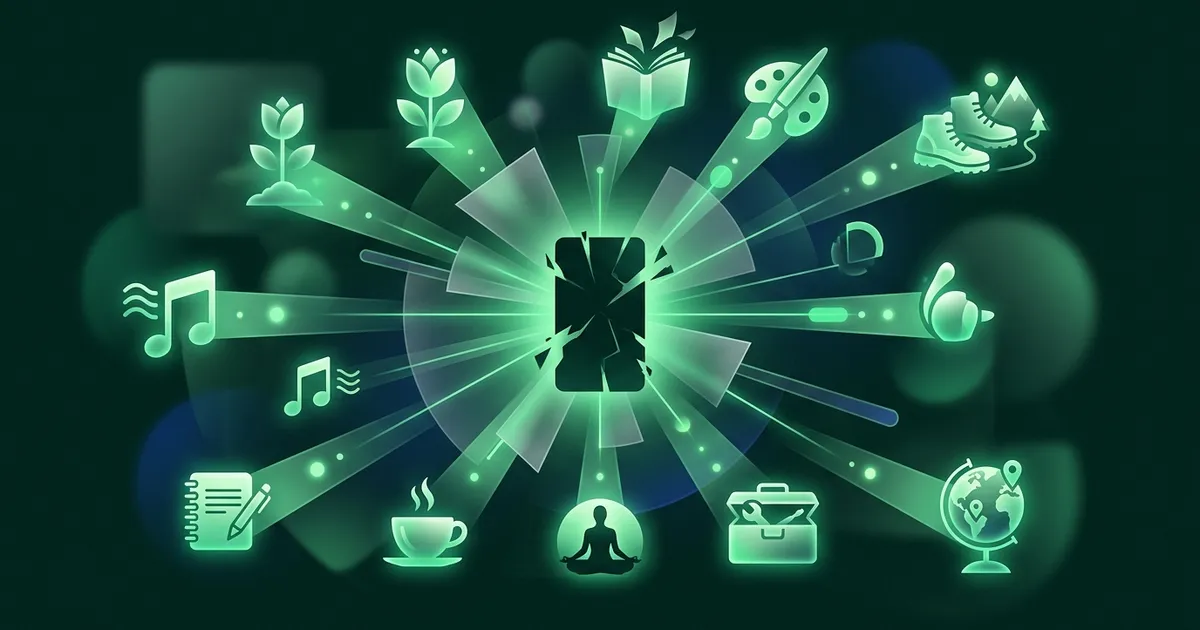
A curiosity home screen argues for a different default. It does not need to look austere. It needs to make the better action obvious.
Put learning, reading, notes, audio, maps, and messaging where the feed apps used to live. Keep the camera easy to reach. Put the browser there only if you use it to search with intent, not as a trapdoor into the same old loops. Move social apps into a folder with a boring name, away from the first screen. Do not delete them as a dramatic gesture unless you need to. Just stop giving them the throne.
Then add prompts. A note widget with three questions can do more than another blocker: What am I curious about? What do I want to remember? What would make this moment complete? These are small interruptions, but they return agency to the front of the interaction.
The home screen should not shame you. It should steer you.
Replace the Scroll, Not the Human Need Behind It
People scroll for reasons that make sense. They are tired. They want novelty. They want relief. They want to feel connected. They want a tiny reward after doing too many responsible things. Any alternative that ignores those needs will fail.
This is where a lot of digital wellness advice becomes unrealistic. It treats every phone urge as a defect. But sometimes the urge is just your brain asking for texture. A little surprise. A little aliveness. A little sense that the world is larger than your inbox.
Intentional curiosity works because it respects that need. It does not say, "Stop wanting stimulation." It says, "Choose better stimulation." Learn why a psychological bias exists. Read one page of an essay. Take a photo of a detail you normally ignore. Ask a friend a real question. Listen to five minutes of a lecture while you walk. Do one lesson on a topic that has been quietly tugging at you.
The emotional difference is obvious. Empty scrolling leaves you oddly less satisfied the longer you do it. Curiosity has a stopping point. You learn the thing, save the note, finish the lesson, send the message, close the loop. There is a small feeling of completion. That feeling matters.
The Better Question
We should keep the best parts of digital minimalism: the skepticism, the cleanup, the refusal to let every platform treat attention as public property. But minimalism is not enough because humans do not live by absence. We need appetite. We need interests. We need better defaults that can survive a Tuesday night when we are tired and the couch is winning.
So instead of asking whether your phone is good or bad, ask what it is training you to do.
Is it training you to wait for whatever comes next, or to follow questions? Is it making boredom intolerable, or making curiosity easier to access? Is it filling ten spare minutes with residue, or with something you might still care about tomorrow?
The phone is not going away. For most of us, it should not. It is too useful, too woven into modern life, too full of genuine possibility. The real choice is whether it remains a feed machine by default or becomes a curiosity machine by design.
At NerdSip, we are obviously biased toward the second option. We think idle phone time can become a place where knowledge compounds. Not because everyone needs to optimize every second of existence, but because your attention deserves better than emptiness dressed as entertainment.
Delete what drains you. Keep what connects you. Then build a phone that helps you wonder on purpose.
Frequently Asked Questions
Is digital minimalism bad advice?
No. Digital minimalism is a useful reset, especially if your phone feels chaotic. The problem is that deletion alone does not create a positive default. After the cleanup, you still need an intentional answer for what your phone is for.
What should I use my phone for instead of scrolling?
Use it for deliberate curiosity: short lessons, thoughtful reading, note capture, language practice, audio learning, planning, and asking specific questions. The difference is not whether the phone is involved; it is whether you chose the interaction on purpose.
How do I make my phone less distracting without quitting it?
Remove empty feeds from the first tap, put curiosity tools on the home screen, create small intentional prompts, and use natural stopping points. You are not trying to become unreachable. You are redesigning the default path your thumb takes.
Every NerdSip course clears a four-layer fact-checking pipeline before it reaches the app: grounded in live sources, scored nightly, gated on failure, and reviewable by a person at one tap. Articles on this blog are drafted with AI assistance, then researched, verified, and edited by our team.
Editorial responsibility: ai51 UG (haftungsbeschränkt). Responsible editor named in the imprint.
📚 Keep Learning
Explore the NerdSip learning hubs
The blog is our editorial layer. When you want to move from reading into doing, these hubs organize the rest of NerdSip by format, including the app itself and the press that has written about it.
Make Your Phone Feed Your Curiosity
NerdSip turns idle phone checks into 5-minute lessons on psychology, science, history, strategy, and whatever else your brain wants to chase next.
Courses on this topic
4.7 stars from 380 reviews · 10,000+ learners