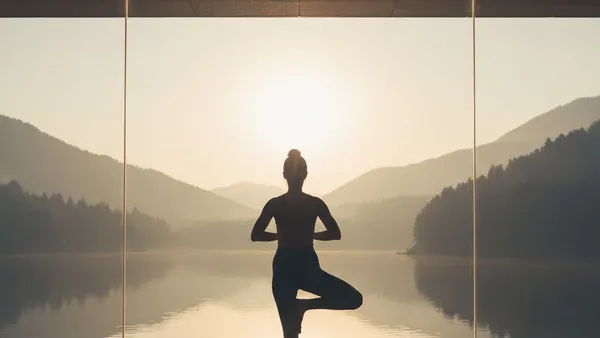
Think you need to be flexible to start yoga?
Prompted by NerdSip Explorer #9528
Build a stress-busting, beginner-friendly yoga habit.
If you have ever thought, 'I cannot do yoga because I am not flexible,' you are entirely normal! However, saying you are too stiff for yoga is like saying you are too dirty to take a shower. Flexibility is a *result* of yoga, not a prerequisite.
The word 'yoga' comes from an ancient Sanskrit word that loosely translates to 'yoke' or 'union.' It is simply the practice of connecting your mind with your body, using your breath as the bridge between the two. It is not about twisting yourself into a human pretzel.
For a busy adult juggling a career, relationships, and life, yoga offers a much-needed pause button. It is a system designed to release the physical tension that builds up from sitting at a desk, while simultaneously clearing mental clutter.
Think of your yoga mat as a personal laboratory. It is a safe space to experiment with how you move and how you breathe. You do not need to be an acrobat; you just need to be willing to show up and pay attention.
Key Takeaway
Yoga is about connecting your mind and body, not about being perfectly flexible.
Test Your Knowledge
What is the best way to think about flexibility when starting yoga?
In yoga, your breath is your steering wheel. The physical poses are great, but the way you breathe while doing them is where the real magic happens. In the yoga world, breathwork is often called Pranayama.
When we get stressed—like when reading an urgent work email—our breathing becomes shallow and lives only in our upper chest. This signals to the brain that we are in danger, triggering a 'fight or flight' response that floods the body with stress hormones.
Deep, slow breathing into your belly does the exact opposite. It presses a biological button that activates your 'rest and digest' nervous system. It tells your brain, 'We are safe, you can relax now.'
During a yoga practice, your main goal is simply to keep your breath smooth and steady. If you find yourself holding your breath in a pose, it is a clear sign that you have pushed too hard and need to ease up. Your breath is your best teacher.
Key Takeaway
Deep, steady breathing tells your nervous system to relax and acts as a guide for your practice.
Test Your Knowledge
What does holding your breath during a yoga pose usually indicate?
Every yoga practice has a built-in reset button, and it is called Child's Pose. If you only learn one posture from this entire course, let it be this one.
To find Child's Pose, you kneel on the floor, bring your big toes to touch, and spread your knees comfortably wide. Then, sit your hips back toward your heels and melt your chest and forehead down to the mat, reaching your arms forward.
This pose gently stretches the hips, thighs, and ankles while relaxing the muscles of the lower back. Because your forehead is resting on the ground, it naturally calms the brain and helps relieve stress and fatigue.
Here is the most important rule of beginner yoga: You can go into Child's Pose at *any* time during a class. If you are tired, if a pose feels too complex, or if you just need a mental break, you simply drop into Child's Pose. It is a sign of wisdom, not weakness.
Key Takeaway
Child's Pose is a resting posture that you can take at any time during a yoga practice to reset.
Test Your Knowledge
When is the appropriate time to take Child's Pose during a yoga class?
At first glance, Mountain Pose (or *Tadasana*) looks like you are just standing around waiting for a bus. But do not be fooled by its simplicity. It is an active, powerful posture that forms the blueprint for almost every other yoga pose.
To do it, stand with your feet hip-width apart. Instead of just slumping, actively press all four corners of your feet into the floor. Feel your leg muscles engage and your kneecaps lift slightly.
Next, roll your shoulders up, back, and down. Let your arms hang by your sides with your palms facing forward. Imagine a string attached to the crown of your head, pulling you gently upward to make you an inch taller.
For anyone who spends eight hours a day hunched over a keyboard, Mountain Pose is the ultimate antidote. It reminds your body what perfect, neutral posture feels like. It teaches you how to be grounded, stable, and completely present in your own skin.
Key Takeaway
Mountain Pose is an active standing posture that resets your alignment and improves daily posture.
Test Your Knowledge
Which of the following best describes the physical action of Mountain Pose?
If your back feels stiff from sleeping weirdly or sitting too long, Cat-Cow is your new best friend. It is a gentle, flowing movement that acts like WD-40 for the hinges of your spine.
You start on your hands and knees, like a tabletop. As you take a deep breath in, you drop your belly toward the floor, lift your chest, and look up. This is the 'Cow' part of the movement, creating a gentle backbend.
As you exhale, you do the exact opposite. You press the floor away, round your spine up toward the ceiling, and tuck your chin to your chest. This is the 'Cat' part, mimicking a Halloween cat stretching its back.
Moving slowly back and forth between these two shapes links your breath with your movement. It massages your spine, stimulates your internal organs, and gently wakes up your core muscles. It is the perfect, low-impact way to start a morning or warm up for a workout.
Key Takeaway
Cat-Cow is a gentle spinal movement that links breath with motion to relieve back stiffness.
Test Your Knowledge
How should your breath match your movement in Cat-Cow?
Downward-Facing Dog is arguably the most famous yoga pose in the world. When done right, it stretches the entire back of your body—from your heels all the way up to your neck.
To picture it, imagine your body forming an upside-down 'V' shape. Your hands are pressing firmly into the mat, your hips are pushed high up into the air, and your legs are reaching back.
Here is the biggest secret for beginners: *You do not have to keep your legs straight!* Bending your knees is actually highly encouraged. Bending the knees takes the pressure off tight hamstrings and allows you to lengthen your spine, which is the true goal of the pose.
At first, Downward Dog might feel like hard work for your arms and shoulders. But as you build strength over time, it actually becomes a resting pose. It is a fantastic way to build upper body strength while stretching out the stiffness in your legs.
Key Takeaway
Downward Dog stretches the whole back of the body, and bending your knees is a great modification for beginners.
Test Your Knowledge
What is the true goal of Downward-Facing Dog?
Balance poses are incredibly revealing. They tell you exactly how distracted or focused your mind is on any given day. Tree Pose is the perfect introduction to standing balance.
To try it, stand on one leg. Take the sole of your other foot and place it against the inside of your standing leg. You can place it low on your ankle like a kickstand, or up on your calf. The only rule: never press your foot directly into the side of your knee joint!
The secret to balancing is not just physical strength; it is visual focus. In yoga, this focal point is called a Drishti. If you stare at a single, unmoving spot on the floor or wall in front of you, balancing becomes significantly easier.
Wobbling is completely normal. In fact, wobbling means your stabilizing muscles are working and getting stronger. If you fall out of the pose, simply smile, take a breath, and build your tree again.
Key Takeaway
Tree Pose builds physical stability and mental focus by using a fixed visual point.
Test Your Knowledge
Where should you avoid placing your foot during Tree Pose?
There is a common misconception that using yoga props—like foam blocks or canvas straps—means you are 'bad' at yoga. In reality, props are tools of empowerment. They bring the floor closer to you and make poses fit your unique body.
Imagine trying to drive a car without adjusting the seat. It would be uncomfortable and unsafe! Using a prop is simply adjusting the yoga pose to fit your current skeleton and muscle tension.
If you cannot reach the floor comfortably in a forward fold, placing your hands on two yoga blocks instantly relieves the strain on your lower back. If you cannot reach your toes in a seated stretch, looping a strap around your feet gives you longer arms.
Even advanced yoga practitioners use props to deepen their stretches or support their joints. Embracing props is a sign of a mature, mindful practice. It proves you are listening to your body instead of letting your ego dictate the pose.
Key Takeaway
Yoga props are valuable tools that adapt poses to fit your body comfortably and safely.
Test Your Knowledge
Why is using a yoga block beneficial in a forward fold?
At the end of every yoga class, you lie completely flat on your back, close your eyes, and do absolutely nothing. This is called Savasana, or Corpse Pose.
Physically, it is the easiest pose in the world. Mentally, it is often the hardest. When your body finally stops moving, your brain usually decides it is the perfect time to remind you about the laundry, your emails, and what you are having for dinner.
Savasana is not nap time; it is integration time. It allows your nervous system to absorb the benefits of the physical work you just did. It teaches you how to relax completely without falling asleep—a rare skill in our hyper-stimulated modern world.
When your mind wanders during Savasana (and it will), your only job is to gently notice it, let the thought go, and bring your attention back to your breath. It is the ultimate practice of letting go.
Key Takeaway
Savasana is the final resting pose where your body integrates the practice and your mind learns to be still.
Test Your Knowledge
Why is Savasana often considered mentally challenging?
The ultimate goal of yoga is not to become really good at standing on one leg in a quiet studio. The goal is to use what you learn on your mat to navigate the chaos of real life.
This concept is called taking your yoga 'off the mat.' When you practice staying calm while your thighs are burning in a difficult pose, you are actually training your brain to stay calm during a tense meeting at work.
When you learn to deepen your breath during a tough stretch, you can use that exact same deep breath to avoid losing your temper when stuck in bumper-to-bumper traffic.
Yoga is a toolkit. The physical poses keep your body healthy and mobile, but the mindfulness and breathwork upgrade your mental operating system. By showing up for yourself in a simple, daily practice, you slowly become a more centered, resilient version of yourself in the real world.
Key Takeaway
The skills of focus and calm breathing learned in yoga apply directly to managing everyday life stress.
Test Your Knowledge
What does it mean to take your yoga 'off the mat'?
Track your progress, earn XP, and compete on leaderboards. Download NerdSip to start learning.