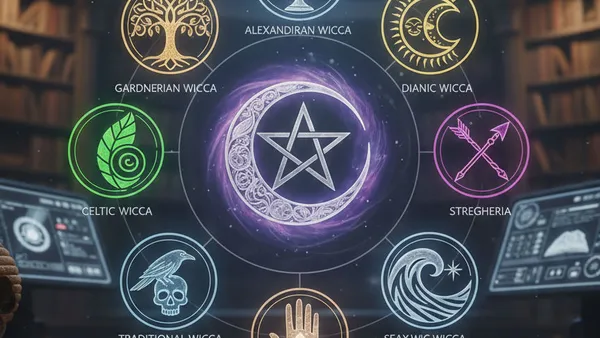
Curious about witchcraft? Discover the many hidden branches of the Wiccan religion!
Prompted by A NerdSip Learner
Find the Wiccan path that perfectly fits you.
Imagine walking into an ice cream parlor. You know you want ice cream, but there are dozens of flavors. Wicca is exactly like that! While Wicca is a single spiritual religion, it is divided into various branches known as traditions.
When modern Wicca began to grow in the mid-20th century, it started with a specific set of rules and rituals. But as human nature goes, people began to explore, adapt, and create new ways to connect with the divine. Today, there is no single 'Wiccan Pope' or ultimate rulebook that every practitioner must follow.
Some traditions are highly structured, requiring years of study and formal initiation by a group (called a coven). Other traditions are incredibly free-flowing, allowing individuals to practice entirely on their own terms.
Whether you are drawn to ancient Celtic myths, modern feminism, or simply want a quiet, personal connection with nature, there is a path for you. In this course, we will explore the most popular flavors of Wicca, helping you understand the beautiful diversity of this earth-based spirituality!
Key Takeaway
Wicca has many different traditions, offering a spiritual path for every type of personality.
Test Your Knowledge
What is the best analogy for understanding Wiccan traditions?
If Wicca were a family tree, Gardnerian Wicca would be the sturdy trunk. Founded in the 1950s by a British civil servant named Gerald Gardner, this is the 'original recipe' of modern Wicca. Gardner is largely credited with bringing witchcraft out of the shadows and into the public eye.
Gardnerian Wicca is highly structured and traditional. You cannot simply declare yourself a Gardnerian; you must be formally trained and initiated by an existing coven (a local group of witches). It is a mystery religion, meaning that many of its rituals, teachings, and specific names of the gods are kept strictly secret from the outside world.
In this tradition, practitioners honor both a Horned God and a Mother Goddess equally. Rituals are formal, deeply symbolic, and often performed outdoors. Some covens even practice 'skyclad' (a poetic term for ritual nudity) to symbolize equality and closeness to nature.
Because of its strict rules and powerful lineage, Gardnerian Wicca offers a deeply rooted, community-focused experience for those who love tradition.
Key Takeaway
Gardnerian Wicca is the oldest structured form of modern Wicca, requiring formal coven initiation.
Test Your Knowledge
How does someone officially join a Gardnerian coven?
Shortly after Gardnerian Wicca took the world by storm, a man named Alex Sanders stepped into the spotlight in the 1960s. He founded Alexandrian Wicca, a vibrant and slightly more theatrical sibling to the Gardnerian path. In fact, the media playfully dubbed Sanders the 'King of the Witches'!
Alexandrian Wicca shares many similarities with its predecessor. It requires formal initiation, operates in covens, and honors both a God and a Goddess. However, it places a much heavier emphasis on ceremonial magic.
Think of ceremonial magic as the high drama of the magical world. It involves complex rituals, specific magical tools, and teachings borrowed from ancient mystical systems. If Gardnerian Wicca is a rustic folk song, Alexandrian Wicca is a grand symphony.
Despite the complexity, Alexandrian covens are often known for being a bit more eclectic and open to new ideas than their stricter Gardnerian cousins. It is the perfect path for those who love deep magical study, rich symbolism, and a touch of theatrical flair.
Key Takeaway
Alexandrian Wicca is a structured path that places a strong emphasis on elaborate ceremonial magic.
Test Your Knowledge
What separates Alexandrian Wicca from simpler, rustic traditions?
During the feminist movements of the 1970s, a powerful new branch of witchcraft emerged: Dianic Wicca. Named after Diana, the fierce Roman goddess of the hunt and the moon, this tradition is all about celebrating the Divine Feminine.
While most traditional Wiccan paths emphasize a balance between a male God and a female Goddess, Dianic Wicca focuses almost exclusively on the Goddess. She is viewed as the ultimate source of life, nature, and the universe.
Many Dianic covens are strictly for women. They provide a safe, empowering space for women to explore their spirituality, heal from societal pressures, and celebrate the natural phases of womanhood. Their rituals often focus on the cycles of the moon and personal empowerment.
It is important to note that Dianic Wicca is not about excluding men out of malice; rather, it is about creating a focused, sisterhood-driven environment. It’s a beautifully empowering path for those seeking to connect deeply with female energy, feminist ideals, and the ultimate Mother Goddess.
Key Takeaway
Dianic Wicca is a female-centered tradition that focuses almost exclusively on honoring the Goddess.
Test Your Knowledge
Which divine figure is the central focus of Dianic Wicca?
Imagine trying to learn a computer program, but the code is locked away. Then, someone invents an 'open-source' version that anyone can use and modify. That is exactly what Raymond Buckland did when he created Seax-Wica in the 1970s!
Buckland originally brought traditional Gardnerian Wicca to the United States. However, he eventually realized that the strict secrecy and required coven initiations were holding people back. He decided to create a completely new, transparent tradition based on ancient Anglo-Saxon folklore.
The most revolutionary thing about Seax-Wica is its openness. There is absolutely no oath of secrecy. The rituals, teachings, and guidelines are openly published in books for anyone to read.
Furthermore, you do not need a coven to initiate you. Seax-Wica allows practitioners to self-dedicate, meaning you can formally start your spiritual journey all by yourself in your living room! It’s an accessible, honest, and flexible path for independent learners.
Key Takeaway
Seax-Wica is an 'open-source' tradition known for its complete lack of secrecy oaths.
Test Your Knowledge
What makes Seax-Wica incredibly unique compared to older, traditional paths?
If you feel a deep, soul-stirring connection to misty green landscapes, ancient standing stones, and whispered folklore, Celtic Wicca might be your spiritual home. This tradition beautifully merges standard Wiccan practices with the rich mythology of Ireland, Scotland, and Wales.
Unlike highly structured traditions, Celtic Wicca is incredibly fluid and deeply rooted in nature. Practitioners—sometimes called solitary green witches or modern Druids—work closely with the elements of earth, air, fire, and water.
A major focus of this path is working with the 'Fae' (fairies and nature spirits) and honoring the ancient Celtic pantheon of gods and goddesses, such as the Morrigan or Brigid. Magic here is practical and earth-based, heavily relying on the energy of trees, herbs, and local wildlife.
Celtic Wiccans often celebrate the changing of the seasons with immense passion, recognizing the earth as a living, breathing entity. It is a deeply romantic, earthy tradition perfect for those who want to feel the magic woven into the natural world.
Key Takeaway
Celtic Wicca beautifully merges core Wiccan practices with ancient Celtic mythology and deep nature lore.
Test Your Knowledge
What elements are you most likely to work with in Celtic Wicca?
While some Wiccan paths feel like a structured Sunday church service, the Feri Tradition (often spelled Faery) feels more like a wild, ecstatic dance under the moonlight. Founded by Victor and Cora Anderson in the mid-20th century, this path is unique, intense, and deeply personal.
The Feri tradition is not for the faint of heart. Instead of focusing heavily on polite, formal ceremonies, it embraces ecstasy and trance. Practitioners seek a direct, passionate, and sometimes overwhelming connection with the divine forces of the universe.
A core component of Feri is 'shadow work.' This means bravely exploring the darker, hidden parts of your own psyche—your fears, your anger, and your flaws—and turning that energy into spiritual power.
Because of its intense focus on personal transformation and mystical experiences, it rarely relies on large covens. Instead, it is passed down through small groups or one-on-one mentorships. It is the ultimate path for the brave spiritual rebel.
Key Takeaway
The Feri tradition is an intense, ecstatic path focusing on trance and deep psychological exploration.
Test Your Knowledge
Which of these best describes the vibe of the Feri tradition?
Can magic change the world? The Reclaiming Tradition says yes—absolutely! Emerging in the late 1970s, spearheaded by prominent voices like Starhawk, this tradition brilliantly blends mystical witchcraft with fierce political activism.
Reclaiming Wicca was born out of the anti-nuclear, feminist, and environmental peace movements. Practitioners of this path believe that your spiritual life cannot be separated from your civic duties. If you love the Earth, you must actively protect it.
Unlike older traditions that have a strict hierarchy of High Priests and Priestesses, the Reclaiming Tradition is entirely egalitarian. Everyone’s voice is equal. Rituals are highly participatory, often involving joyous chanting, dancing, and communal energy building rather than strictly scripted lines.
Whether they are casting a spell for inner peace or marching in a protest for climate justice, Reclaiming witches use their magic as a tool for collective liberation. It is an incredibly inspiring path for those who want their spirituality to make a tangible difference in society.
Key Takeaway
The Reclaiming Tradition combines magical practices with active political, feminist, and environmental activism.
Test Your Knowledge
What is a core philosophy of the Reclaiming Tradition?
What happens when you love the ritual tools of Alexandrian Wicca, the Goddess focus of Dianic Wicca, and the herbal magic of Celtic Wicca? You put them all on a plate and become an Eclectic Wiccan!
Today, Eclectic Wicca is by far the most popular and widespread form of the religion. As the word 'eclectic' suggests, this path involves picking and choosing elements from various traditions, cultures, and spiritual systems to build a completely custom practice.
An Eclectic Wiccan is not bound by the rules of any specific coven. They might meditate using Buddhist techniques in the morning, honor a Norse god in the afternoon, and cast a traditional Wiccan circle at night. It is the ultimate DIY spirituality.
While some critics argue that it lacks deep traditional roots, its supporters celebrate its ultimate freedom. Eclectic Wicca allows your spirituality to evolve naturally as you grow, ensuring that your path is always authentically yours.
Key Takeaway
Eclectic Wiccans customize their religion by blending elements from various different traditions.
Test Your Knowledge
What is the defining characteristic of an Eclectic Wiccan?
Historically, to be a witch meant you had to find a local coven, prove your worth, and be formally initiated. Today, the vast majority of Wiccans are Solitary Practitioners, meaning they walk their spiritual path completely alone.
Solitary practice is not a specific set of rules, but rather a *way* of practicing. Solitaries learn from books, podcasts, online communities, and their own intuition. They celebrate the changing seasons alone in their gardens and cast spells quietly in their bedrooms.
Being a solitary witch requires immense self-discipline, as you are your own high priest or priestess. However, the reward is total freedom. You never have to compromise your beliefs for a group, and you can practice magic exactly when and how you please.
Whether you are solitary by choice or simply because there are no covens nearby, this independent path proves that the only thing you truly need to connect with the divine is an open heart and a willing spirit.
Key Takeaway
Solitary Wiccans practice alone, enjoying complete freedom and flexibility without joining a coven.
Test Your Knowledge
Why might someone choose to be a Solitary Practitioner?
Track your progress, earn XP, and compete on leaderboards. Download NerdSip to start learning.