Ever wonder why smart AI sometimes gives totally clueless answers?
Prompted by A NerdSip Learner
Understand the 3 big flaws in AI memory systems.
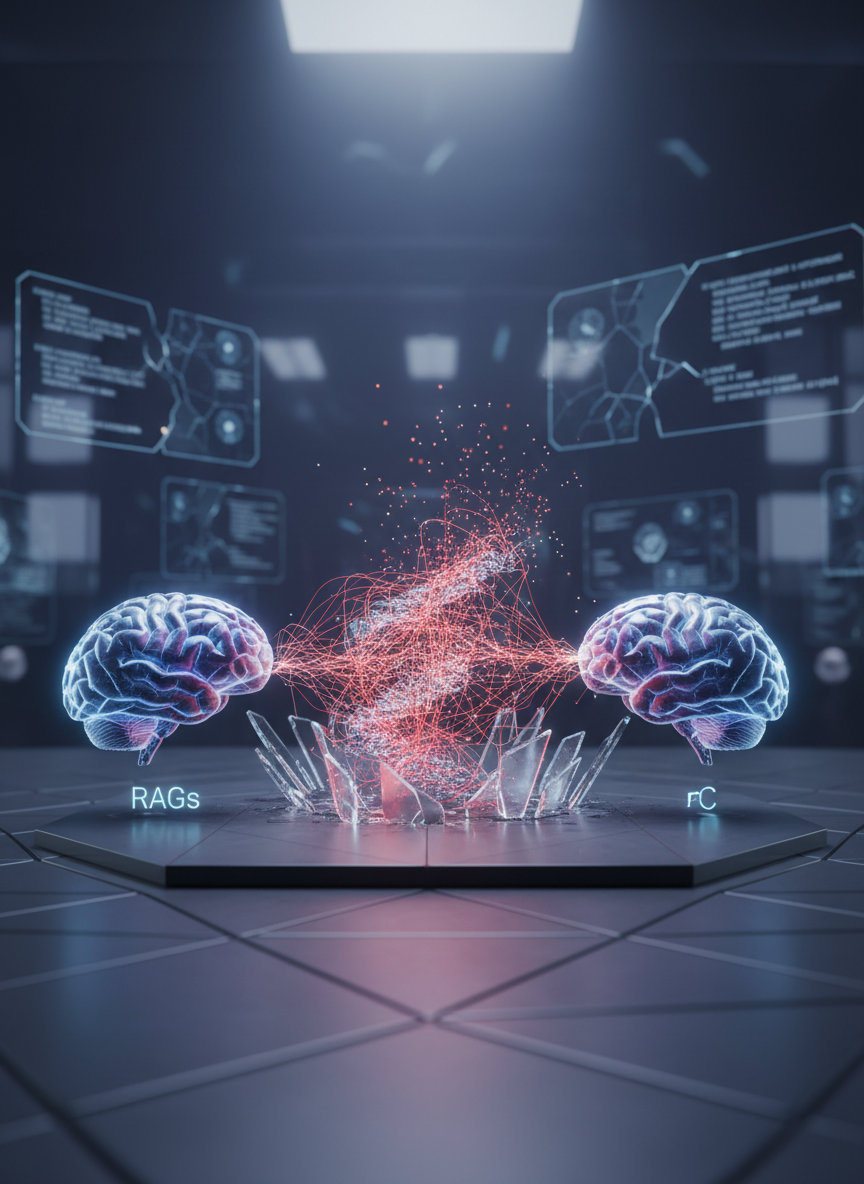
Imagine you have a massive history textbook, but instead of reading it normally, someone rips the pages into random scraps and hands them to you. This is how RAG (Retrieval-Augmented Generation) often works!
To help AI answer questions using your data, we slice that data into small 'chunks' (like paragraphs). But here is the problem: computers often cut the paper in the wrong place.
Imagine a sentence like: *'The key to the treasure is...'* and the chunk ends there. The next chunk starts with *'...under the mat.'* The AI sees these as two separate, unrelated facts. Because the context was snapped in half, the AI loses the meaning. It’s like trying to understand a movie by watching random 10-second clips out of order. This structural failure means the AI might have the right info, but it can't connect the dots!
Key Takeaway
RAG systems chop data into chunks, often breaking the connection between ideas.
Test Your Knowledge
What is a major risk when 'chunking' data for an AI?
So, we have our chunks of text. When you ask a question, the AI goes hunting for the most relevant chunks to build an answer. But sometimes, it brings back junk.
This is called Retrieval Noise. Imagine asking a librarian for a book on 'Apples' (the fruit), but they bring you a stack of books about 'Apple' (the iPhone company), 'The Big Apple' (NYC), and a recipe for apple pie.
If the AI retrieves 5 documents and 3 of them are irrelevant, the AI gets confused. It tries to mash all that info together into one answer. The result? A hallucination! It might tell you that Steve Jobs baked a pie in New York City to invent the iPhone. The more data you feed a RAG system, the harder it is to find the *exact* right piece of info without getting distracted by similar-sounding noise.
Key Takeaway
Retrieving irrelevant documents confuses the AI, leading to weird, mixed-up answers.
Test Your Knowledge
What happens when an AI retrieves 'noisy' or irrelevant data?
How does an AI know that 'King' and 'Queen' are related? It turns words into numbers (vectors). Think of this like plotting points on a map. Words with similar meanings sit close together.
However, there is a limit to how much meaning you can squeeze into a number. This leads to Semantic Collapse. Imagine taking a beautiful, high-definition photo of a forest and shrinking it down to a tiny, blurry thumbnail.
In that blurry version, a pine tree and an oak tree look exactly the same—just green blobs. When we compress complex human ideas into simple vectors, we lose nuance. The AI might treat 'I am unhappy' and 'I am devastated' as basically the same thing because their numbers are too close. When everything starts looking the same to the AI, its answers become generic, boring, or completely miss the emotional point.
Key Takeaway
Turning words into numbers can compress meaning too much, making different ideas look identical to the AI.
Test Your Knowledge
What is the main issue with 'Semantic Collapse'?
Track your progress, earn XP, and compete on leaderboards. Download NerdSip to start learning.