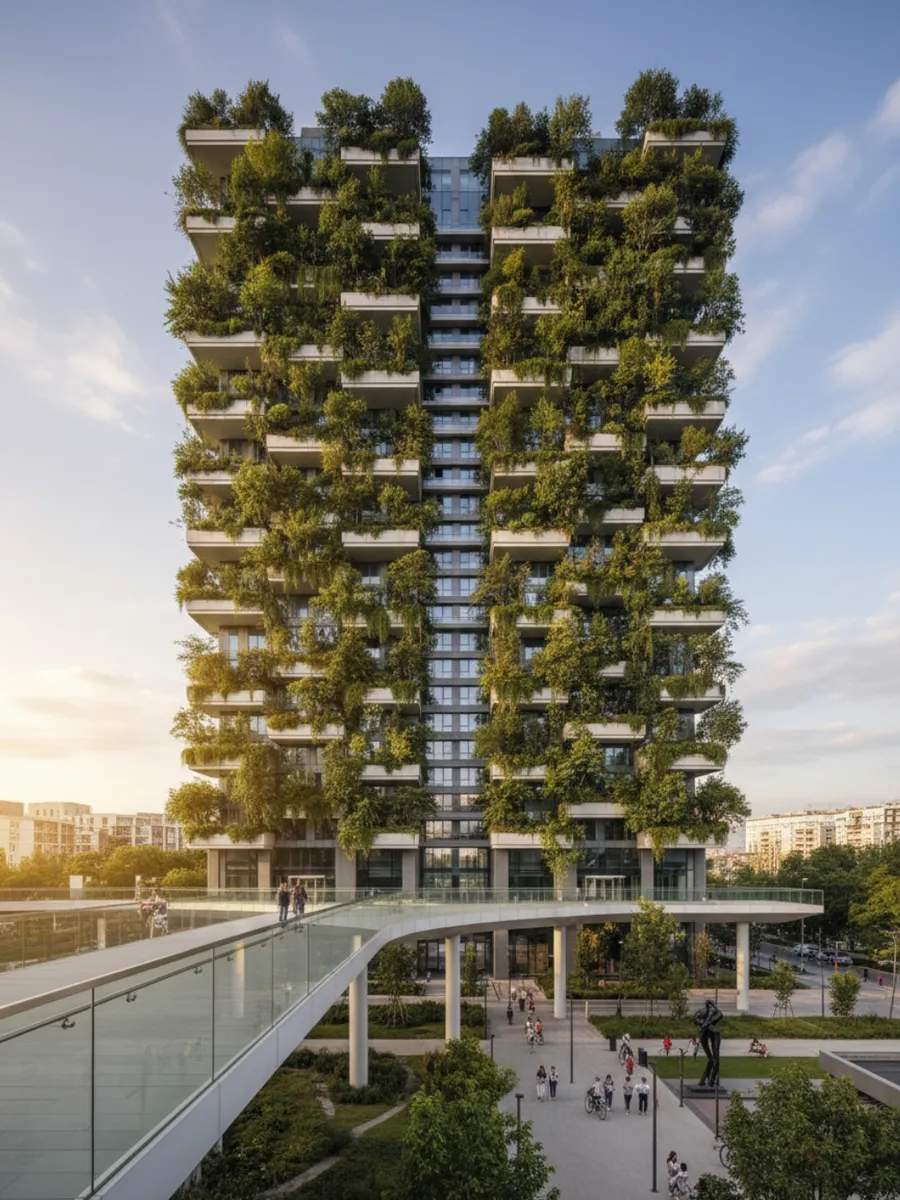
Did you know some buildings produce more oxygen than a small park?
Prompted by A NerdSip Learner
How modern skyscrapers are integrating living forests into facades.
For decades, the urban skyline was dominated by what architects call 'mineral' facades—glass, steel, and concrete. However, a revolutionary shift began in 2014 with the completion of Bosco Verticale (Vertical Forest) in Milan. Designed by Stefano Boeri Architetti, these two residential towers transformed the skyscraper from a sterile structure into a 'home for trees that also houses humans and birds.'
This concept isn't just about placing potted plants on balconies. It is a fundamental rethinking of urban density. By integrating thousands of plants directly into the building's skin, architects are creating a vertical ecosystem. This approach aims to reduce urban sprawl by concentrating the equivalent of several hectares of forest onto a much smaller urban footprint.
At its core, Vertical Forest architecture challenges the traditional separation between nature and the city. Instead of building next to a park, the building *becomes* the park. This marks the beginning of a new era where architecture is measured not just by its height, but by its biological contribution to the city.
Key Takeaway
Vertical Forest architecture replaces traditional 'mineral' facades with living ecosystems, integrating nature directly into high-rise urban structures.
Test Your Knowledge
What is the primary architectural shift represented by the Vertical Forest concept?
One of the most remarkable claims of vertical forests is their ability to improve air quality. A single project like the Nanjing Vertical Forest is estimated to produce roughly 60 kg of oxygen every day while absorbing approximately 25 tons of carbon dioxide annually. By acting as a giant air filter, the vegetation traps fine dust particles (PM10) from urban traffic, significantly cleaning the air for residents and neighbors alike.
Beyond air quality, these buildings act as thermal regulators. The thick layer of vegetation creates a natural microclimate. In the summer, the leaves provide shade and release moisture through transpiration, which can reduce the building's surface temperature by as much as 30°C compared to traditional glass walls. This leads to a measurable drop in indoor temperatures, often reducing the need for energy-heavy air conditioning.
Furthermore, the multi-layered greenery acts as an acoustic buffer. The leaves and soil absorb and scatter city noise, creating a tranquil environment inside. This biological 'shield' protects inhabitants from the chaotic sounds of the modern metropolis, proving that living architecture is as much about human wellness as it is about environmental health.
Key Takeaway
Vertical forests act as biological filters and thermal regulators, producing oxygen, capturing dust, and naturally cooling the building.
Test Your Knowledge
How does the vegetation on a vertical forest affect the building's temperature in summer?
Building a forest in the sky presents massive engineering challenges. The most immediate concern is weight. A single large tree, along with its water-saturated soil, can weigh several tons. To handle this, architects use reinforced concrete balconies, often over 25 cm thick, designed to support these 'living loads' across cantilevered spans of up to 3.35 meters.
Wind is the second major hurdle. At heights of 100 meters or more, wind speeds can be intense. Engineers must conduct extensive wind tunnel testing to ensure that trees won't be uprooted during storms. In projects like Bosco Verticale, the largest trees are often secured with hidden safety steel cages that restrain the root ball, ensuring the tree remains stable even in gale-force winds.
Finally, the 'skin' of the building must be perfectly waterproofed and root-resistant. If a single root penetrates the structural concrete, it could cause long-term damage. Special multi-layered membranes and drainage systems are installed within the planters to manage water flow and keep the building’s core safe and dry.
Key Takeaway
Vertical forests require specialized structural engineering to manage the extreme weight of soil and trees, as well as wind-resistant safety systems.
Test Your Knowledge
What is a common method used to prevent large trees from being uprooted by high winds at high altitudes?
You can't just plant any tree on a skyscraper. The selection process, often led by specialized agronomists like Laura Gatti, is a precise science. Each facade of a vertical forest is treated as a different micro-ecosystem. Plants on the southern side must be sun-tolerant and drought-resistant, while those on the northern side must thrive in shade and resist stronger winds.
Architects typically prioritize native species. Local plants are better adapted to the regional climate and support local biodiversity by attracting native birds and insects. In Milan’s Bosco Verticale, for example, over 1,600 specimens of birds and butterflies were recorded living in the towers within the first few years of completion.
Before they ever reach the building, these plants are often 'pre-cultivated' in a nursery for several years. They are grown in conditions that mimic the wind and light they will face on the balcony. This 'training' ensures that the trees are hardy enough to survive the transition from the ground to a high-altitude planter.
Key Takeaway
Plant selection is based on the specific orientation and microclimate of each balcony, with a preference for native species that support local biodiversity.
Test Your Knowledge
Why are plants often 'pre-cultivated' in nurseries before being moved to a vertical forest?
Watering a forest that stands 100 meters tall requires more than just a hose. Most vertical forests use highly sophisticated, centralized irrigation systems. To remain sustainable, these systems often recycle the building's greywater—filtered water from sinks and showers—to nourish the plants. This reduces the demand on the city's freshwater supply.
Maintenance is perhaps the most unique aspect of these buildings. Residents are generally not responsible for the trees on their balconies. Instead, specialized teams of 'flying gardeners'—arborists who are also trained climbers—descend from the roof on ropes to prune, check for pests, and monitor plant health several times a year.
Digital sensors are also increasingly used to monitor the soil's moisture and nutrient levels in real-time. If a specific planter is becoming too dry, the centralized system can automatically adjust the water flow. This fusion of 'low-tech' nature and 'high-tech' monitoring is what keeps the vertical forest thriving year after year.
Key Takeaway
Vertical forests use centralized, automated irrigation (often using recycled water) and specialized 'flying gardeners' for professional maintenance.
Test Your Knowledge
Who is typically responsible for pruning and maintaining the trees in a vertical forest development?
The success of the Milan prototype has sparked a global movement. In China, the Nanjing Vertical Forest and the Easyhome Huanggang Vertical Forest have adapted the model to much denser, more polluted environments. These projects are larger in scale, featuring thousands of trees across multiple towers, and are intended to serve as 'green lungs' for rapidly growing urban centers.
The design is also being adapted for different climates. While the Milan towers feature deciduous trees that lose leaves in winter to allow sun into the apartments, projects in tropical regions like Singapore use evergreen species to provide year-round shade. This flexibility shows that the 'Vertical Forest' is not a one-size-fits-all design, but a modular philosophy.
Beyond luxury residential towers, the concept is moving into offices and hotels. The goal is to create entire 'Forest Cities,' where the distinction between a building and a park completely disappears. By scaling up, architects hope to significantly mitigate the 'Urban Heat Island' effect that plagues major world cities.
Key Takeaway
The Vertical Forest model is being adapted worldwide to different climates and building types, aiming for large-scale urban reforestation.
Test Your Knowledge
How do vertical forest designs typically differ between Mediterranean and tropical climates?
Despite their beauty, vertical forests face criticism. The primary challenge is cost. These buildings are significantly more expensive to construct and maintain than standard towers, leading many to label them as 'luxury green' for the wealthy. To be truly sustainable, the industry must find ways to bring these costs down for social housing and public infrastructure.
There are also ecological risks. In Chengdu, China, a vertical forest project called Qiyi City Forest Garden became famous after it was largely abandoned by residents. The thick, unmanaged vegetation led to a massive infestation of mosquitoes, rendering the balconies unusable. This serves as a stark reminder that without rigorous, professional maintenance, the dream of a vertical forest can become a nightmare.
Looking forward, the future of this architecture lies in smarter materials—such as lightweight soil substitutes—and better integration with renewable energy. If we can solve the issues of cost and maintenance, vertical forests could transform our concrete jungles into truly breathable, living cities.
Key Takeaway
While promising, vertical forests must overcome high costs and maintenance challenges to become a viable solution for all socio-economic levels.
Test Your Knowledge
What happened to the Qiyi City Forest Garden project in Chengdu?
Track your progress, earn XP, and compete on leaderboards. Download NerdSip to start learning.