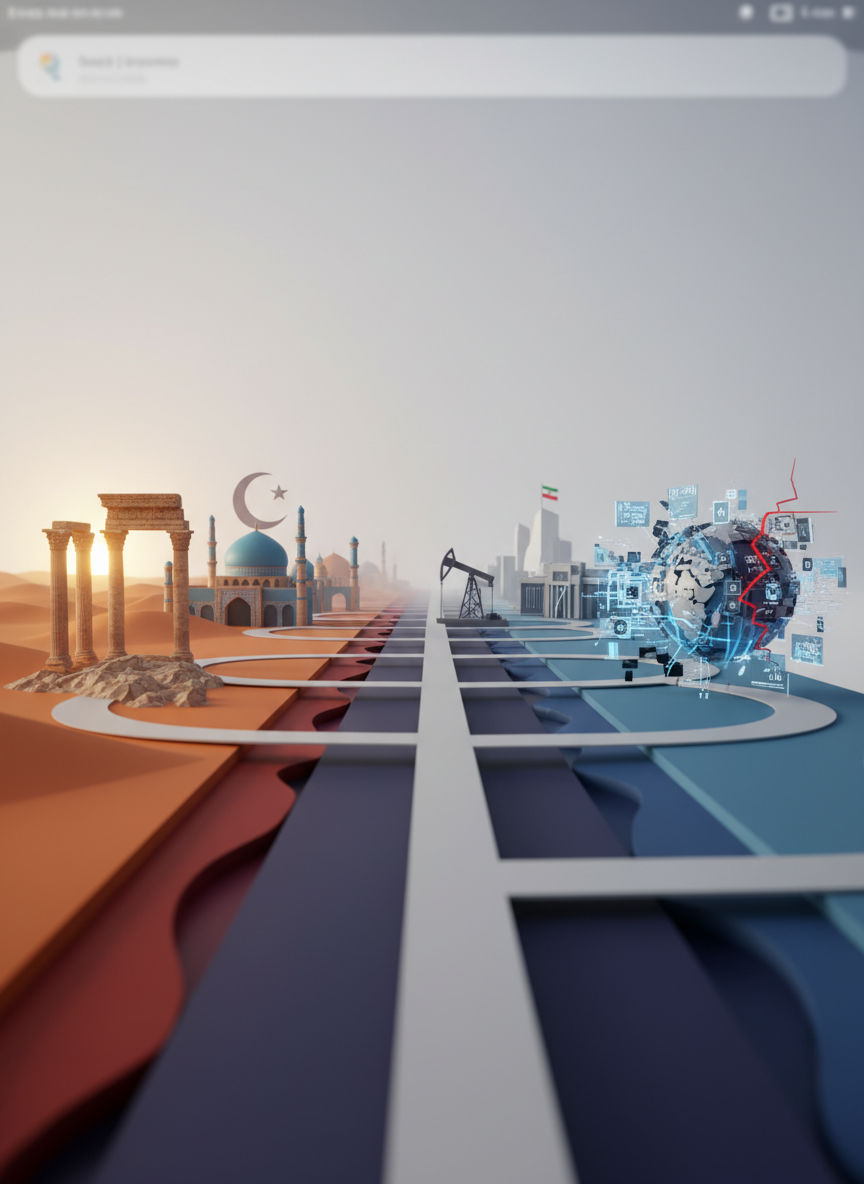
How did an ancient empire become America's ultimate adversary?
Prompted by A NerdSip Learner
Trace 2,500 years of Iranian history up to today.
The geopolitical DNA of modern Iran is inextricably linked to its roots as the Achaemenid Empire (c. 550–330 BCE). Founded by Cyrus the Great, this was the world’s first superpower, pioneering a model of centralized administration over vast, multi-ethnic territories through the satrapy system—a structure that balanced local autonomy with absolute imperial allegiance.
Unlike many modern Middle Eastern nation-states whose borders were arbitrarily drawn by colonial powers, Iran possesses a deep, continuous civilizational identity. Even after the Arab-Islamic conquest of the 7th century, Persian culture, language, and administrative expertise largely assimilated their conquerors, creating a distinct Persianate Islamic civilization.
Understanding this imperial legacy is crucial for analyzing contemporary Iranian foreign policy. The modern state’s projection of power across the Levant and Mesopotamia often mirrors the historical strategic depth sought by ancient Persian dynasties, viewing regional hegemony not just as a religious imperative, but as a historical baseline of national security.
Key Takeaway
Iran's modern geopolitical ambitions are deeply rooted in its continuous, 2,500-year-old civilizational identity as a regional superpower.
Test Your Knowledge
Which administrative structure allowed the Achaemenid Empire to effectively govern its vast multi-ethnic territories?
The 16th-century rise of the Safavid Dynasty fundamentally altered Iran's geopolitical trajectory by establishing Twelver Shi'ism as the official state religion. This was not merely an act of piety; it was a calculated political maneuver by Shah Ismail I to differentiate his realm from the expanding Sunni Ottoman Empire to the west and the Uzbeks to the east.
This sectarian differentiation created a persistent, localized identity that insulated Iran from total absorption into the broader Sunni Islamic world. The Safavids institutionalized the power of the Shiite *ulama* (clergy), granting them immense social and economic leverage through the control of religious endowments (*waqf*) and tax collection.
The legacy of the Safavid synthesis is profoundly visible today. The intertwining of Persian nationalism with Shiite theology laid the structural groundwork for the modern concept of *velayat-e faqih* (Guardianship of the Islamic Jurist), merging theological authority with absolute state power in a uniquely Iranian context.
Key Takeaway
The Safavid Dynasty's adoption of Twelver Shi'ism deliberately separated Iran from its Sunni neighbors, permanently intertwining religious authority with national identity.
Test Your Knowledge
What was a major geopolitical motivation for the Safavid Dynasty's establishment of Twelver Shi'ism as the state religion?
During the 19th and early 20th centuries, Iran (then known as Persia) under the Qajar Dynasty found itself trapped in the "Great Game"—a prolonged geopolitical cold war between the British Empire and Tsarist Russia. Instead of outright colonization, these imperial powers reduced Iran to a weak, heavily exploited buffer state.
Lacking a modern military apparatus or a robust domestic economy, the Qajar monarchs funded their lavish lifestyles by selling sweeping economic monopolies—known as concessions—to foreign powers. The most notorious of these was the 1901 D'Arcy Concession, which granted British actors exclusive rights to prospect for, extract, and sell Iranian oil, laying the foundation for the Anglo-Persian Oil Company.
This era of humiliating foreign exploitation birthed a fierce, enduring anti-imperialist sentiment within the Iranian populace. The systemic extraction of national wealth by foreign actors became the psychological catalyst for the 1906 Constitutional Revolution and remains a core grievance in Iranian political discourse today.
Key Takeaway
19th-century foreign exploitation through economic concessions birthed a deep, enduring anti-imperialist sentiment in the Iranian political consciousness.
Test Your Knowledge
How did the Qajar Dynasty primarily generate revenue during the 19th-century "Great Game"?
Following a 1921 British-backed coup, military officer Reza Khan established the Pahlavi Dynasty, initiating a ruthless program of rapid modernization, secularization, and centralized state-building. His son, Mohammad Reza Shah, aggressively accelerated this process post-World War II, heavily funded by surging global oil revenues.
Under the Shah, Iran morphed into a classic rentier state—a government that derives all or a substantial portion of its national revenues from the rent of indigenous resources to external clients. Because the monarchy relied on petrodollars rather than domestic taxation, the regime became structurally unaccountable to the Iranian populace, stifling organic democratic institutions.
While the Shah's "White Revolution" of the 1960s brought land reform and women's enfranchisement, it also aggressively displaced rural populations and marginalized the traditional clerical establishment. This forceful, top-down Westernization alienated the masses, creating a volatile socioeconomic powder keg beneath a glittering veneer of modern prosperity.
Key Takeaway
The Pahlavi dynasty built a wealthy but fragile rentier state, using oil revenues to fund rapid modernization while severing the government's accountability to its citizens.
Test Your Knowledge
In political science, what defines a "rentier state" as seen during the Pahlavi Dynasty?
The year 1953 represents the original sin in modern US-Iran relations. Iran's democratically elected Prime Minister, Mohammad Mosaddegh, led a wildly popular movement to nationalize the British-controlled Iranian oil industry, seeking to reclaim economic sovereignty and redirect revenues toward domestic development.
In response, the British MI6 and the American CIA orchestrated Operation Ajax, a covert coup d'état that violently ousted Mosaddegh and consolidated absolute autocratic power in the hands of Mohammad Reza Shah. The intelligence agencies bribed politicians, hired street thugs, and manipulated the military to execute the regime change.
For Washington, it was a pragmatic Cold War maneuver to prevent a perceived slide toward Soviet influence and secure global energy markets. For Iranians, it was the catastrophic destruction of their democratic aspirations. This direct American intervention cemented a paradigm of deep paranoia and anti-Americanism that would fatally undermine the Shah's legitimacy decades later.
Key Takeaway
The 1953 CIA-backed coup against Prime Minister Mosaddegh destroyed Iran's democratic trajectory and cemented enduring anti-American resentment.
Test Your Knowledge
What was the primary objective of the CIA-backed Operation Ajax in 1953?
By 1978, the Shah's brutal internal security apparatus (SAVAK) and rampant corruption had united a bizarre, fragile coalition of Marxist revolutionaries, liberal democrats, and conservative clerics in opposition. This mass mobilization culminated in the 1979 Islamic Revolution, a geopolitical earthquake that entirely overthrew the Pahlavi monarchy.
Ayatollah Ruhollah Khomeini brilliantly outmaneuvered his secular and leftist allies, establishing a theocratic republic based on his novel theological doctrine of Velayat-e Faqih (Guardianship of the Islamic Jurist). This doctrine radically reinterpreted traditional Shiite quietism, arguing that a leading Islamic cleric must hold absolute political authority over the state.
The revolution fundamentally realigned the geopolitical map of the Middle East. By capturing the US Embassy and holding 52 Americans hostage for 444 days, the new regime explicitly positioned itself as the vanguard of anti-Western resistance. The US-Iran relationship instantly transformed from a strategic proxy alliance into a hostile, zero-sum ideological war.
Key Takeaway
The 1979 Revolution united disparate factions to overthrow the Shah, but Ayatollah Khomeini monopolized power to forge a theocracy fundamentally hostile to the West.
Test Your Knowledge
What is the core tenet of Ayatollah Khomeini's doctrine of Velayat-e Faqih?
In 1980, perceiving post-revolutionary chaos in Tehran, Saddam Hussein’s Iraq launched a surprise invasion of Iran, sparking the devastating Iran-Iraq War (1980–1988). This brutal, entrenched conflict became the defining crucible for the newly formed Islamic Republic, resulting in hundreds of thousands of casualties, trench warfare, and the horrific use of chemical weapons by Iraq.
Instead of collapsing under the pressure, the Iranian regime utilized the existential external threat to consolidate absolute domestic control. It heavily militarized society, ruthlessly purged political dissidents, and forged a powerful national narrative of sacred defense and holy martyrdom that continues to permeate Iranian state propaganda today.
Crucially, the conflict birthed the Islamic Revolutionary Guard Corps (IRGC) as a dominant military, political, and economic force. Recognizing their conventional military inferiority, the IRGC began cultivating asymmetric proxy militias in Lebanon and Iraq—a strategic adaptation that would eventually become the foundation of Iran’s modern extraterritorial power projection.
Key Takeaway
The devastating Iran-Iraq War allowed the theocratic regime to consolidate internal power and birthed the IRGC's reliance on asymmetric warfare.
Test Your Knowledge
How did the Iran-Iraq War fundamentally shape the Islamic Republic's long-term military strategy?
In the early 2000s, alarming revelations regarding Iran's clandestine nuclear enrichment facilities triggered a massive international security crisis. Western powers feared the imminent weaponization of the nuclear fuel cycle, while Iran insisted its program was entirely peaceful and a sovereign technological right.
This standoff led to the imposition of crushing, multilateral economic sanctions, paralyzing the Iranian economy, restricting oil exports, and plunging the rial into a hyper-inflationary spiral. The 2015 Joint Comprehensive Plan of Action (JCPOA) offered temporary relief in exchange for verifiable, strict curbs on the nuclear program, but the unilateral US withdrawal in 2018 collapsed the diplomatic architecture.
The subsequent "maximum pressure" campaign fundamentally devastated Iran's middle class but failed to induce regime capitulation. The government, caught in a cycle of economic attrition, shifted toward a "resistance economy" and dangerously accelerated its uranium enrichment, utilizing its status as a nuclear threshold state as its ultimate geopolitical leverage.
Key Takeaway
The collapse of the 2015 nuclear deal and subsequent sanctions devastated Iran's economy, driving the regime to use its nuclear threshold as geopolitical leverage.
Test Your Knowledge
How did the Iranian regime adapt its strategy in response to the crippling "maximum pressure" sanctions following the collapse of the JCPOA?
To counter American hegemony and Israeli military superiority without engaging in direct, conventional warfare, Iran constructed the Axis of Resistance. Masterminded largely by the late IRGC Quds Force commander Qasem Soleimani, this is a vast, highly sophisticated network of heavily armed non-state actors across the Levant and the Arabian Peninsula.
By funding, arming, and directing groups like Hezbollah in Lebanon, the Houthis in Yemen, and various Shia militias in Iraq and Syria, Iran achieved plausible deniability while projecting power hundreds of miles from its borders. This "forward defense" strategy forces adversaries to fight Iran's proxies rather than engaging the Iranian homeland directly.
The 2023–2024 Gaza War hyper-activated this entire network, drawing US and Israeli forces into prolonged, multi-front skirmishes. The Axis successfully disrupted global maritime shipping and established a permanent threshold of violence, escalating regional tensions to a near-breaking point and perfectly setting the stage for future direct kinetic conflict.
Key Takeaway
Iran projects power and deters adversaries through the "Axis of Resistance," a vast network of asymmetric proxy militias across the Middle East.
Test Your Knowledge
What is the primary strategic utility of Iran's "Axis of Resistance" in the Middle East?
The culmination of decades of internal repression, economic isolation, and aggressive foreign policy erupted in late 2025. Driven by a catastrophic collapse of the rial and profound domestic misery, massive nationwide anti-government protests engulfed over 100 Iranian cities. The public openly demanded the dismantling of the theocracy.
Amidst this extreme domestic vulnerability, the geopolitical tightrope finally snapped. Following a brief conflict known as the "12-Day War" in mid-2025, diplomatic channels totally collapsed. By early 2026, the US and Israel concluded that the regime's rapid escalation of proxy attacks and its narrowing nuclear breakout window posed an unacceptable, existential threat to regional stability.
This dynamic resulted in the launch of massive, coordinated military campaigns—codenamed Operation Roaring Lion and Operation Epic Fury—on February 28, 2026. The strikes targeted critical leadership and military infrastructure, immediately triggering regional retaliation, the closure of the Strait of Hormuz, and plunging the globe into a severe conflict.
Key Takeaway
A combination of massive domestic uprising in 2025 and an escalating proxy war triggered direct, devastating military strikes by the US and Israel in early 2026.
Test Your Knowledge
What dual crises served as the immediate catalyst for the outbreak of the 2026 US-Iran war?
Track your progress, earn XP, and compete on leaderboards. Download NerdSip to start learning.