What secrets are hiding inside the ancient Viking alphabet?
Prompted by NerdSip Explorer #7768
Decode the history and mystery of ancient runes.
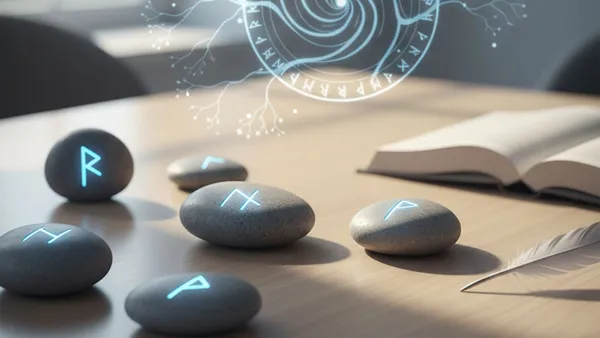
When you hear the word runes, you might picture wizards, magical spells, or Viking warriors. But at their core, runes were simply an everyday alphabet.
Long before the letters you are reading right now became the standard, ancient Germanic and Nordic tribes needed a way to communicate. They developed the runic alphabet to write messages, mark graves, and label their belongings.
You might know our modern writing system as the "alphabet"—a word combining the first two Greek letters, Alpha and Beta. The runic system works the exact same way!
The most famous runic alphabet is called the Elder Futhark. Historians call it this because its first six letters make the sounds F, U, Th, A, R, and K. So, saying "Futhark" is basically just saying "the ABCs" in an ancient tongue.
Key Takeaway
Runes were an ancient alphabet used by Northern European tribes, with the "Futhark" named after its first six letters.
Test Your Knowledge
Why is the oldest runic alphabet called the "Elder Futhark"?
If you look closely at ancient runic symbols, you will notice something distinct: they are almost entirely made of straight, angular lines. You won't find the smooth curves of an 'O' or an 'S' here.
There is a very practical reason for this sharp, spiky design. Ancient people didn't have paper and ink. Instead, they wrote on the materials they had around them, primarily wood, bone, and stone.
Imagine trying to carve a perfectly round circle into a piece of wood using a crude knife. If you carve curved lines across the natural grain of the wood, it will easily splinter and break.
By sticking to straight vertical and diagonal cuts, the writers ensured their messages stayed clear and the wood stayed intact. The environment literally shaped the way the language looked!
Key Takeaway
Runes feature sharp, straight lines because they were designed to be carved into hard, natural materials without splintering them.
Test Your Knowledge
What is the main reason runic letters do not have smooth curves?
While runes functioned as a normal alphabet, they have always carried a mystical reputation. In fact, language experts believe the root word for "rune" originally meant "secret" or "whisper."
In ancient times, the very act of reading and writing was incredibly rare. To someone who couldn't read, watching a person carve scratches into a stone to silently communicate a message probably looked a lot like magic.
Over time, individual runes took on deeper symbolic meanings. For example, the first rune, *Fehu*, didn't just make the "F" sound; it also represented wealth and cattle.
Today, the mystical side of runes has experienced a massive revival. While they are no longer used for writing daily letters, many modern people use runic symbols for personal reflection, art, and inspiration—keeping the ancient whispers alive.
Key Takeaway
The word "rune" is widely thought to mean "secret," reflecting the awe and mystery that surrounded early writing.
Test Your Knowledge
What is the root meaning of the word "rune" widely believed to be?
Track your progress, earn XP, and compete on leaderboards. Download NerdSip to start learning.