Why was killing a bee in medieval Lithuania treated like murder?
Prompted by A NerdSip Learner
Unlock the secrets of ancient tree beekeeping.
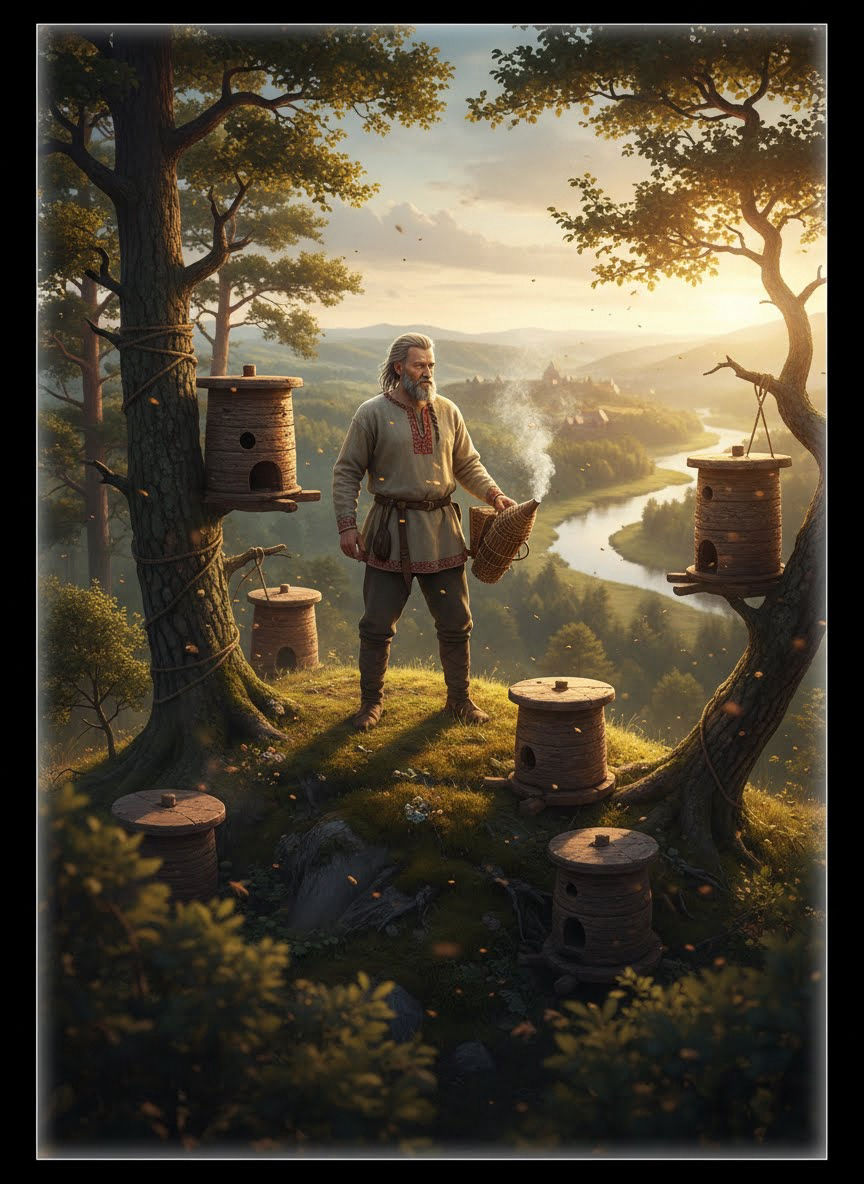
Forget the cute white boxes you see in fields today. In 1300s Lithuania, beekeeping was an extreme sport! This practice was called hollow-tree beekeeping (or *drevinė bitininkystė*). Instead of bringing bees to the farm, beekeepers went deep into the primeval forests.
They didn't build hives; they sculpted them. A beekeeper would locate a massive pine or oak tree and carve a hollow cavity high up in the trunk—sometimes 10 to 15 meters in the air!
This wasn't just farming; it was an alliance with the forest. The tree remained alive, the bees stayed high above predators (mostly), and the forest floor remained wild. It was a sustainable system that required immense skill, bravery, and a lack of fear of heights.
Key Takeaway
Medieval Lithuanians kept bees in hollowed-out cavities of living trees, not in ground-level boxes.
Test Your Knowledge
Where were the bee colonies located in 1300s Lithuania?
Why go to all the trouble of climbing giant trees? Because in the 14th century, honey and wax were arguably more valuable than cash.
Sugar didn't exist in Europe yet. If you wanted something sweet, you needed honey. But more importantly, if you wanted light, you needed beeswax. The Grand Duchy of Lithuania became a European superpower of wax export.
Tons of Lithuanian beeswax were shipped down river routes to Western Europe to make candles for massive cathedrals and castles. The demand was insatiable. In fact, wax was often used *as* currency. You could pay your taxes, fines, or buy land just by using processed beeswax!
Key Takeaway
Honey was the only sweetener, and beeswax was a critical export used as currency and for lighting.
Test Your Knowledge
Besides honey, what was the most valuable product derived from these bees?
Imagine staring up at a 15-meter pine tree. How do you get up there without a ladder? You use a geinys.
The *geinys* was a brilliant, braided rope system made from elk leather or linden bark. It looped around the tree trunk and the beekeeper's waist. By leaning back and shimmying up, a beekeeper could scale massive trees in minutes.
Once up there, they had to balance on a small wooden plank, calm the bees with smoke, and harvest the honey—all while hanging in mid-air! To mark their territory, beekeepers carved a family symbol, called a signet, into the bark. This wasn't graffiti; it was a legal claim of ownership that was respected by everyone in the forest.
Key Takeaway
Beekeepers used a specialized rope system called a 'geinys' to climb and carved signets to claim trees.
Test Your Knowledge
What was the 'geinys' used for?
We tend to think of the Middle Ages as lawless, but when it came to bees, the Lithuanians were incredibly strict. The Lithuanian Statutes (laws developed from these ancient customs) had harsh penalties for bee crimes.
Because bees were so economically vital, stealing honey or destroying a bee tree was a capital offense. If you were caught destroying a hollow with bees in it, the punishment could be death.
Even walking near someone else's bee tree with a climbing rope was considered 'intent to steal' and was punishable by a heavy fine. These laws protected the beekeepers' livelihood and ensured the forest ecosystem remained intact. You simply did not mess with another man's bees.
Key Takeaway
Bee laws were severe, with penalties ranging from heavy fines to death for destroying a hive.
Test Your Knowledge
What could happen if you were caught destroying a bee tree?
Here is the coolest part: In Lithuanian culture, bees were considered spiritually equal to humans.
In the Lithuanian language, there are different words for 'dying.' People *miršta*, while animals *dvesia*. But bees? They *miršta*—the same word used for people. They are the only creature to share this honor.
This respect created a unique social bond. If you helped someone with their bees, you became a bičiulis. This word literally means 'bee-friend,' but today it is the common Lithuanian word for 'good friend' or 'buddy.' The relationship started with sharing the work of the hive and the sweet reward of honey, proving that friendship in Lithuania is literally built on bees!
Key Takeaway
Bees are linguistically treated as humans in Lithuania, and the word for 'friend' comes from beekeeping.
Test Your Knowledge
What is unique about the Lithuanian word for 'friend' (bičiulis)?
Track your progress, earn XP, and compete on leaderboards. Download NerdSip to start learning.