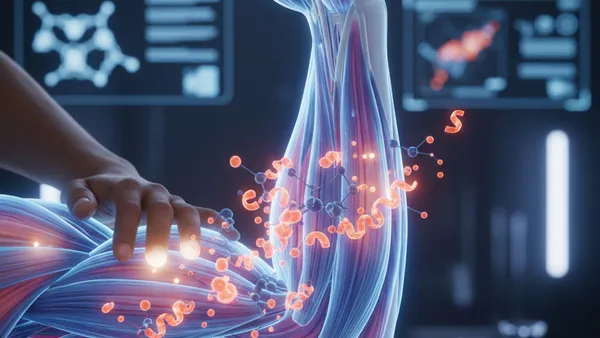
Ever wonder how lifting heavy things actually forces your muscles to grow?
Prompted by A NerdSip Learner
Master the biological rules of muscle building.
Welcome to the amazing world of muscle building! Whether you want to lift heavier groceries with ease or sculpt your ideal physique, the entire process relies on a biological phenomenon called hypertrophy.
Hypertrophy is simply the scientific term for the increase in the physical size of your muscle cells. When you train, you aren't actually growing *new* muscle cells to replace the old ones. Instead, your existing muscle fibers are expanding, getting significantly thicker and stronger over time.
To make this happen, your body needs a very specific set of signals. Your body is a highly efficient machine—it won't build expensive, energy-hungry muscle tissue unless it absolutely has to for its own survival. You have to give it a compelling reason to adapt.
Over the next few lessons, we'll decode exactly how to flip the switch on muscle growth. We will explore the mechanical triggers, the foundational nutrition required, and the hidden magic of recovery!
Key Takeaway
Muscle growth, or hypertrophy, is your body's way of thickening existing muscle fibers to adapt to new physical demands.
Test Your Knowledge
What happens to your muscle cells during hypertrophy?
If you want to build muscle efficiently, you need to understand the ultimate growth trigger: mechanical tension. This is the physical force generated when your muscles contract against heavy resistance.
Imagine pulling on a thick, heavy-duty rubber band. The tighter you stretch it, the more tension it experiences. When you lift a challenging weight, your muscle fibers experience a similar, intense strain. This strain is instantly detected by specialized tension sensors embedded in your cells.
These sensors send a frantic chemical message to your brain: "We aren't strong enough for this! We need backup!" This panic triggers a cascade of biological reactions designed to fortify the muscle so it can survive the stress next time.
To keep this growth process going week after week, you must use progressive overload. This means you must gradually increase the weight or the number of repetitions over time, forcing your muscles to constantly adapt to new, unfamiliar levels of tension.
Key Takeaway
Mechanical tension from resistance training signals your body to fortify and grow your muscles through progressive overload.
Test Your Knowledge
What is 'progressive overload' in the context of muscle building?
When you push your muscles hard in the gym, you are actually causing microscopic damage to your muscle fibers. Don't panic! This isn't an injury. These tiny micro-tears are a completely normal and crucial part of the growth process.
Enter the unsung heroes of muscle building: satellite cells. You can think of them as a highly skilled biological repair crew waiting quietly on the outside edges of your muscle fibers.
When a muscle fiber is damaged by intense, heavy exercise, these satellite cells wake up and rush to the site of the micro-tears. They fuse directly with the damaged muscle fiber, donating their own nuclei to the cell.
This incredible addition of new nuclei increases the cell's overall capacity to synthesize proteins. This process directly leads to a thicker, more resilient muscle fiber. Ultimately, you break your muscles down in the gym, but you build them back up even stronger afterward!
Key Takeaway
Intense exercise causes micro-tears in muscle fibers, which are repaired and reinforced by satellite cells.
Test Your Knowledge
What role do satellite cells play in muscle growth?
Have you ever done a high-rep set of exercises and felt an intense, burning sensation deep in your muscles? That familiar feeling is called metabolic stress, and it is another powerful driver of muscle hypertrophy.
When you exercise vigorously, your muscles rapidly consume localized energy. This process produces biological byproducts like lactate, which causes the pH level in your muscles to drop. This temporary acidic environment creates that famous muscular "burn."
At the exact same time, blood rushes in and pools in the working muscle, creating a localized swelling effect commonly known in gym culture as "the pump." This cellular swelling actually signals the muscle cell to grow larger in order to protect its structural integrity from bursting.
While mechanical tension from heavy lifting is the primary driver of growth, adding some higher-rep, burn-inducing sets to your weekly routine forces your muscles to adapt to metabolic stress, helping to maximize your total results.
Key Takeaway
Metabolic stress, felt as a 'burn' or a 'pump' during high-rep exercises, provides a secondary signal for your muscles to grow.
Test Your Knowledge
What causes the 'burn' you feel during high-rep exercises?
You can train as hard as humanly possible, but without the correct building materials, your muscles simply cannot grow. In the human body, those vital materials are amino acids, which are extracted directly from the protein you eat.
When you consume protein-rich foods like chicken, tofu, eggs, or beans, your digestive system breaks them down into individual amino acids. These act like tiny biological Lego bricks floating through your bloodstream, waiting to be utilized.
Your muscles eagerly absorb these amino acids and use them to construct new, thicker muscle tissue. Among these amino acids, one specific type called leucine is particularly special—it acts like the master foreman on a construction site, giving the ultimate green light to start building.
To maximize your growth potential, experts generally recommend spreading your protein intake evenly across several meals throughout the day. This ensures your body always has a steady, reliable supply of bricks to repair and build tissue.
Key Takeaway
Dietary protein provides the amino acids (especially leucine) required to construct new, larger muscle fibers.
Test Your Knowledge
Why is the amino acid leucine compared to a 'construction foreman'?
Building muscle is not a one-way street; it is actually a constant, daily tug-of-war between two opposing biological processes: Muscle Protein Breakdown (MPB) and Muscle Protein Synthesis (MPS).
Hard training breaks down muscle tissue, and everyday living naturally degrades your body's proteins. To actually grow larger muscles, the overall rate of your synthesis (building) must ultimately exceed the rate of your breakdown. This positive balance is the true secret to hypertrophy.
When you combine intense resistance training with a high-quality protein meal, you create a massive spike in your Muscle Protein Synthesis. This elevated building phase is powerful and can last anywhere from 24 to 48 hours after a single tough workout!
This is exactly why consistency is so crucial. By repeatedly triggering MPS through smart training and regular, evenly spaced protein feedings, you consistently win the tug-of-war, slowly adding robust new tissue to your frame over time.
Key Takeaway
Muscle growth only occurs when the rate of Muscle Protein Synthesis exceeds the rate of Muscle Protein Breakdown.
Test Your Knowledge
How long can Muscle Protein Synthesis remain elevated after a tough resistance workout?
Here is a profound truth that surprises many beginners: you do not actually build any muscle while you are lifting weights. In the gym, you are only providing the *stimulus*. The actual growth happens exclusively when you are resting!
Sleep is arguably the single most powerful performance-enhancing tool available to humans. When you enter deep, restorative sleep, your body naturally releases a massive surge of Human Growth Hormone (HGH) and testosterone.
These potent hormones act as a massive amplifier for your body's repair processes, rapidly accelerating muscle protein synthesis. Conversely, regularly skimping on your sleep raises cortisol (a stress hormone), which can actually cause your body to break down precious muscle tissue.
Prioritizing 7 to 9 hours of quality sleep every night, along with taking dedicated rest days between your most intense workouts, ensures your body has the necessary time and resources to rebuild bigger and stronger.
Key Takeaway
Your muscles repair and grow during rest and deep sleep, thanks to the release of vital growth hormones.
Test Your Knowledge
What happens if you consistently skimp on sleep?
While dietary protein provides the raw physical materials for muscle, the actual process of building new tissue requires an enormous amount of metabolic energy. That energy usually comes from maintaining a caloric surplus, which means eating slightly more calories than you burn each day.
Imagine trying to build a massive extension on a house while the city has shut off the electricity. It just won't happen! Your body views muscle building as an "expensive" biological luxury. If you are chronically under-eating, your body will rightfully prioritize basic survival over building big biceps.
Carbohydrates are your body's preferred source of high-octane fuel. When you eat healthy carbs, they are broken down and stored directly in your muscles as glycogen.
Having full glycogen stores allows you to train intensely and lift heavier weights. Furthermore, stored glycogen actively pulls water into the muscle cells, creating an anabolic (muscle-building) environment that heavily favors growth.
Key Takeaway
Building muscle requires excess energy (a caloric surplus) and stored carbohydrates (glycogen) to fuel intense workouts.
Test Your Knowledge
How does the body view building muscle if you are not eating enough calories?
Have you ever noticed how rapidly you get stronger during your first few weeks of lifting, even before your muscles look any bigger in the mirror? This early phenomenon isn't magic; it is driven entirely by neuromuscular adaptation.
Your brain communicates with your muscles through a vast, complex network of nerves. When you first try a new exercise, your nervous system is clumsy and highly inefficient at firing the correct sequence of muscle fibers.
With consistent practice, your brain essentially learns how to recruit more muscle fibers simultaneously and fire them much faster. You are quite literally upgrading your body's software before you begin upgrading the physical hardware!
Only after your nervous system becomes highly efficient at a specific movement pattern does the body shift its primary focus toward increasing the physical size of the muscle (hypertrophy) to handle further demands.
Key Takeaway
Early strength gains are mostly due to your brain learning to use existing muscle fibers more efficiently, known as neuromuscular adaptation.
Test Your Knowledge
Why do beginners usually get stronger before their muscles get noticeably bigger?
Understanding the detailed science of muscle building is incredibly empowering, but properly applying it requires one master ingredient above all others: patience. Building noticeable muscle naturally is a remarkably slow, steady physiological process.
Under completely optimal conditions, a dedicated beginner might build a maximum of 1 to 2 pounds of pure muscle tissue per month. As you become more advanced and closer to your physical peak, this rate slows down significantly.
Your individual genetics also play a substantial role in your journey. Biological factors like your specific muscle fiber type ratio, skeletal bone structure, and natural hormone levels dictate the exact shape and maximum size your muscles can eventually reach.
However, do not let that discourage you! Every single person can build significantly more muscle than they currently possess. By combining mechanical tension, adequate protein, and sufficient rest over months and years, you can completely transform your health and physique!
Key Takeaway
Building muscle is a marathon, not a sprint, requiring immense patience, consistency, and a healthy respect for your own genetics.
Test Your Knowledge
Under optimal conditions, roughly how much muscle might a dedicated beginner expect to build in a month?
Track your progress, earn XP, and compete on leaderboards. Download NerdSip to start learning.