How did a single river turn a desert into history’s greatest empire?
Prompted by A NerdSip Learner
Map the life-giving rhythms of the ancient Nile.
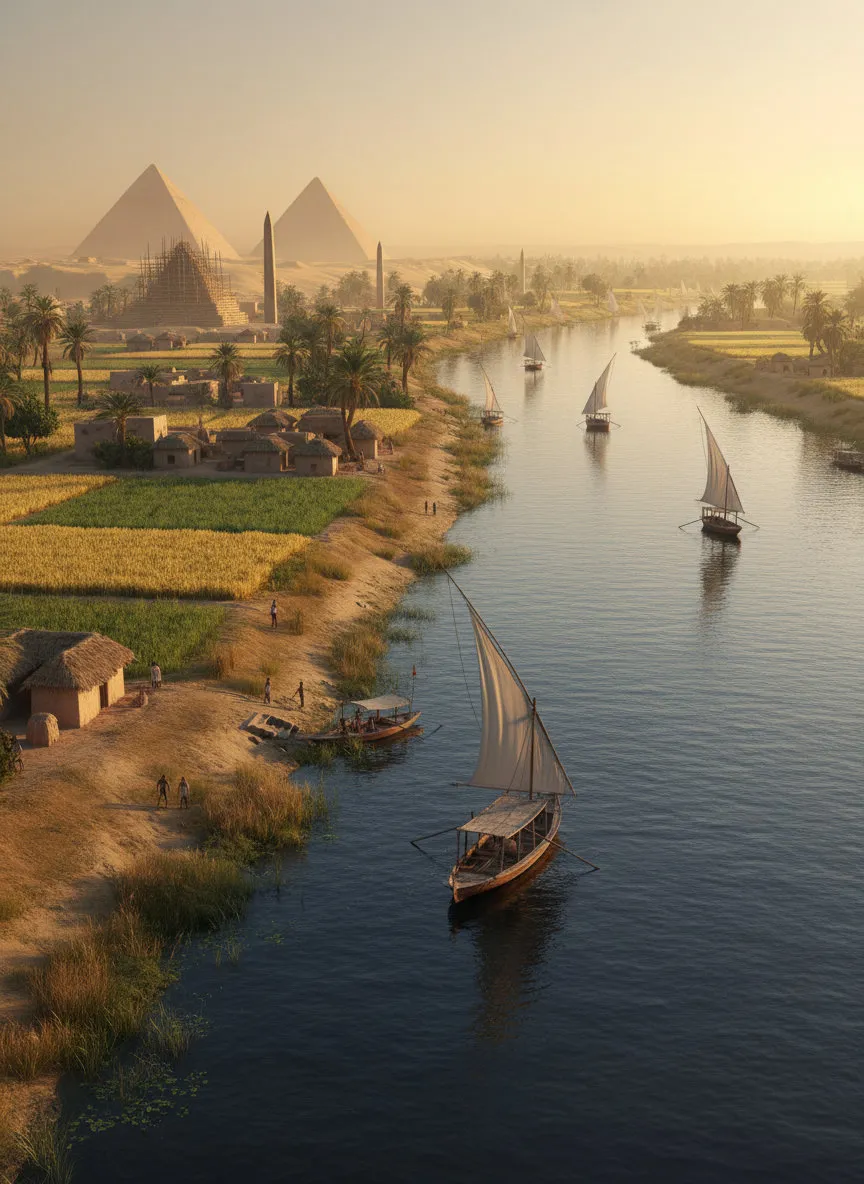
Imagine standing on the banks of the Nile 4,000 years ago during the Middle Kingdom. You aren't looking at a static river, but a living, breathing entity that dictates the rhythm of existence. The most crucial event of the year is Akhet—the season of inundation. Unlike the destructive floods of other ancient rivers, the Nile's rise was predictable and gentle. It transformed the valley into a vast, shallow lake, depositing a layer of rich, dark volcanic silt brought all the way from the Ethiopian highlands.
This miraculous mud created a sharp distinction in the geography. The Egyptians called their home Kemet, or 'The Black Land,' referring to this fertile soil that sparkled with life. Just beyond the river's reach lay 'Deshret,' the Red Land of the scorching desert. For an Egyptian at age 30, this wasn't just geography; it was a spiritual truth. Order (Ma'at) existed on the black soil, while chaos reigned in the red sands.
Without this annual pulse of water and soil, the grand civilization we know would never have started. It was the only way to grow food in an area with almost no rainfall. The river didn't just support life; it *was* life, worshipped as the god Hapi, who arrived annually to feed the people.
Key Takeaway
The annual, predictable flooding of the Nile deposited nutrient-rich silt, creating the fertile 'Black Land' (Kemet) essential for agriculture.
Test Your Knowledge
What did the Ancient Egyptians call the fertile land created by the Nile's silt?
Once the floodwaters receded around October, the planting season, known as Peret, began. But 4,000 years ago, farmers didn't just hope for the best; they were master hydraulic engineers. They utilized a system called basin irrigation. By building earthen walls parallel to the river, they trapped the floodwater in large 'basins' for weeks. This soaked the soil thoroughly before the water was released back into the river or downstream to the next field.
This management allowed them to grow massive surpluses of the two staples of the Egyptian diet: emmer wheat for bread and barley for beer. In fact, laborers were often paid in these commodities! This agricultural surplus is the secret engine of history. Because the land was so productive, not everyone had to farm.
This freedom from subsistence farming allowed society to specialize. While farmers tended the basins, others could become stonemasons, scribes, or priests. The stability of the Nile directly funded the complex bureaucracy of the Middle Kingdom, allowing art, literature, and monumental architecture to flourish.
Key Takeaway
The Egyptians used basin irrigation to trap water, generating food surpluses that allowed society to diversify into specialized trades like architecture and writing.
Test Your Knowledge
Which system did farmers use 4,000 years ago to manage floodwaters?
In a world without paved roads, the Nile was the ultimate superhighway, unifying a kingdom that stretched hundreds of miles from south to north. Geography gave the Egyptians a perfect logistical gift: the river flows North (towards the Mediterranean Sea), but the prevailing winds blow South.
This meant a captain could drift casually downstream with the current to transport heavy granite obelisks or grain to the delta. To return home? Simply unfurl the large, square linen sail and let the wind push the boat upstream against the current. This dual-directional travel made the centralized control of the Middle Kingdom pharaohs possible. A decree—or an army—could move from Thebes to Memphis in a matter of weeks.
Beyond trade, the river was a stage for religious theater. During great festivals, statues of gods traveled by boat between temples. For the average Egyptian, the river wasn't a barrier; it was the connector. It linked the granite quarries of Aswan to the administrative centers of the north, binding the 'Two Lands' of Upper and Lower Egypt into a single, powerful state.
Key Takeaway
The Nile served as a perfect transportation system because the river current flowed north while the wind blew south, allowing easy travel in both directions.
Test Your Knowledge
How did boats travel south (upstream) against the Nile's current?
Track your progress, earn XP, and compete on leaderboards. Download NerdSip to start learning.