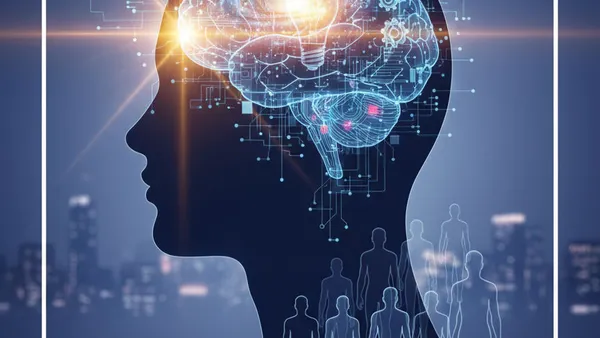
Why does your brain secretly rewrite your memories every time you think?
Prompted by A NerdSip Learner
Decode hidden cognitive loops and reclaim your psychological agency.
You already know your brain uses an autopilot to save energy. But when your core beliefs are challenged, your brain doesn't just filter information—it actively fights it. This is known as motivated reasoning.
Unlike a judge logically weighing evidence to find the truth, your mind often acts like a defense attorney. Its primary client is your ego. When faced with facts that contradict your deeply held beliefs, your brain's emotional centers activate first, perceiving the conflicting data as a literal physical threat.
This subconscious defense mechanism explains why arguing with pure facts rarely changes someone's mind. To overcome motivated reasoning, you have to separate your identity from your ideas. By adopting a 'scout mindset'—driven by curiosity rather than defense—you can observe new information without feeling attacked.
Key Takeaway
Your brain acts like a lawyer defending your pre-existing beliefs, prioritizing ego protection over absolute truth.
Test Your Knowledge
What is the primary function of motivated reasoning?
Have you ever had a strong 'gut feeling' about a decision? That isn't just a metaphor. According to the Somatic Marker Hypothesis, your physical body dictates choices before your conscious mind even catches up.
Throughout your life, your brain attaches emotional and physical tags—somatic markers—to past experiences. A rapid heartbeat, a tight chest, or a sudden sense of calm are all data points. When you face a complex decision, your brain simulates the outcome and triggers these subtle bodily sensations to guide you toward or away from a choice.
Without these physical sensations, decision-making becomes almost impossible. People with specific emotional brain damage can endlessly debate the logic of a simple choice, but without a 'gut feeling,' they remain paralyzed. Your body is constantly doing advanced cognitive math.
Key Takeaway
Your physical 'gut feelings' are rapid, data-driven calculations made by your subconscious mind.
Test Your Knowledge
What happens when a person's somatic markers are disrupted?
You are already familiar with the basic habit loop. But why are some behaviors, like endlessly scrolling social media or playing slot machines, so relentlessly addictive? The secret lies in variable reward schedules.
When your brain knows exactly when a reward is coming, dopamine levels eventually stabilize. The action becomes routine, but not necessarily compulsive. However, when a reward is entirely unpredictable—maybe you hit the jackpot, maybe you get nothing—your dopamine spikes dramatically.
This psychological lever hijacks your attention. The sheer *anticipation* of the reward becomes more thrilling to your nervous system than the reward itself. Understanding this mechanism allows you to spot where apps and marketers are using unpredictability to capture your focus, and helps you design better rewards for your own positive habits.
Key Takeaway
Unpredictable rewards trigger massive dopamine spikes, creating the strongest, hardest-to-break behavioral loops.
Test Your Knowledge
Why do variable reward schedules create compulsive behaviors?
We tend to think of memory like a video recording stored in a secure neural vault. In reality, human memory relies on a fragile process called reconsolidation.
Every single time you recall a memory, you pull it out of the vault, making it neurologically unstable. When you put it back, your brain re-saves it along with your *current* environment, thoughts, and emotions. You aren't actually remembering the original event; you are remembering the last time you remembered it.
While this means our memories are highly unreliable and prone to distortion, it is also a powerful psychological tool. Therapists use this window of instability to help patients decouple intense fear from traumatic memories, literally rewriting the emotional weight of the past.
Key Takeaway
Recalling a memory makes it unstable, allowing it to be subtly altered and rewritten every time you think about it.
Test Your Knowledge
What does the process of memory reconsolidation imply about our memories?
Moving beyond a simple growth mindset brings us to one of the most foundational concepts in psychology: your Locus of Control. This framework describes where you believe the power over your life resides.
An *external* locus of control means you subconsciously believe fate, luck, the economy, or other people dictate your outcomes. You view yourself as a passenger. An *internal* locus of control means you believe your own choices, effort, and resilience determine your destiny. You are the driver.
Research consistently links a strong internal locus to lower stress, greater career success, and higher emotional resilience. While we cannot control everything that happens to us, shifting your locus of control involves relentlessly focusing on your own micro-responses to an uncontrollable world.
Key Takeaway
Cultivating an internal locus of control shifts your psychological baseline from a passive observer to an active creator.
Test Your Knowledge
Which of the following is an example of an external locus of control?
Track your progress, earn XP, and compete on leaderboards. Download NerdSip to start learning.