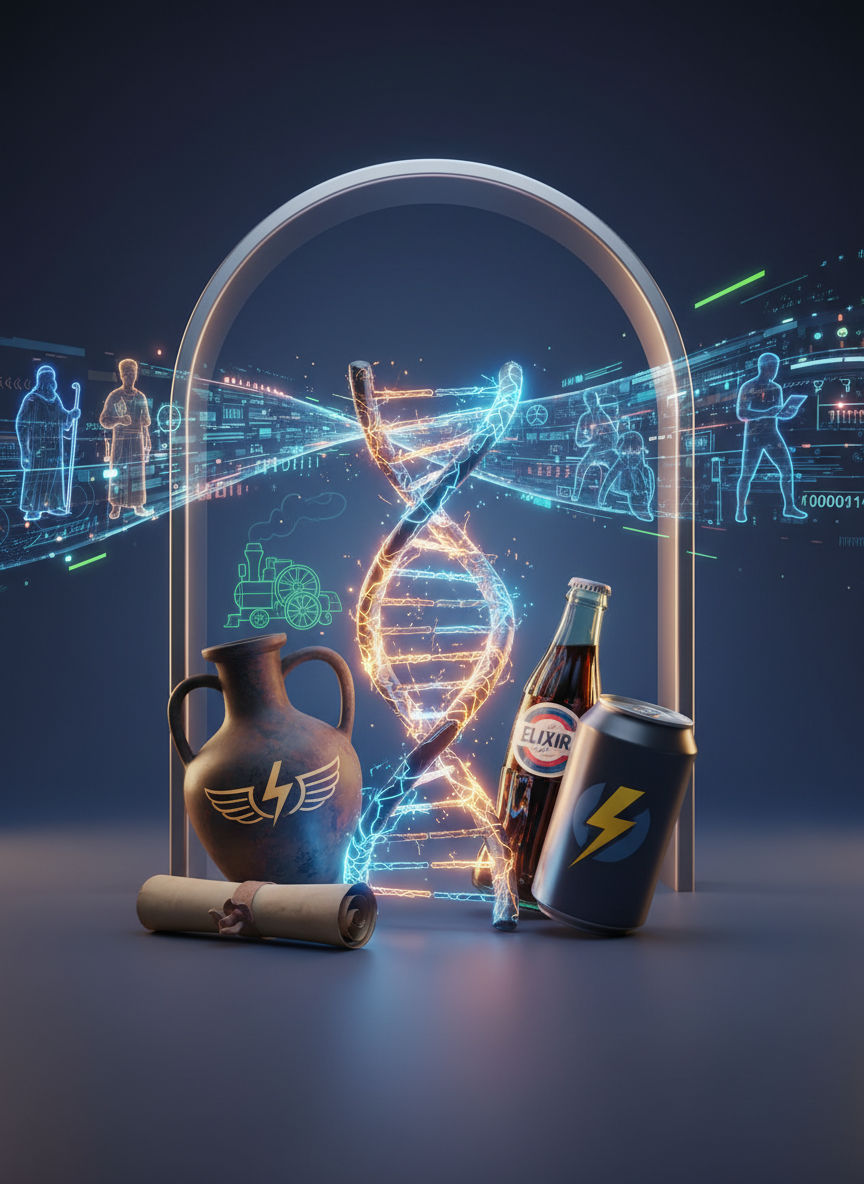
Discover how ancient leaves and Thai truck drivers built a billion-dollar energy drink empire.
Prompted by NerdSip Explorer #6116
Trace the wild evolution of your favorite energy drinks.
Long before neon cans filled the gas station coolers, humans were constantly searching for a way to beat the midday slump. Our ancient ancestors didn't have science labs or factories; instead, they had nature!
For thousands of years, people across the globe chewed leaves, brewed roots, and roasted beans just to get a little extra pep in their step. High in the Andes mountains, South Americans chewed coca leaves for stamina to survive at extreme altitudes. Across the ocean, East Africans brewed coffee beans to stay alert, and ancient Chinese cultures mastered the complex art of brewing tea.
These natural, plant-based stimulants all had one major thing in common: they tapped into the invisible power of caffeine and other naturally occurring compounds. These chemicals trick the human brain into feeling wide awake, masking the feeling of exhaustion.
Think of these early plants as the "version 1.0" of energy drinks. They proved that human beings have always craved a magical shortcut to feeling focused, alert, and ready to take on the day's hard work!
Key Takeaway
Humans have relied on naturally stimulating plants like coffee and tea for thousands of years.
Test Your Knowledge
What did ancient cultures rely on to get an energy boost?
In the late 1800s, local pharmacists started creating magical "tonics" to cure everything from mild headaches to pure, agonizing exhaustion. The most famous of these pharmacy tonics eventually grew to become the most popular soda on planet Earth: Coca-Cola.
When Coca-Cola first hit the market in 1886, it was basically the ultimate energy drink of its era. Why? Because the original, historical recipe actually contained real cocaine extracted from the coca leaf, sitting right alongside heavy caffeine extracted from the kola nut!
At the time, this combination wasn't considered a massive scandal. It was marketed to the public as a "brain tonic" guaranteed to cure fatigue and give folks a massive burst of energy to get through the day.
Eventually, the highly controversial and dangerous ingredient was completely removed in the early 1900s. But Coca-Cola’s massive early success proved a very important point: everyday people were desperate for a tasty, convenient beverage that could artificially charge up their batteries!
Key Takeaway
The original Coca-Cola acted as an early energy drink by using a highly stimulating (and now illegal) ingredient.
Test Your Knowledge
What highly stimulating ingredient was famously included in the original Coca-Cola recipe?
Jump ahead to the year 1949 in the bustling city of Chicago. A clever businessman named William Mark Swartz noticed a strange problem. People were drinking normal sodas loaded with empty sugar, but they were still complaining about feeling sluggish and tired all the time.
He had a bright idea: what if a fizzy soda could actually be packed with healthy vitamins? He created a carbonated drink called Dr. Enuf, which was loaded with a unique blend of B-vitamins, caffeine, and pure cane sugar.
Swartz enthusiastically pitched his new drink as "Manna from Heaven." He promised the public that his beverage would cure stomach aches, nasty hangovers, and the dreaded midday "brain fog." It was the very first time someone intentionally combined the fun bubbles of a soda with the chemical boost of vitamins and caffeine.
While Dr. Enuf didn't conquer the globe, it laid the exact blueprint for what a modern energy drink would eventually become.
Key Takeaway
Dr. Enuf was the first carbonated drink to combine caffeine, sugar, and B-vitamins for a functional boost.
Test Your Knowledge
What made Dr. Enuf a unique predecessor to modern energy drinks?
If you want to find the true, undeniable birthplace of the modern energy drink, you have to look at post-World War II Japan. In 1962, a massive pharmaceutical company created a tiny, brown glass bottle called Lipovitan D.
Japan’s post-war economy was absolutely booming, and factory workers were pulling incredibly long, exhausting shifts to rebuild the country. They needed a serious boost. Lipovitan D looked and tasted a bit like bitter cough syrup, but it contained a magical new ingredient: Taurine.
Taurine is a naturally occurring amino acid that helps support mental focus and physical endurance under heavy stress. Workers could quickly chug this tiny bottle and power through their grueling night shifts.
Lipovitan D wasn't marketed as a fun party drink for young people. It was a hardcore, no-nonsense productivity tool meant strictly for truck drivers and laborers. It proved that millions of people would gladly drink something medicinal if it meant they could work harder!
Key Takeaway
The modern energy drink was born in Japan in 1962 as a powerful productivity tonic for overworked laborers.
Test Your Knowledge
Who was the original target audience for Japan's Lipovitan D?
The runaway success of Japan’s little brown energy bottles quickly spread across the rest of Asia. In 1976, a clever Thai entrepreneur named Chaleo Yoovidhya decided to make his own version specifically designed for the working class of Thailand.
He created a sweet, non-carbonated syrup that was much more pleasant to drink, and he called it Krating Daeng. If you translate that name into English, it means—you guessed it—Red Bull!
Just like the drinks in Japan, Krating Daeng became a massive hit with Thai laborers, construction workers, and tired truck drivers desperately trying to stay awake on long hauls. The iconic logo featured two red bulls charging directly at each other in front of a bright yellow sun, representing sheer physical power and stamina.
At this point in history, energy drinks were still mostly considered a cheap, sticky medicine for blue-collar workers. But Krating Daeng was about to meet a European visitor who would change everything.
Key Takeaway
Krating Daeng was a sweet, non-carbonated Thai energy syrup that eventually birthed the Red Bull brand.
Test Your Knowledge
What does the Thai name 'Krating Daeng' translate to in English?
In the mid-1980s, an Austrian businessman named Dietrich Mateschitz flew to Thailand for an important work trip. When he landed, he was suffering from terrible, mind-numbing jet lag. Desperate for any kind of relief, he bought a local bottle of Krating Daeng.
To his absolute amazement, his jet lag completely vanished! He instantly realized that this Asian working-class tonic could be a massive, money-making hit in the Western world if packaged correctly.
He tracked down the creator, Chaleo Yoovidhya, and the two men formed a historic partnership. Mateschitz took the syrupy Thai formula back to Europe, tweaked the flavor to be less sweet for Western palates, and added a crucial element: carbonation (fizzy bubbles).
In 1987, the newly bubbly, repackaged drink launched in Austria under its translated English name: Red Bull. It wasn't just a quirky new drink anymore; it was the birth of a multi-billion dollar global beverage empire.
Key Takeaway
An Austrian businessman discovered a Thai energy tonic, added carbonation, and launched it globally as Red Bull.
Test Your Knowledge
What major change did Dietrich Mateschitz make to Krating Daeng for the Western market?
When Red Bull first launched in Europe, the company faced a huge, glaring problem: the drink tasted kind of weird! It didn't taste like familiar cola or sweet fruit juice. To sell it to the masses, they needed a totally unique, out-of-the-box strategy.
Instead of running normal, boring commercials on television, Red Bull decided to target the coolest, most energetic people they could find. They bypassed grocery stores and handed out free cans at wild college parties, underground nightclubs, and massive music festivals.
Even more brilliantly, they began heavily sponsoring extreme sports. They plastered their logo on fearless snowboarders, cliff divers, and lightning-fast Formula 1 race cars. They completely distanced themselves from the old 'tired factory worker' image of the past.
With the iconic, unforgettable slogan, *'Red Bull gives you wings,'* they convinced the entire world that drinking their odd-tasting beverage made you feel adventurous, edgy, and totally unstoppable.
Key Takeaway
Red Bull built its empire by avoiding traditional ads and associating the brand with youth culture and extreme sports.
Test Your Knowledge
How did Red Bull primarily market its new drink in the early days?
Red Bull finally entered the United States in 1997, and it was a smash hit overnight. But a small, 8-ounce silver can left a lot of room for fierce competition. The early 2000s brought the next massive evolution: The Monster Boom.
New, aggressive brands like Monster Energy (launched in 2002) and Rockstar realized that American consumers simply wanted *more*. They launched massive 16-ounce cans adorned with aggressive, eye-catching logos like neon green monster claw marks.
Not only were these new cans twice the size of a standard Red Bull, but they were also much sweeter and came in dozens of wild, candy-like fruit flavors. They leaned heavily into modern youth culture, sponsoring video game tournaments, punk rock tours, and skateboarding events.
This wild era proved that energy drinks weren't just a temporary fad or a one-hit wonder. They had officially become a permanent, booming category in the beverage aisle!
Key Takeaway
Brands like Monster expanded the market by offering larger 16-ounce cans, sweeter flavors, and an edgy alternative image.
Test Your Knowledge
How did brands like Monster Energy differentiate themselves from Red Bull in the early 2000s?
As energy drinks became wildly popular across the globe, they also ran into some serious, high-profile trouble. The biggest controversy happened when beverage companies started mixing heavy doses of caffeine directly with alcohol.
In the late 2000s, a notorious drink called Four Loko hit college campuses. It combined the heavy alcohol content of several beers with the buzzing caffeine of several cups of coffee. The caffeine masked the sluggish feeling of being drunk, leading young people to consume dangerous amounts, resulting in severe health emergencies.
Governments quickly stepped in to stop the chaos. In 2010, the United States banned the sale of pre-mixed caffeinated alcoholic beverages, forcing brands to completely change their recipes.
Even without the alcohol, doctors began warning the public—especially kids—about drinking too many energy drinks in a single day. High levels of caffeine and sugar were linked to racing hearts and severe anxiety, proving these drinks required caution.
Key Takeaway
The dangerous combination of extreme caffeine and alcohol led to severe health risks and strict government bans.
Test Your Knowledge
Why did the US government step in to ban drinks like the original Four Loko in 2010?
Today, the energy drink aisle at your local grocery store looks vastly different than it did twenty years ago. As everyday people became much more health-conscious, they stopped wanting drinks loaded with 50 grams of artificial sugar and mysterious, unpronounceable chemicals.
Enter the 'Clean Energy' era. Modern, sleek brands like Celsius and Alani Nu have completely exploded in popularity. They focus heavily on zero sugar, natural caffeine extracted from green tea, and added vitamins specifically designed for fitness recovery.
We also have the rise of 'Gamer Fuel'—powders and drinks like Prime or G-Fuel, designed specifically to boost mental focus for e-sports competitors without the dreaded heavy sugar crash.
From ancient people chewing raw coca leaves, to exhausted Japanese factory workers chugging medicinal tonics, to modern athletes sipping sugar-free sparkling water, the ultimate goal hasn't changed. We are all just looking for that perfect, lightning-in-a-bottle boost to conquer the day!
Key Takeaway
Modern energy drinks focus heavily on 'clean' ingredients, zero sugar, and specialized functional formulas for fitness and gaming.
Test Your Knowledge
What defines the modern 'Clean Energy' drink era?
Track your progress, earn XP, and compete on leaderboards. Download NerdSip to start learning.