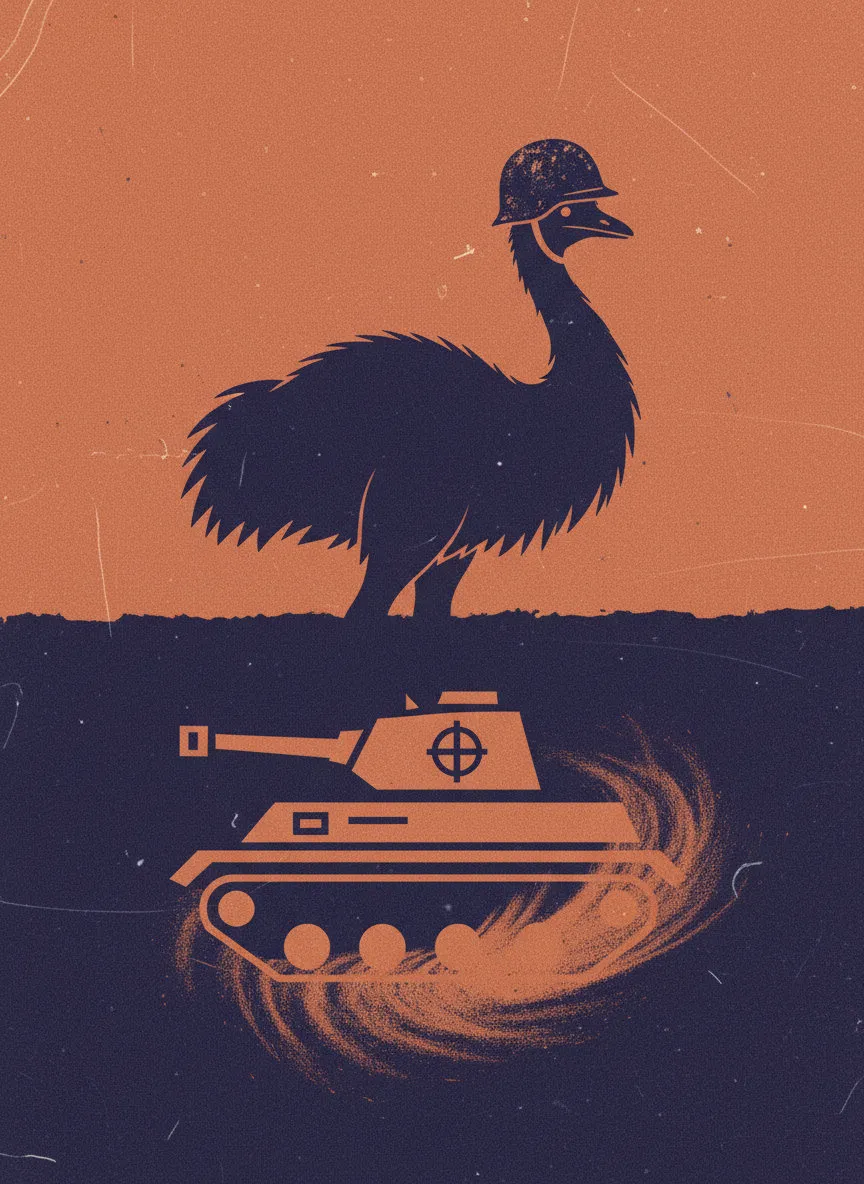
Australia once declared war on birds... and the birds won.
Prompted by A NerdSip Learner
Analyze the tactical failures of the world's strangest military conflict.
In the aftermath of World War I, the Australian government gave land in Western Australia to returning veterans to farm wheat. It sounded like a great plan until the Great Depression hit, causing wheat prices to tank. But the soldiers-turned-farmers were about to face a much stranger enemy than economic collapse.
In 1932, following a severe drought, approximately 20,000 emus migrated inland from the coast. These weren't just a few birds; it was a massive, flightless horde looking for water and food. They found the cultivated wheat lands to be a perfect buffet, destroying crops and flattening fences in the process.
Desperate and watching their livelihoods disappear, the ex-soldier farmers didn't call animal control. They petitioned the Minister of Defence, Sir George Pearce. Why? because they believed machine guns were the only tool capable of stopping the 'Feathered Invasion.'
Key Takeaway
The conflict began due to a collision of economic desperation, drought-induced migration, and agricultural expansion.
Test Your Knowledge
What primary event triggered the massive emu migration to the farmlands?
Sir George Pearce, eager to show that the government was helping its veterans, readily agreed to intervene. He was even nicknamed the 'Minister for the Emu War.' His solution was surprisingly heavy-handed: he deployed a military detachment led by Major G.P.W. Meredith.
The force included two soldiers armed with Lewis automatic machine guns and 10,000 rounds of ammunition. The plan was simple: herd the birds together and open fire. The military fully expected this to be mere target practice against intellectually inferior opponents.
However, this military response highlighted a massive overestimation of technology. The government assumed that because they had machine guns, the problem would simply vanish. They failed to account for the terrain, the nature of the target, and the sheer unpredictability of wild animals.
Key Takeaway
The government responded with disproportionate military force, assuming superior weaponry would guarantee an easy victory.
Test Your Knowledge
What weapon was assigned to Major Meredith's detachment?
The first engagement took place in November 1932. The soldiers spotted a group of about 50 emus and opened fire from a long range. To their shock, the birds didn't huddle together in fear. Instead, they scattered in every direction, running at speeds of up to 50 km/h (31 mph).
The emus seemed to instinctively adopt 'guerrilla tactics.' They split into small, fast-moving groups that made impossible targets for machine gunners. Major Meredith noted that the birds seemed to have leaders who kept watch while others ate, signaling the flock to scatter the moment danger approached.
It became quickly apparent that the military drill of firing into a dense mass wasn't going to work. The emus were chaotic, agile, and surprisingly strategic. The soldiers wasted hundreds of rounds for only a handful of confirmed kills.
Key Takeaway
The emus unintentionally used guerrilla tactics—scattering and speed—to render the machine guns ineffective.
Test Your Knowledge
How did the emus react when fired upon?
As the campaign continued, the soldiers discovered another frustrating fact: emus are incredibly tough. Even when hit, many birds kept running. Their dense feathers, thick skin, and vital organs protected by layers of muscle meant that unless a bullet hit a critical spot, the bird could survive and escape.
Major Meredith was famously quoted saying, 'If we had a military division with the bullet-carrying capacity of these birds, it would face any army in the world.' He even compared them to tanks. The Lewis guns, designed to mow down infantry lines, were failing against poultry.
The soldiers tried mounting the guns on a truck to chase the birds, but the terrain was so rough that the gunner couldn't aim without falling out. The emus were winning the arms race simply by being biologically durable and faster than the vehicles chasing them.
Key Takeaway
Emus proved to be surprisingly resilient to gunfire, leading the military to compare their durability to tanks.
Test Your Knowledge
What did Major Meredith compare the emus to?
Hoping to turn the tide, the military planned a major ambush near a dam where over 1,000 emus were spotted. This was the perfect strategic setup: a choke point where the birds would be stationary and grouped together. The soldiers lay in wait, holding their fire until the birds were at point-blank range.
When the signal was given, the gunner opened fire... and the gun jammed after only a few shots. By the time they cleared the jam, the 1,000 birds had scattered and vanished into the bush. It was a humiliating failure of equipment at the most critical moment.
This incident highlighted the tactical absurdity of the war. Even when the humans had the element of surprise and the perfect location, mechanical failure and bad luck allowed the 'enemy' to escape almost unharmed.
Key Takeaway
The best tactical opportunity of the war failed due to a mechanical weapon jam during an ambush.
Test Your Knowledge
Why did the ambush at the dam fail?
By mid-November, the operation was becoming a public relations disaster. The press was mocking the military, and questions were being raised in the Australian Parliament about the cost of the operation versus the results. Major Meredith's report was bleak: thousands of rounds of ammunition fired, but only a few hundred birds killed.
The military withdrew on November 8th. Although they briefly returned for a second attempt later that month with slightly better results, the 'war' was effectively lost. The emus remained in the territory, eating the wheat and destroying the fences.
Interestingly, Major Meredith noted that his unit had suffered 'no casualties.' This was the only positive statistic in a war where the Australian military was outmaneuvered by flightless birds. The emus had successfully defended their territory through sheer numbers and chaos.
Key Takeaway
The military was forced to withdraw due to negative press, high costs, and an embarrassingly low success rate.
Test Your Knowledge
What was the outcome of the initial military campaign?
So, if machine guns didn't work, how did Australia eventually solve the emu problem? The government shifted strategies from military intervention to economic incentives. They instituted a 'bounty system,' paying locals for every emu beak they collected.
This system was vastly more effective. Over a six-month period in 1934 alone, over 57,000 bounties were claimed. The locals, who knew the land and the birds better than the military, were far more efficient at pest control than a machine gun unit.
The Great Emu War stands today as a hilarious but important lesson in ecology and military tactics. It proved that brute force is often the wrong tool for environmental management, and that sometimes, nature simply refuses to follow the rules of warfare.
Key Takeaway
The 'war' proved that local incentive programs (bounties) were far more effective than centralized military force.
Test Your Knowledge
Which method eventually proved effective in controlling the emu population?
Track your progress, earn XP, and compete on leaderboards. Download NerdSip to start learning.