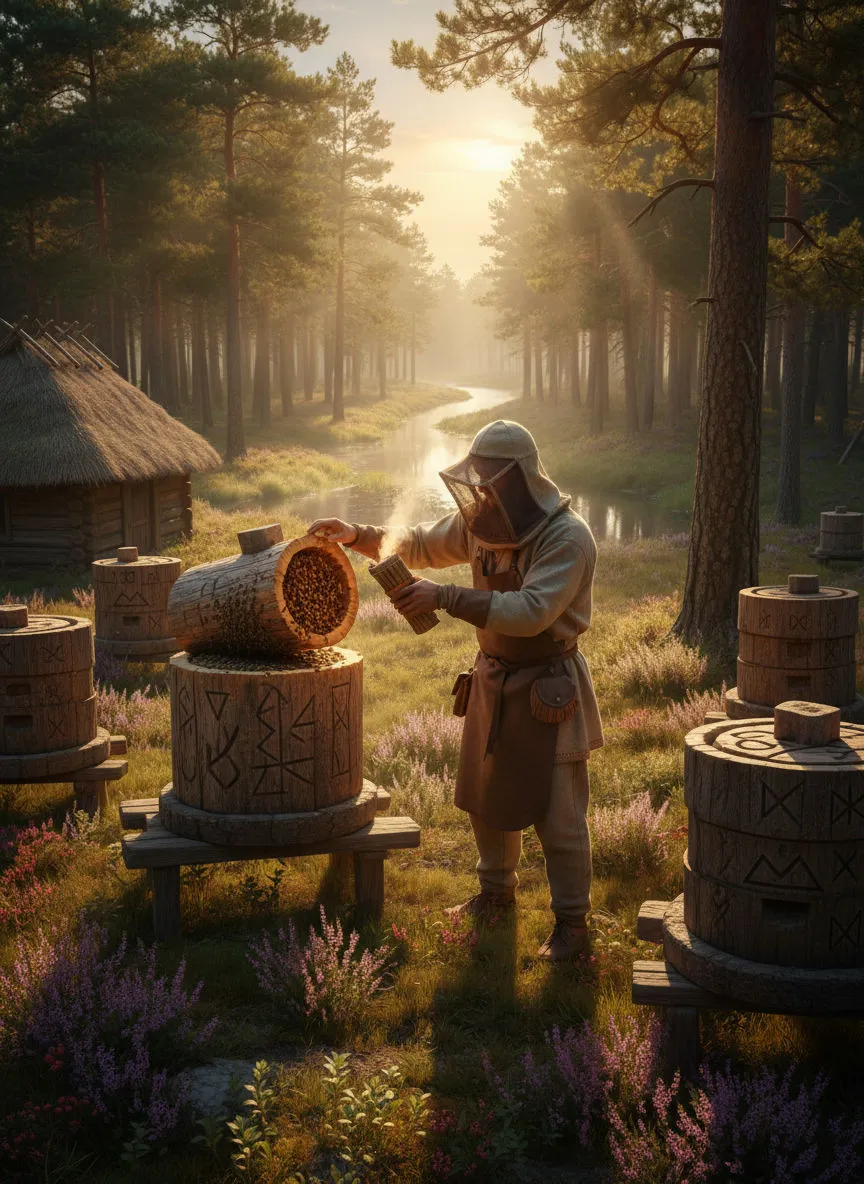
Why did ancient Lithuanians treat bees like members of their own family?
Prompted by A NerdSip Learner
Uncover the Bronze Age roots of Baltic honey culture.
Imagine a world 3,000 years ago, where the deep forests of the Baltic region were the ultimate treasure chest. In 1000 BC, Lithuanians weren't using the wooden boxes we see in fields today. Instead, they practiced tree beekeeping (*drevinė bitininkystė*). They would search for natural hollows high up in massive pine trees where wild swarms lived.
To claim a hive, a hunter would carve a unique property mark into the bark. This was sacred law; stealing honey from another's tree was one of the gravest crimes in Baltic society. Beekeepers used complex rope systems made of leather or hemp to scale these trees, often reaching heights of 15 meters to harvest the sweet reward.
Bees were so respected that the Lithuanian language even has a special word for friendship, bičiulis, which literally means 'a person with whom you share a swarm.' This shows that honey wasn't just food; it was the foundation of the earliest social bonds and trust in the community.
Key Takeaway
Ancient Lithuanians harvested honey from high tree hollows, creating a culture built on trust and shared swarms.
Test Your Knowledge
What does the ancient Lithuanian word 'bičiulis' reveal about their culture?
In the Late Bronze Age, bees provided something even more valuable than honey: beeswax. While honey was the only concentrated sweetener available—essential for making mead, the world's oldest fermented drink—wax was a high-tech material for the era.
Metalworkers used the lost-wax technique to create intricate bronze tools and jewelry. They would carve a shape in wax, cover it in clay, and then pour molten bronze into it, melting the wax away. Without the humble bee, the stunning bronze ornaments found in Baltic archaeological sites might never have existed.
Beyond metallurgy, beeswax was used for waterproofing ceramic pots and as a primitive medical ointment. Because honey and wax were so difficult to obtain, they became symbols of wealth and status. Historians believe that honey was likely used as a form of 'currency' in trade with neighboring tribes, making the beekeeper a vital member of the village economy.
Key Takeaway
Beeswax was a critical industrial material used for bronze casting and waterproofing in 1000 BC.
Test Your Knowledge
Why was beeswax particularly important to Bronze Age metalworkers?
To the ancient Balts, bees weren't just insects; they were divine messengers. They worshiped Austėja, the goddess of bees and woven things, who protected the family and the swarm. Her husband, Bubilas, was the god of honey and drones, often depicted as a loud, buzzing presence. These deities ensured the fertility of the forest and the survival of the tribe.
This spiritual connection led to a unique linguistic quirk that survives in Lithuania today. In many languages, there are different words for the death of a human and the death of an animal. However, in Lithuanian, the word miršta (to die) is used for humans and only for bees. Every other animal is said to 'perish' (*dvėsta*).
This shows that in 1000 BC, bees were considered souls on the same level as people. They were seen as models of a perfect society—selfless, hardworking, and loyal to the family. To kill a bee was not just a mistake; it was an insult to the gods and a strike against the harmony of nature.
Key Takeaway
Lithuanian mythology and language treat bees as sacred beings with the same spiritual dignity as humans.
Test Your Knowledge
Which Lithuanian goddess was believed to protect both bees and the human family?
Track your progress, earn XP, and compete on leaderboards. Download NerdSip to start learning.