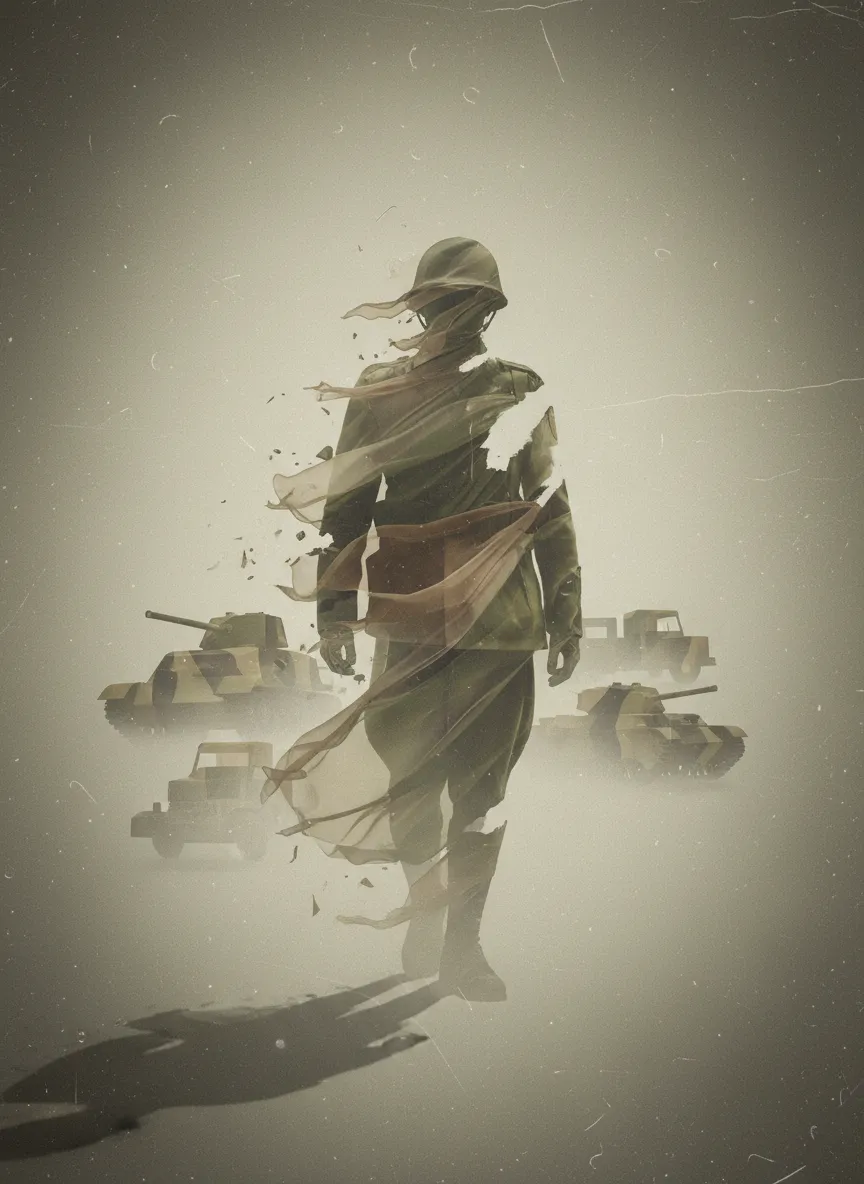
How an army of inflatable tanks fooled the Nazis and won the war.
Prompted by A NerdSip Learner
Learn the art of military deception used by the 23rd Headquarters Special Troops.
Imagine a unit of soldiers where the primary weapons weren't rifles or grenades, but sketchpads, acting skills, and creativity. Welcome to the 23rd Headquarters Special Troops, better known as the "Ghost Army." Activated in 1944, this top-secret unit was unlike anything the US Army had seen before.
Recruited largely from art schools, advertising agencies, and theaters, these men were artists, designers, and sound engineers. Their mission? To deceive the German army into thinking Allied forces were positioned where they weren't, or were much larger than they actually were. They used their artistic talents to save lives by drawing enemy fire away from real combat units.
Over the course of the war, this unique group of 1,100 men staged more than 20 battlefield deceptions. They were the masters of the "tactical illusion," proving that sometimes, the best way to win a fight is to trick your opponent into fighting a ghost.
Key Takeaway
The 23rd Headquarters Special Troops was a unique unit of artists and designers tasked with tactical deception.
Test Your Knowledge
What was the primary background of many soldiers recruited for the Ghost Army?
One of the Ghost Army's most iconic tools was the pneumatic decoy. These weren't children's pool toys; they were life-sized, inflatable replicas of Sherman tanks, jeeps, trucks, and even airplanes. While a real Sherman tank weighed over 30 tons, these rubber versions weighed only about 90 pounds and could be set up or deflated in minutes.
From the ground, they looked a bit odd, but from the perspective of a German reconnaissance plane flying at 1,000 feet, they were indistinguishable from the real thing. The Ghost Army would deploy these inflatables under the cover of darkness, covering them with imperfect camouflage to ensure enemy pilots would spot them and report a massive troop buildup.
To complete the illusion, the soldiers would even create fake tracks in the mud leading up to the balloons using bulldozers. This attention to detail ensured that the German High Command wasted valuable time and resources preparing for attacks that would never come.
Key Takeaway
Inflatable tanks and vehicles were used to fool aerial reconnaissance into believing the Allied force was massive.
Test Your Knowledge
Why did the Ghost Army use imperfect camouflage on their inflatable tanks?
Visuals were only half the battle. If an army looks big but sounds silent, the enemy gets suspicious. Enter the Sonic Deception Company. These audio engineers recorded the sounds of armored divisions at Fort Knox—tanks clanking, engines revving, and sergeants shouting orders.
On the battlefield, they mounted massive 500-pound speakers onto half-tracks (armored vehicles). These powerful speakers could project sound up to 15 miles away. They would mix these pre-recorded tracks on the fly to match the scenario, creating a "soundscape" of a bustling army moving into position.
The audio was so effective that it often terrified local civilians and confused German listening posts completely. By playing these sounds at night in foggy or wooded areas, they could convince the Nazis that a massive armored division was flanking them, causing the enemy to retreat or redeploy their forces unnecessarily.
Key Takeaway
The Ghost Army used massive speakers and recorded sounds to mimic the noise of a moving army.
Test Your Knowledge
How far could the Ghost Army's sound speakers project their audio?
In WWII, radio was the primary method of communication, and the Germans were excellent at intercepting it. The Ghost Army turned this against them through "Radio Deception." Skilled operators created fake radio networks, mimicking the traffic of real units.
Every radio operator has a unique style of tapping out Morse code, known as a "fist." The Ghost Army operators were so skilled they could learn and mimic the specific "fist" of a real operator from another division. This meant that when the Germans listened in, they recognized the tapping style and were convinced the real 75th Infantry (or other units) were present.
They sent dummy messages about supplies, troop movements, and command orders. By flooding the airwaves with realistic but completely false information, they painted a picture of troop movements that existed only in the minds of the German intelligence officers.
Key Takeaway
Radio operators mimicked the unique Morse code styles of real units to feed false intel to German listeners.
Test Your Knowledge
What is a radio operator's unique style of tapping Morse code called?
To make the deception perfect, the Ghost Army used a technique they called "Atmosphere." This was essentially method acting on a battlefield scale. It wasn't enough to have fake tanks and fake radio; the soldiers themselves had to look the part when they went into French towns.
The unit carried a massive inventory of counterfeit shoulder patches and bumper markings. If they were pretending to be the 6th Armored Division, they would sew on the correct patches and paint the correct numbers on their trucks. They would drive their trucks in loops through towns to simulate long convoys passing through.
Soldiers were even instructed to go to local cafes and drop hints to spies or loose-lipped locals. They might complain about "the Colonel" or talk about their "long drive from Normandy." These small, human details were often the final piece of the puzzle that convinced German spies that the illusion was reality.
Key Takeaway
Soldiers used acting, fake uniforms, and staged conversations to fool spies in local towns.
Test Your Knowledge
What did the technique called 'Atmosphere' involve?
The Ghost Army's masterpiece was Operation Viersen in March 1945. As the Allies prepared to cross the Rhine River into the heart of Germany, the Ghost Army was tasked with drawing enemy attention away from the real crossing point. They set up a massive fake front 10 miles south of the actual attack zone.
Utilizing every trick in their book, they deployed hundreds of inflatable tanks, blasted sounds of bridge-building machinery, and created a frenzy of fake radio traffic. They even used smoke screens to hide the "activity" (or lack thereof). The deception was so convincing that the German army moved the bulk of their artillery and reserves to fight the Ghost Army.
When the real Allied forces crossed the Rhine further north, they met light resistance. The Ghost Army had successfully impersonated two whole divisions (over 30,000 men) with just 1,100 troops. It is estimated that this single operation saved thousands of American lives.
Key Takeaway
Operation Viersen was the unit's biggest success, fooling the Germans into defending the wrong part of the Rhine River.
Test Your Knowledge
How many divisions did the 1,100 men of the Ghost Army impersonate during Operation Viersen?
For decades after World War II, the story of the Ghost Army remained a complete secret. The soldiers were ordered never to speak of what they did, not even to their wives or children. The Pentagon kept the files classified, believing the deception tactics might be needed again in the Cold War against the Soviet Union.
It wasn't until 1996—more than 50 years after the war ended—that the information was finally declassified. Suddenly, families learned that their fathers and grandfathers hadn't just been clerks or truck drivers, but the master magicians of WWII.
In 2022, the unit was finally awarded the Congressional Gold Medal, the highest civilian honor in the United States. Their legacy teaches us that in war, creativity and ingenuity can be just as powerful as brute force. They proved that the art of deception could save real lives.
Key Takeaway
The unit's existence was classified for over 50 years, finally receiving recognition decades later.
Test Your Knowledge
When were the Ghost Army's missions finally declassified?
Track your progress, earn XP, and compete on leaderboards. Download NerdSip to start learning.