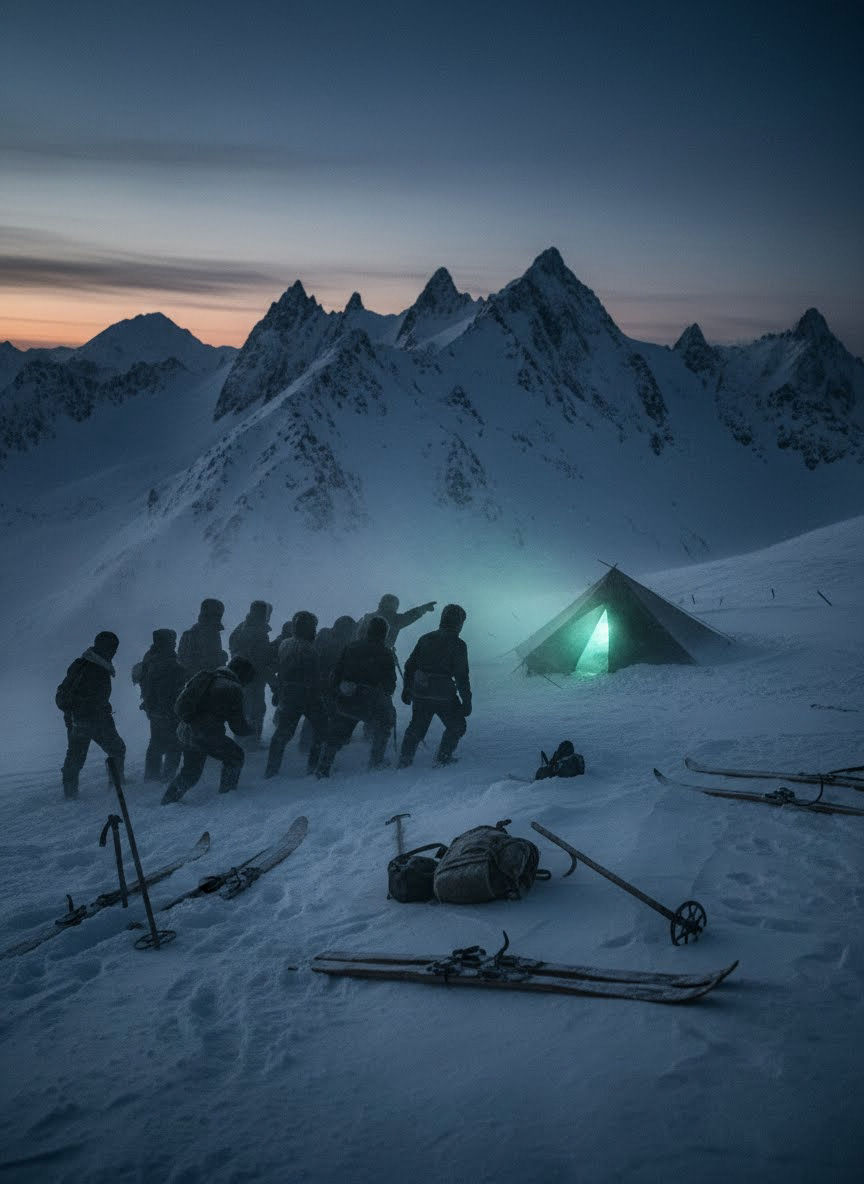
What forced 9 experienced hikers to flee into freezing darkness?
Prompted by A NerdSip Learner
Uncover the facts behind history's eeriest mountain mystery.
Imagine it’s February 1959. Nine experienced hikers, led by Igor Dyatlov, trek deep into the Ural Mountains of the Soviet Union. Their goal? To reach the peak of Otorten, a mountain whose name essentially translates to "Don't go there." They never arrived.
When search parties finally found their campsite weeks later, the scene was baffling. The tent was collapsed and half-buried in snow, but here is the scary part: it had been cut open from the inside.
All the hikers’ belongings—including their shoes and warm coats—were left neatly stacked inside. Footprints showed the group had fled calmly but hurriedly down the slope into the freezing night, wearing only socks or underwear. Why would experienced trekkers abandon their only shelter in -30°C weather? This question became the seed of a legend.
Key Takeaway
The mystery began when searchers found the tent cut open from the inside, with all gear left behind.
Test Your Knowledge
What was the most baffling detail about the condition of the hikers' tent?
As searchers followed the footprints, the story turned from tragic to terrifying. The bodies were found scattered down the mountain, some near a cedar tree and others further away.
The forensic evidence didn't make sense. The first few hikers died of hypothermia, which is expected in the cold. But a second group, found buried under snow months later, had injuries that looked like they were caused by a car crash. We are talking crushed chests and fractured skulls—yet there were no external bruises or scratches.
To make matters stranger, one hiker was missing her tongue and eyes. Clothing tested positive for trace amounts of radiation. The Soviet government closed the case file, stating the cause of death was simply a "compelling natural force." This vague explanation sparked decades of wild theories.
Key Takeaway
The hikers suffered massive internal injuries with no external signs of violence, deepening the mystery.
Test Your Knowledge
How did the Soviet investigators officially describe the cause of death?
For 60 years, people blamed everything from aliens and Yetis to secret KGB missile tests. But in recent years, modern science has offered a compelling answer that doesn't involve little green men.
Using advanced computer simulations (actually adapted from the movie *Frozen*!), researchers proposed the Slab Avalanche Theory. Unlike a loud, crashing avalanche, a slab avalanche is a silent killer. A heavy block of snow, hardened by wind, could have slid onto the tent while they slept.
This explains the crushed chests (the weight of the snow) and the cut tent (trapped hikers slicing their way out). The hikers likely fled in a panic, fearing a second slide, and succumbed to the brutal cold. While some questions remain, it serves as a reminder: sometimes nature is scarier than fiction.
Key Takeaway
Modern simulations suggest a rare 'slab avalanche' explains the weird injuries and the sudden escape.
Test Your Knowledge
What modern tool helped researchers support the Slab Avalanche theory?
Track your progress, earn XP, and compete on leaderboards. Download NerdSip to start learning.