How did the world's greatest empires vanish within a single generation?
Prompted by A NerdSip Learner
Understand the perfect storm that ended the Bronze Age.
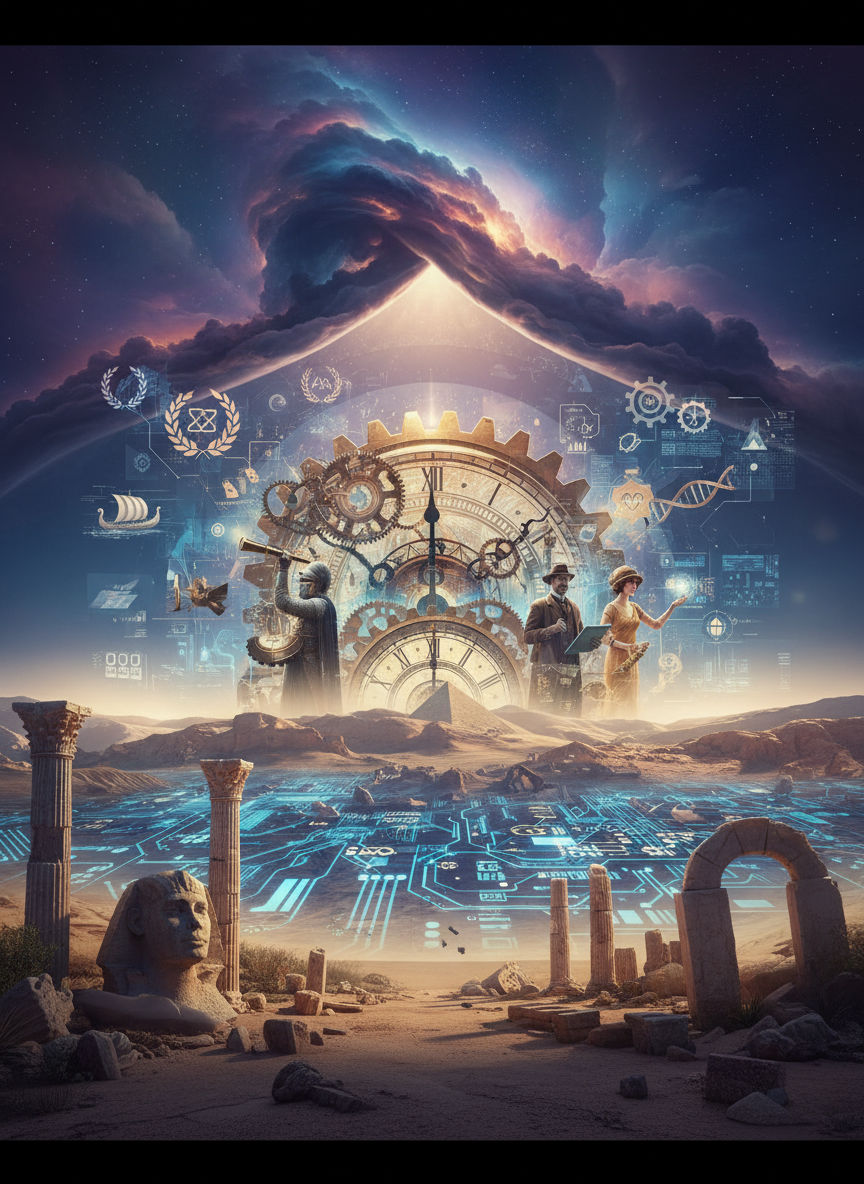
Around 1200 BCE, the Eastern Mediterranean was thriving in what historians consider our first highly globalized world. Powerful empires like the Egyptians, the Hittites in Anatolia, and the Mycenaeans in Greece were deeply interconnected.
It was an era of booming international diplomacy and trade. These civilizations relied heavily on a crucial recipe: mixing copper from Cyprus and tin from as far away as modern-day Afghanistan to create bronze. Bronze was the plastic of the ancient world—used for everything from armor and weapons to plows and luxury goods.
Because tin was so rare, these empires were forced to trade with one another, creating a massive, interdependent economic web. Royal families exchanged gifts, merchants sailed across the sea, and a period of relative peace and immense wealth flourished. But this hyper-connectedness also meant that if one pillar of the network wobbled, the entire Mediterranean world was at risk of tumbling down.
Key Takeaway
The Late Bronze Age was a highly interconnected era heavily dependent on international trade to produce bronze.
Test Your Knowledge
Why did Bronze Age empires have to trade internationally to survive?
Suddenly, this prosperous and stable world started to starve. For decades, historians wondered what could weaken such mighty empires, but modern science has provided a chilling answer.
Recent studies of ancient tree rings, sediment cores, and fossilized pollen data reveal a massive, region-wide shift in the climate. A severe megadrought hit the Eastern Mediterranean, lasting for centuries. Rain stopped falling, rivers dried up, and fertile agricultural lands slowly turned into arid dust.
Because these massive empires relied on a surplus of grain to feed their armies, workers, and elites, the continuous crop failures were devastating. Famine swept through the lower classes, leading to widespread riots and social upheaval. Kings who claimed to be gods or divinely appointed suddenly couldn't provide the most basic necessity: food. This environmental disaster severely weakened the foundations of civilization, leaving them incredibly vulnerable to what was coming next.
Key Takeaway
A centuries-long megadrought caused massive crop failures, famine, and social unrest across the ancient world.
Test Your Knowledge
What modern scientific evidence points to a massive drought during the Bronze Age?
Desperate times forced desperate measures. Enter the Sea Peoples, one of history's greatest unsolved mysteries. According to Egyptian carvings, this was a massive, enigmatic coalition of seafaring raiders who suddenly appeared on the horizon, destroying everything in their path.
While their exact origins remain heavily debated by historians, many believe they came from the western Mediterranean or the Aegean. Crucially, ancient reliefs show them traveling not just with warships, but with ox-drawn carts carrying women and children. This suggests they weren't just bloodthirsty pirates; they were likely climate refugees fleeing the very same drought and famine that was starving the major empires.
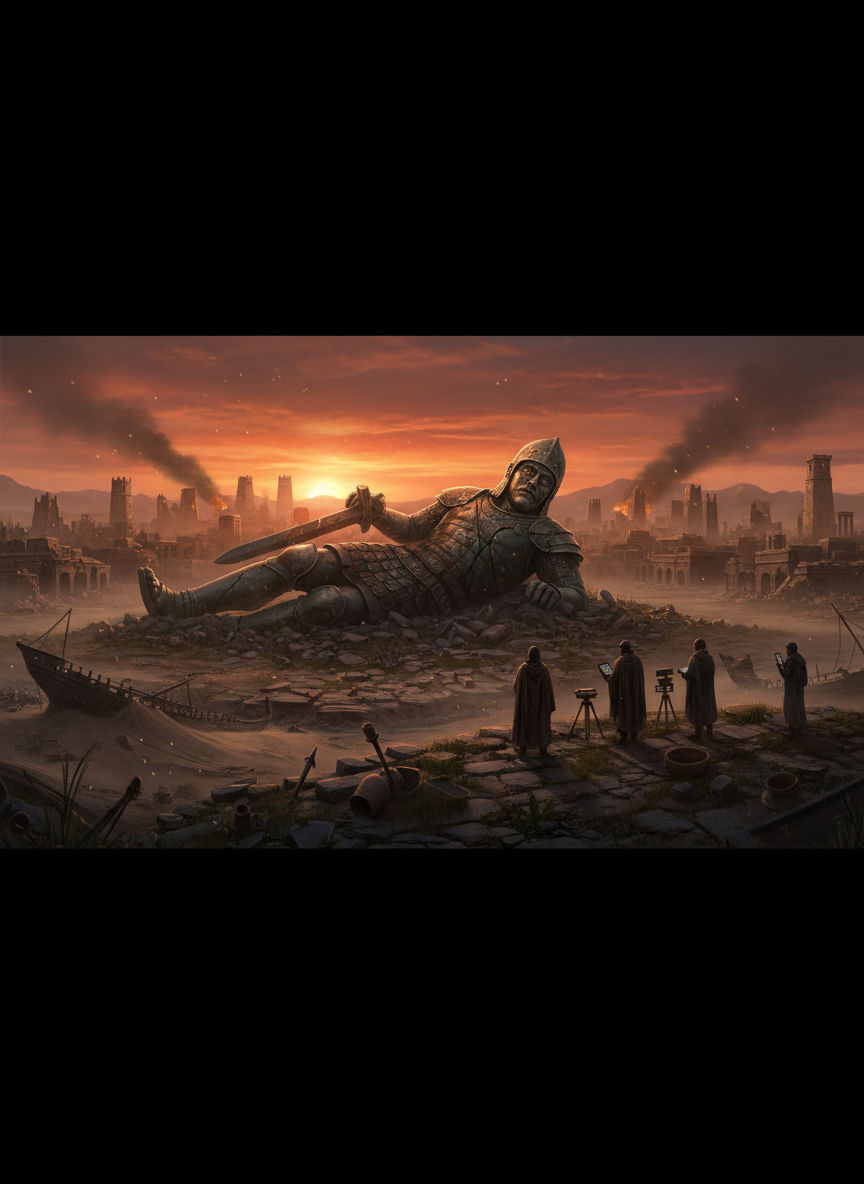
The Sea Peoples swept across the coastlines, burning mighty trade cities to the ground and contributing to the fall of the Hittite Empire. Though the Egyptians ultimately defeated them in a massive naval battle, the immense military effort left Egypt permanently crippled.
Key Takeaway
The mysterious Sea Peoples were likely a mix of raiders and climate refugees who overwhelmed the weakened empires.
Test Your Knowledge
What visual evidence suggests the Sea Peoples were migrating refugees, not just military raiders?
So, was it just the Sea Peoples and a drought that ended the Bronze Age? Most modern historians point to a more terrifying concept: a systems collapse.
Think of the Bronze Age world like a fragile house of cards. When the climate changed and the Sea Peoples disrupted the shipping lanes, the international trade networks completely broke down. Kings could no longer get tin. Without tin, there was no bronze. Without bronze, armies couldn't fight effectively, and farmers couldn't harvest efficiently.
To make matters worse, geological evidence suggests a devastating series of earthquakes—known as an earthquake storm—rocked the region over a 50-year period, destroying palaces and infrastructure. The hyper-connected nature of these empires became their fatal flaw. When one crucial node in the network failed, the cascading domino effect brought down the entire political, economic, and social system of the Mediterranean.
Key Takeaway
The Bronze Age collapse was a 'systems collapse' where climate, invaders, and broken trade networks created a fatal domino effect.
Test Your Knowledge
Why was the interconnected nature of the Bronze Age a vulnerability?
The aftermath of this collapse was staggering. Within a single human lifespan, majestic palaces were abandoned, international trade ceased entirely, and the population plummeted.
In many areas, such as Greece, the very art of writing was completely forgotten. The world plunged into what historians call a Dark Age, a period where cultural and economic progress seemingly rolled backward for centuries. However, human beings are incredibly resilient, and from the ashes of the Bronze Age, society began to adapt.
Since the international trade routes required to make bronze were shattered, people had to turn to a metal they could find locally in the earth: iron. Though harder to forge, iron was abundant. This forced adaptation ushered in the Iron Age, democratizing tools and weapons, and eventually paving the way for brand-new civilizations—like the Phoenicians and classical Greeks—to rise from the ruins.
Key Takeaway
The collapse plunged the world into a Dark Age but forced humanity to discover and utilize iron, reshaping history.
Test Your Knowledge
Why did societies transition from bronze to iron after the collapse?
Track your progress, earn XP, and compete on leaderboards. Download NerdSip to start learning.