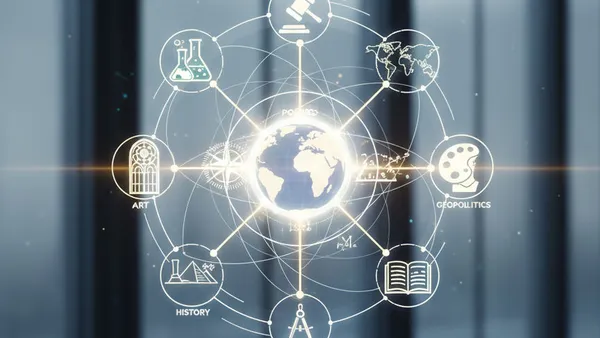
How does the whole world actually work?
Prompted by A NerdSip Learner
Understand the forces shaping our universe.
Have you ever wondered what you, your smartphone, and a distant star all have in common? They are all constructed from the exact same microscopic building blocks known as atoms. Think of atoms as the universe's ultimate, most versatile LEGO set.
By snapping these incredibly tiny pieces together in different combinations, nature creates absolutely everything around us. A few atoms joined together make a refreshing drop of water, while trillions of them perfectly arranged make up the beating heart in your chest!
Science is simply our systematic way of figuring out how these blocks fit together. By asking curious questions, running careful experiments, and observing the results, scientists uncover the invisible rules that govern everything from gigantic black holes to the tiny viruses that cause a cold.
So, when you study subjects like biology, chemistry, or physics, you are not just memorizing boring facts from a textbook. You are actually learning the fundamental source code of reality, discovering how a handful of simple cosmic ingredients magically built an entire universe.
Key Takeaway
Science is the study of the invisible building blocks and rules that create everything in the universe.
Test Your Knowledge
What is science essentially doing in the context of the universe's 'building blocks'?
Imagine trying to build a spaceship or bake a perfectly rising cake without knowing any measurements or amounts. It would be a total disaster! Mathematics is the incredible tool we use to measure, build, and truly understand the hidden patterns of our complex world.
Many people mistakenly think math is just a cruel invention used by teachers to torture students with confusing numbers. But math is actually a universal, beautiful language. It is the exact way the universe communicates its deepest and most profound secrets.
Look closely at a bright yellow sunflower, the perfect spiral of a snail's shell, or the way a mighty river branches out into smaller streams. These are all perfect mathematical patterns! Nature relies on math to decide how many petals a flower needs or how a massive galaxy spins in space.
When you take the time to learn math, you are learning to read this secret, cosmic code. Even if you only know basic addition or fractions, you are practicing the exact same logical thinking that brilliant engineers use to build safe bridges and programmers use to design your favorite video games.
Key Takeaway
Math is not just about numbers; it is the universal language used to understand the patterns of nature.
Test Your Knowledge
Why is math described as a universal language?
If human history is an epic, action-packed movie, then geography is the massive, interactive stage where all the action takes place. Geography isn't just about memorizing the capital of France or blindly pointing to a continent on a map; it's the rich study of our physical world and exactly how we interact with it.
Think about how much the land itself shapes our daily lives. Towering mountains act like massive stone walls that protect countries from outside invasion, but they also make trading goods incredibly difficult. Rivers are natural, fast-moving highways that provide fresh water, which is exactly why almost every major ancient city was built right next to one.
Climate—the long-term weather patterns over many years—decides what kinds of food we can grow and what clothes we must wear to survive. If a region is blessed with rich, fertile soil and plenty of predictable rain, a powerful, thriving civilization can easily bloom there.
Understanding geography helps you clearly see why people live where they do, why certain countries are much wealthier than others, and how humans are permanently connected to the physical earth. You are standing on a massive, spinning stage, and its shape changes absolutely everything.
Key Takeaway
Geography is the study of our physical world and how the land and climate directly shape human civilization.
Test Your Knowledge
Why were almost all major ancient cities built next to rivers?
Imagine if you woke up tomorrow morning with a completely blank memory. You wouldn't know who your best friends were, how to cook a meal, or even how to speak a language! History is essentially the collective memory of the entire human race.
For hundreds of thousands of years, early humans lived as traveling nomads, constantly wandering the earth just to hunt wild animals and gather edible plants. But roughly ten thousand years ago, someone incredibly clever figured out how to plant seeds. This single invention—farming—changed the world forever.
Because people no longer had to constantly travel just to find their next meal, they could finally settle down in one place. Small farming villages slowly grew into massive, bustling cities. People started inventing entirely new jobs like becoming skilled builders, traveling merchants, and protective soldiers.
By studying history, we learn vital lessons from the epic successes and the tragic mistakes of the millions of people who came before us. We see how a small spark of a brilliant idea, like inventing the wheel or writing down laws, snowballed over thousands of years into the modern world.
Key Takeaway
History is the collective memory of humanity, showing us how we grew from nomadic wanderers to city builders.
Test Your Knowledge
What major invention allowed early humans to stop wandering and build permanent cities?
Since the very dawn of time, curious humans have looked up at the sparkling starry night sky and asked some incredibly heavy questions: 'Why are we here?', 'What happens after we die?', and 'How should we treat each other?'
Religion is a massive, central part of the human story precisely because it provides comforting answers to these profound, timeless questions. Across the globe, vastly different cultures have developed their own unique belief systems, daily rituals, and sacred texts to connect with a higher power or find inner peace.
Studying religion academically isn't about proving which specific religion is completely 'right.' Instead, it is all about understanding what different groups of people truly believe and why they believe it. It dramatically helps us see the world through someone else's deeply personal perspective.
Whether people actively practice Christianity, Islam, Hinduism, Buddhism, or various indigenous traditions, their spiritual beliefs deeply shape how they celebrate holidays, how they vote in elections, and how they raise their children. By learning about world religions, you gain a vital key to understanding the diverse values driving humanity.
Key Takeaway
Religious studies help us understand the diverse beliefs and values that deeply shape human cultures around the world.
Test Your Knowledge
What is the main goal of studying religions academically?
Have you ever felt an emotion so complicated and intense that ordinary words just weren't enough to describe it? That is exactly where art steps in. Art is the ultimate human superpower—the unique ability to take an invisible feeling or abstract idea and make it visible for everyone to experience.
Since the ancient days of painting wild, roaming animals on the rough walls of dark caves, humans have eagerly used art to tell compelling stories. A haunting musical melody, a vibrant oil painting, or a graceful cultural dance can effortlessly cross oceans and time, connecting you with someone who lived centuries ago.
Art is also a highly powerful mirror. It perfectly reflects the culture, the wildest hopes, and the deepest struggles of the society that originally created it. When a society is experiencing a peaceful golden age, their art is often grand and beautiful. When people are protesting unfairness, their art becomes bold and rebellious.
You definitely don't need to be a professional painter or musician to deeply appreciate art. By simply looking at a recognized masterpiece and asking yourself, 'How does this make me feel?', you are participating in a wonderful conversation that is as old as humanity itself.
Key Takeaway
Art is a universal way for humans to express complex emotions and reflect the culture of their time.
Test Your Knowledge
How does art act like a mirror for a society?
Whenever you get a diverse group of people together—whether it's just five friends trying to decide on a pizza topping, or five million people sharing a massive city—there will always be disagreements. Politics is simply the organized system we use to make tough decisions as a group.
Without a clear system in place, everything in society would be completely chaotic. Who pays for the paved roads? How do we keep innocent people safe from harm? Who officially decides what is fair? Politics helps us answer these vital questions by creating a government to carefully write and enforce the rules.
Throughout human history, people have tried many wildly different political systems. Sometimes, a single, incredibly powerful king or queen makes all the rules for everyone. In other, more modern systems, like a representative democracy, the ordinary everyday citizens get to vote and directly choose their own leaders.
While politics can sometimes seem incredibly angry, frustrating, or confusing on the nightly news, it is unbelievably important. It ultimately determines your personal rights, your education quality, and your physical safety. Understanding politics simply means understanding your own power to help shape the rules.
Key Takeaway
Politics is the organized system societies use to make group decisions, create rules, and maintain order.
Test Your Knowledge
What is the fundamental purpose of politics?
Imagine the entire world as a gigantic, complicated schoolyard. Just like teenage students form tight friend groups, trade their favorite snacks, and occasionally get into heated arguments, countries do the exact same things on a massive global scale. This high-stakes international drama is called geopolitics.
Geopolitics is the fascinating study of how geography, economics, and military power heavily influence the complicated relationships between different nations. Every single country wants to be safe, wealthy, and highly respected. To achieve these important goals, they have to carefully interact with their global neighbors.
If a specific country has a rare resource, like deep wells of oil or valuable computer chip materials, other nations will desperately want to be their friend—or forcefully try to control them. If a country controls a major ocean shortcut, they hold incredible leverage over global shipping and trade routes.
World leaders constantly form strategic alliances, sign complex trade deals, or unfortunately, sometimes go to terrible wars. By clearly understanding geopolitics, you can look completely behind the daily news headlines and see the invisible, moving chessboard where countries are constantly maneuvering for ultimate power and survival.
Key Takeaway
Geopolitics is the strategic game countries play to secure resources, wealth, and safety on a global scale.
Test Your Knowledge
What is a major reason countries interact so carefully with each other in geopolitics?
For thousands of years, if you ever wanted something heavy moved or built, you had to use your own aching muscles, or rely on strong animals like horses and oxen. Daily life was incredibly slow, and creating manufactured things took a very long, exhausting amount of time.
But just a few hundred years ago, a massive, explosive shift happened, changing human history forever: the Industrial Revolution. Clever humans discovered exactly how to use science and math to build incredible, towering machines driven by hot steam and burning coal. Suddenly, a single, noisy factory could weave more clothing in one afternoon than a whole village could make in a year!
This beautiful, powerful combination of science, math, and human ingenuity completely rewired world politics and geography. Cities instantly exploded in size as eager people rushed to find steady factory jobs. Speedy trains finally connected distant lands, making the massive world feel so much smaller and tightly connected.
However, this rapid progress definitely came with a heavy, dangerous cost. These brand new machines heavily polluted the air, and powerful nations began aggressively competing for the vast coal and iron needed to feed their growing industries, completely changing the global geopolitical chessboard.
Key Takeaway
The Industrial Revolution combined science and engineering to build machines, radically changing history, cities, and global politics.
Test Your Knowledge
How did the Industrial Revolution dramatically change the geopolitical chessboard?
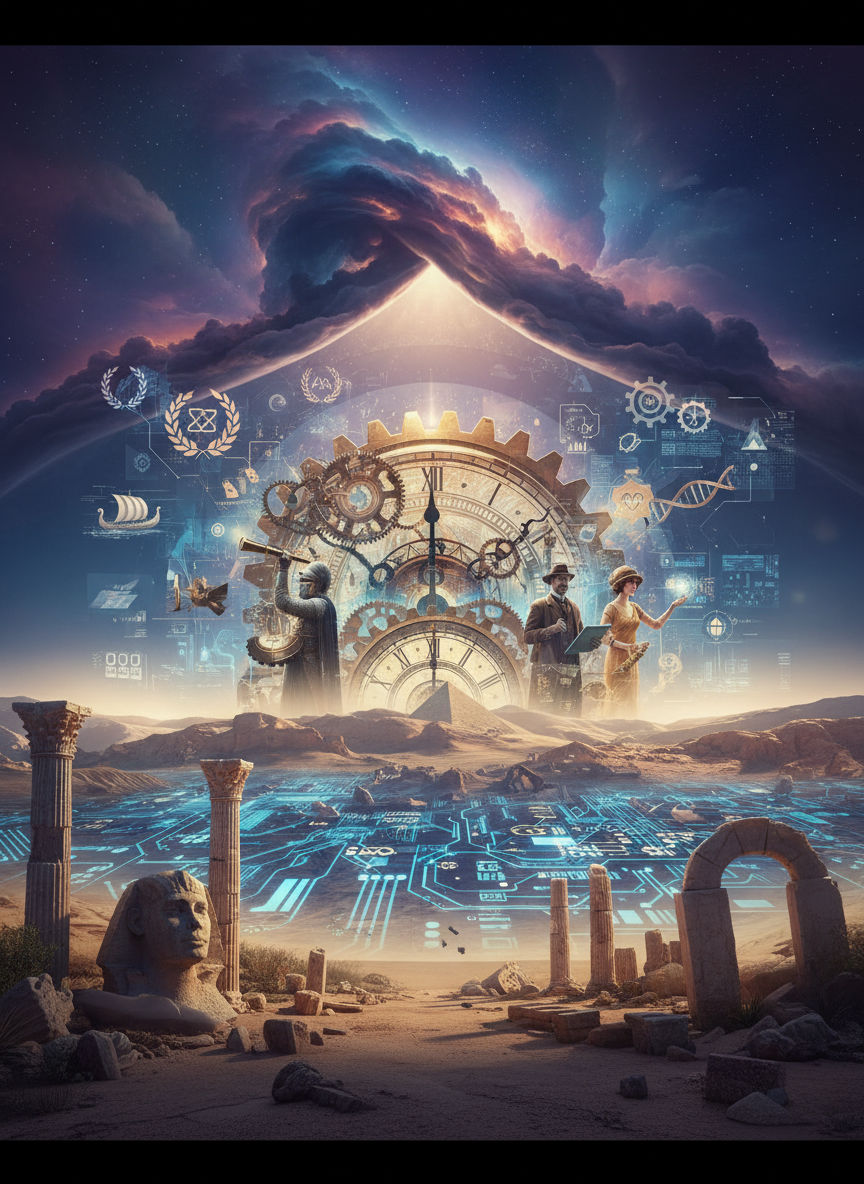
You have just taken a thrilling, whirlwind tour through the tiny building blocks of reality, the elegant math of nature, the epic history of human empires, the stunning beauty of art, and the intense chess game of global politics. But this grand story isn't over yet!
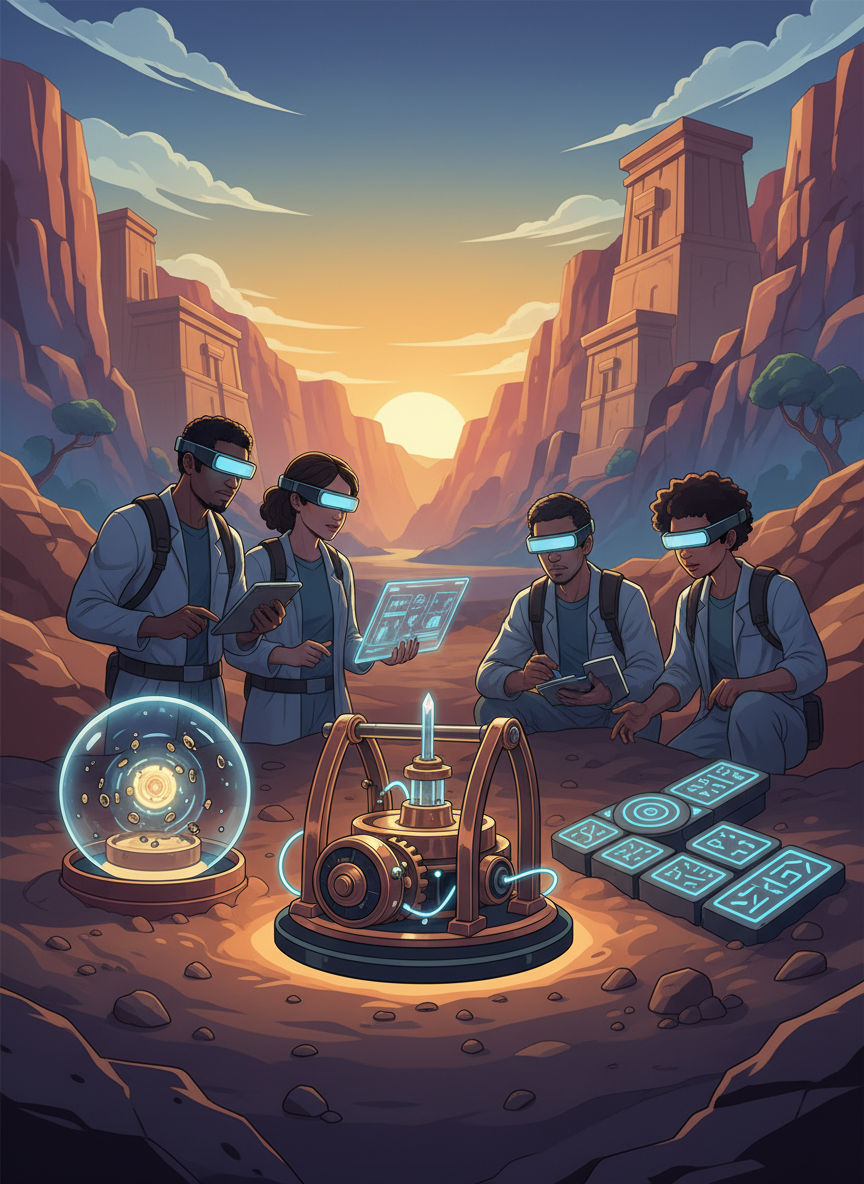
Today, human knowledge and technological progress are accelerating faster than ever before in history. We are actively building artificial intelligence that can paint original pictures, launching reusable rockets that can land themselves, and discovering medical breakthroughs that can literally rewrite our own human DNA. The traditional lines between science, art, and politics are rapidly blurring together.
When a radically new technology is invented, politicians must immediately decide exactly how to safely regulate it. When a massive global climate challenge arises, brilliant scientists and geopolitical leaders must urgently work together to find a lasting solution. Everything in our modern world is deeply connected!
You are the exciting next generation confidently stepping onto this ancient, spinning stage. By truly understanding how the world fundamentally works—from the smallest microscopic atoms to the largest international peace treaties—you will be completely ready to help write the very next exciting chapter of the human story.
Key Takeaway
All fields of human knowledge are deeply connected, and understanding them helps us solve the complex challenges of the future.
Test Your Knowledge
Why is it incredibly important to understand how different subjects like science, politics, and art connect?
Track your progress, earn XP, and compete on leaderboards. Download NerdSip to start learning.