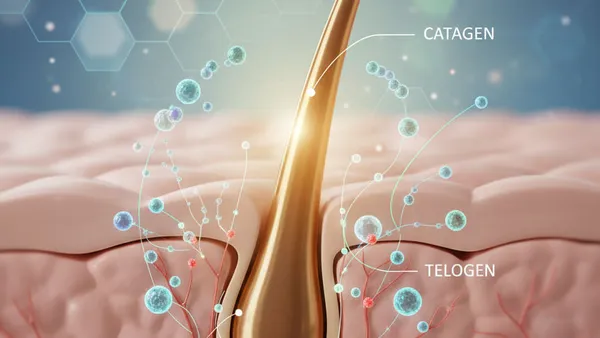
Why do you shed 100 hairs daily but never go bald?
Prompted by NerdSip Explorer #7928
Understand the biology behind your hair's lifespan.
Hair is more than just the strands you style every morning. It's a complex, miniaturized organ! Your hair anatomy is divided into two main parts: the follicle (or root) beneath the skin, and the shaft, which is the visible part you see.
The follicle is alive and highly active. At its very base is the hair bulb, where living cells divide rapidly to build the hair. Tiny blood vessels feed this bulb, delivering the essential nutrients and oxygen necessary for continuous growth. Attached to each follicle is a tiny sebaceous gland that produces sebum, a natural oil that conditions your hair and keeps it from becoming brittle.
Meanwhile, the shaft—the hair you actually brush—is entirely made of dead cells. That's exactly why getting a haircut doesn't hurt! Think of the hair follicle as a bustling 3D printer hidden under your scalp, constantly pushing out a finished, solid product to the surface.
Key Takeaway
The visible hair is entirely dead, while the hidden follicle is a living, active factory.
Test Your Knowledge
Which part of your hair anatomy is actively living and dividing?
What exactly is your hair factory producing? The answer is a tough, protective protein called keratin. If that sounds familiar, it’s because keratin is the exact same sturdy protein that makes up your nails, the outer layer of your skin, and even animal horns!
Inside the hair follicle, living cells are constantly manufacturing keratin. As these newly formed cells are pushed upward by the newer cells beneath them, they undergo a vital process called keratinization. During this process, the cells fill up with keratin, lose their living nucleus, and eventually die.
By the time a hair strand pokes through your scalp, it is essentially a tightly packed column of dead, keratinized cells. This incredibly resilient protein is structured in long, twisted chains that form strong bonds. These chemical bonds dictate your hair's strength, elasticity, and whether your locks are straight, wavy, or curly!
Key Takeaway
Your hair is composed of tightly packed, dead cells filled with a tough protein called keratin.
Test Your Knowledge
What is the primary protein that makes up your hair strands?
Your hair doesn't just grow continuously until you decide to cut it. Instead, every single hair on your body follows a specific, highly regulated biological lifecycle.
This cycle is completely asynchronous—meaning each hair follicle is on its own independent schedule. If they were synced up, you'd shed all your hair at once like a molting snake! Because each follicle operates independently, you maintain a full head of hair even while shedding strands daily.
The hair growth cycle consists of four distinct, carefully timed phases: the Anagen (growth) phase, the Catagen (transition) phase, the Telogen (resting) phase, and the Exogen (shedding) phase. At any given moment, the vast majority of your hair is in the active growth phase, while a smaller percentage is taking a break or getting ready to fall out. This brilliant biological design ensures continuous protection for your scalp.
Key Takeaway
Every single hair follicle follows an independent 4-stage lifecycle of growth, transition, rest, and shedding.
Test Your Knowledge
Why don't humans lose all their hair at the same time?
Welcome to the Anagen phase, the active, bustling growing period of a hair follicle. This is by far the longest phase of the cycle, and for the hair on your scalp, it typically lasts anywhere from two to seven years!
During the Anagen phase, the cells in the root of the hair are dividing rapidly, adding to the hair shaft and pushing it upwards and out of the skin. On average, your scalp hair grows about half an inch (roughly 1.25 centimeters) per month during this time. This constant division of cells requires massive amounts of energy.
The length of your Anagen phase is largely determined by your genetics. People with a very long Anagen phase can naturally grow their hair down to their waist, while those with a shorter phase may find their hair stops growing past their shoulders. Right now, about 85% to 90% of the hair on your head is in this phase.
Key Takeaway
The Anagen phase is the multi-year active growth period, and its length determines your maximum hair length.
Test Your Knowledge
What primary factor dictates how long your Anagen (growth) phase lasts?
All good things must come to an end, and for your hair's epic growth spurt, that end is the Catagen phase. This is a short, transitional period that lasts only about two to three weeks.
After years of continuous growth, the hair follicle suddenly receives a biological signal to hit the brakes. During Catagen, active hair growth completely stops. The hair follicle actually shrinks in size, reducing to about a sixth of its normal length. The deepest part of the follicle collapses, and the hair detaches from the blood supply at the base.
This detached, non-growing hair is now called a club hair. While it's no longer actively growing, the club hair doesn't fall out just yet. It remains firmly anchored in place while the follicle begins to prepare for its upcoming rest period. Only about 1% of your hair is in this transitional phase at any time.
Key Takeaway
The Catagen phase is a brief transition where the hair stops growing and detaches from its blood supply.
Test Your Knowledge
What is a hair called once it detaches from its blood supply during the Catagen phase?
After the high-energy activity of growth and the sudden shutdown of transition, the hair follicle takes a well-deserved vacation. This is the Telogen phase, also known as the resting phase. For the hair on your scalp, this period lasts roughly three months.
During the Telogen phase, the club hair remains securely resting in the follicle, but absolutely no new growth occurs. Meanwhile, beneath the surface, the biological machinery is quietly resetting. The stem cells in the follicle are resting and preparing to eventually build a brand new hair.
Roughly 10% to 15% of the hairs on your head are in the Telogen phase right now. Interestingly, if you experience immense physical or emotional stress—like an illness, extreme diet, or trauma—your body can prematurely shock a large number of hairs into this resting phase. This condition, known as telogen effluvium, leads to noticeable hair thinning a few months after the stressful event.
Key Takeaway
The Telogen phase is a three-month resting period where no growth occurs, but the follicle prepares to reset.
Test Your Knowledge
What happens to the hair follicle during the Telogen phase?
The final stage of the hair lifecycle is the Exogen phase, which is simply the shedding of the old, resting hair. Many biologists consider this an extension or the final step of the Telogen phase.
As the resting period comes to an end, the hair follicle finally wakes up and re-enters the Anagen (growth) phase. A brand new hair begins to form at the base of the follicle. As this new hair vigorously grows upward, it eventually dislodges the old, resting club hair, pushing it out of the skin.
This is why it is completely normal to lose 50 to 100 hairs every single day! You will see them in your hairbrush, in the shower drain, or on your clothes. This daily shedding isn't a sign of balding; it is a healthy, natural biological indicator that new hairs are actively pushing their way to the surface to restart the cycle.
Key Takeaway
Shedding up to 100 hairs a day is normal and happens because new hairs are pushing the old ones out.
Test Your Knowledge
What physically causes the old hair to fall out during the Exogen phase?
Did you know you are almost completely covered in hair? Humans have about 5 million hair follicles, roughly the same number as chimpanzees! The major difference between us and apes lies in the *type* of hair we produce.
There are two main types of hair on the human body: Vellus hair and Terminal hair. Vellus hairs are the short, fine, almost invisible "peach fuzz" strands that cover most of your body. Their primary job is to help regulate body temperature and evaporate sweat.
Terminal hairs, on the other hand, are the thick, deeply pigmented, and longer hairs found on your scalp, eyebrows, and eyelashes. During puberty, hormones called androgens cause many of your tiny vellus follicles (like those on your arms, chest, and face) to transform into larger terminal hair follicles. This is why human hair texture and density change so significantly as we transition from childhood into adulthood.
Key Takeaway
Humans are covered in fine vellus hair (peach fuzz), some of which turns into thick terminal hair during puberty.
Test Your Knowledge
What is the primary function of fine Vellus hair?
While the biological growth cycle is universal, the speed and quality of your hair growth are heavily influenced by several external and internal factors. The primary driver is genetics, which determines your natural hair color, texture, and phase lengths.
Hormones play a massive role as well. For example, pregnancy often keeps hair in the growth phase much longer, resulting in thick, luxurious hair—followed by heavy shedding post-partum when hormones normalize. Age also naturally slows down the cycle; as we get older, hair follicles gradually shrink, and the Anagen phase shortens, leading to naturally thinner hair.
Finally, nutrition is absolutely critical. Because hair growth is considered biologically non-essential for survival, your body will rapidly redirect nutrients to vital organs if you are deficient in key components like iron, protein, zinc, or certain vitamins. A balanced diet ensures your hair factory has the raw materials needed for production.
Key Takeaway
Genetics, hormones, age, and nutrition all dynamically interact to control the speed and quality of your hair growth.
Test Your Knowledge
Why might a poor diet lead to hair loss?
It's time to bust some of the most persistent myths about hair growth! Understanding how your hair biology actually works empowers you to care for it properly, without falling for old wives' tales.
Myth 1: Cutting your hair makes it grow faster. False! The hair shaft is entirely dead. Trimming it removes split ends and makes the hair *look* healthier, but it has absolutely no effect on the living follicle buried in your scalp.
Myth 2: Plucking a gray hair makes two more grow back. False! A single follicle only produces one hair, and plucking it doesn't magically create new follicles. However, repetitive over-plucking can permanently damage the root, meaning no hair will grow back at all.
Myth 3: Shampooing too much causes hair loss. False! Seeing hair in the drain can be scary, but washing simply dislodges hairs that were already in the Exogen (shedding) phase. Good scalp hygiene is highly beneficial!
Key Takeaway
Cutting your hair doesn't increase its growth rate, as the visible hair is dead and disconnected from the root's biological signals.
Test Your Knowledge
Does trimming the ends of your hair cause it to grow faster from the scalp?
Track your progress, earn XP, and compete on leaderboards. Download NerdSip to start learning.