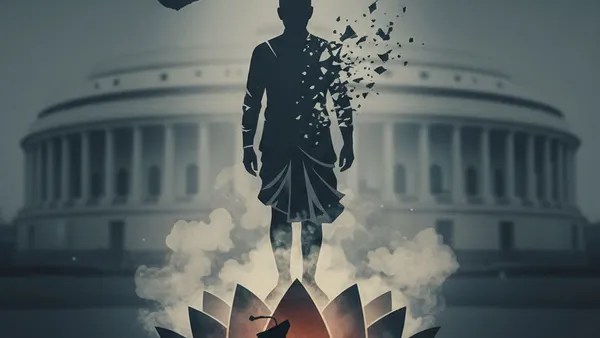
Why did a foreign peace mission end in tragedy?
Prompted by NerdSip Explorer #9048
Understand the history behind a shocking assassination.
In the 1980s, India’s island neighbor, Sri Lanka, was locked in a brutal civil war. A militant group known as the Liberation Tigers of Tamil Eelam (LTTE) was fighting the Sri Lankan government to carve out an independent state for the Tamil minority.
In 1987, India’s then-Prime Minister, Rajiv Gandhi, stepped in to help negotiate an end to the bloodshed. He signed a peace accord and dispatched the Indian Peace Keeping Force (IPKF) to Sri Lanka.
The goal was simple: disarm the militants and maintain peace. However, things quickly spiraled out of control. The LTTE refused to surrender their weapons, and the Indian peacekeepers found themselves dragged into a bitter, full-scale conflict with the very rebels they were sent to disarm.
By 1990, the IPKF was officially withdrawn from Sri Lanka after taking heavy casualties. But the political damage was done. The LTTE deeply resented India's intervention, setting the stage for one of the most shocking assassinations in modern history.
Key Takeaway
India's attempt to keep peace in Sri Lanka led to a bitter conflict with the LTTE militant group.
Test Your Knowledge
What was the primary mission of the Indian Peace Keeping Force (IPKF) when it was sent to Sri Lanka in 1987?
By early 1991, Rajiv Gandhi was no longer the Prime Minister, but he was campaigning relentlessly across India to win back his seat in the upcoming general elections.
Across the ocean in Sri Lanka, the LTTE was watching closely. Their leadership harbored a deep, simmering grudge against Gandhi for sending the military force that had severely weakened their fighters.
The tipping point came during a magazine interview. Gandhi publicly stated that if he were re-elected as Prime Minister, he would strongly consider sending the Indian military back to Sri Lanka to finish disarming the LTTE.
For the militant group, this was perceived as an existential threat. They believed that Gandhi’s return to power would spell the end of their movement. To ensure he never returned to office, the LTTE made a chilling, highly secretive decision: they would eliminate him before the elections concluded.
Key Takeaway
A threat to send the Indian military back to Sri Lanka motivated the LTTE to assassinate Rajiv Gandhi.
Test Your Knowledge
What specific event triggered the LTTE's decision to plot the assassination?
On the fateful night of May 21, 1991, Rajiv Gandhi arrived in Sriperumbudur, a quiet town in southern India, to address a late-night election rally.
As he stepped out of his car, he was swarmed by a massive crowd of adoring supporters, political workers, and schoolchildren. Security protocols were alarmingly loose, allowing the public to get intimately close to the high-profile leader.
Among the crowd was a young woman holding a traditional sandalwood garland. Known by her alias, Dhanu, she was a highly trained LTTE operative operating as a "human bomb."
Dhanu approached Gandhi to offer the garland. As she bent down to respectfully touch his feet—a traditional Indian greeting—she triggered a powerful explosive belt hidden beneath her clothes. The devastating blast instantly claimed the lives of Rajiv Gandhi, the assassin herself, and 14 innocent bystanders, changing the course of Indian history forever.
Key Takeaway
Rajiv Gandhi was killed by a suicide bomber who approached him in a loosely secured crowd at an election rally.
Test Your Knowledge
How did the assassin manage to get close enough to Rajiv Gandhi to trigger the explosion?
The assassination sent shockwaves around the globe. India had lost a major political figure, and the authorities desperately needed answers.
A Special Investigation Team (SIT) was rapidly assembled. Because the assassin had died in the explosion, detectives initially had very few clues to work with. How do you catch a shadow network when the main culprit is gone?
The breakthrough came from an incredibly tragic but crucial piece of evidence. The LTTE had hired a local photographer, a man named Haribabu, to document the assassination. He was killed in the blast, but his camera miraculously survived the explosion.
When investigators developed the film found inside his camera, it revealed a step-by-step visual record of the conspirators in the moments leading up to the blast. These haunting photographs blew the secret LTTE operation wide open, allowing detectives to identify and hunt down the key planners.
Key Takeaway
Photographs recovered from a camera at the crime scene provided the crucial evidence needed to identify the conspirators.
Test Your Knowledge
What crucial piece of evidence led investigators to uncover the assassination plot?
The assassination of Rajiv Gandhi had profound, long-lasting ripple effects on South Asian geopolitics.
Immediately, India drastically shifted its foreign policy. The government completely withdrew its sympathy and support for Tamil militants, adopting a strict "hands-off" approach to the Sri Lankan civil war that lasted for decades.
Domestically, the investigation led to the arrest of dozens of conspirators. After lengthy trials, the Indian Supreme Court sentenced several key individuals to life in prison.
In a highly controversial twist, after spending over 30 years behind bars, the surviving convicts were released by the Supreme Court in 2022 on grounds of long incarceration and good behavior. This sparked immense debate between those advocating for human rights and the grieving families of the 14 innocent bystanders who died that day. Today, the tragedy remains a sobering lesson on the devastating consequences of political violence.
Key Takeaway
The assassination drastically shifted India's foreign policy and resulted in decades-long legal battles that remain controversial today.
Test Your Knowledge
How did India's foreign policy toward Sri Lanka change immediately after the assassination?
Track your progress, earn XP, and compete on leaderboards. Download NerdSip to start learning.