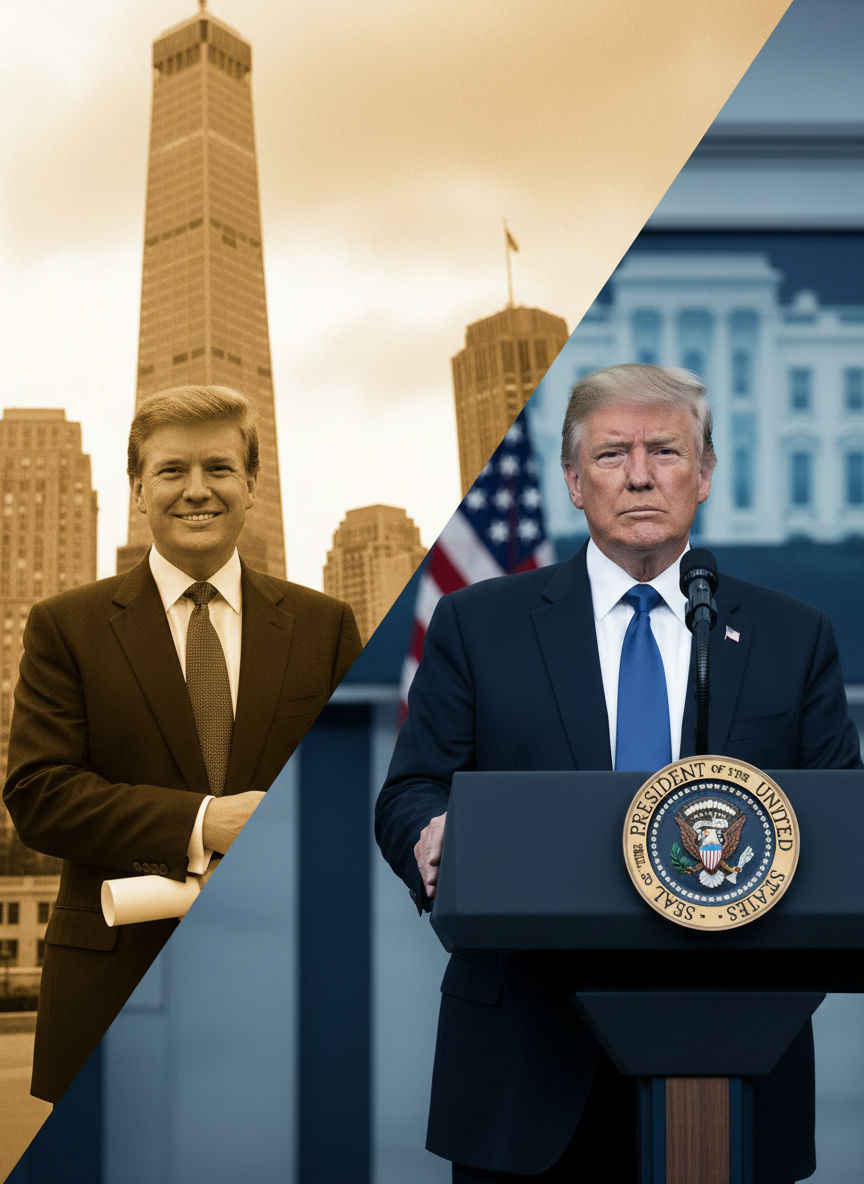
How did a reality TV star pull off the ultimate political comeback?
Prompted by A NerdSip Learner
Understand the 10 defining eras of Donald Trump's life.
Donald John Trump was born in 1946 in the borough of Queens, New York. His sprawling story begins not in the glitz of Manhattan, but in the working-class and middle-class neighborhoods of the outer boroughs. He was the son of Fred Trump, a highly successful and strict real estate developer who built thousands of residential apartments in Brooklyn and Queens.
Growing up in a wealthy and privileged household, Trump was sent to the New York Military Academy as a teenager to instill a sense of discipline and toughness. He later attended Fordham University for two years before transferring to the prestigious Wharton School of the University of Pennsylvania, where he graduated in 1968 with a degree in economics.
Rather than striking out entirely on his own, Trump decided to join his father’s established company, "Elizabeth Trump & Son." By 1971, he was given total control of the business. This early period was incredibly crucial; it provided him with the financial capital, the foundational knowledge of the construction industry, and the ambitious drive that would eventually propel him across the East River to pursue far grander, much riskier real estate ventures.
Key Takeaway
Trump built his early foundation by inheriting and managing his father's highly successful middle-class residential real estate business.
Test Your Knowledge
Which prestigious university did Donald Trump graduate from before taking control of his father's business?
Upon taking total control of his father's company in 1971, Donald Trump swiftly renamed it The Trump Organization. His most pivotal early business decision was deliberately shifting the company's focus away from middle-class housing in the outer boroughs and moving into the glamorous, high-stakes world of Manhattan commercial real estate.
In the late 1970s, New York City was facing a severe, debilitating economic crisis. Seeing an incredible opportunity where others saw only financial ruin, Trump partnered with the Hyatt organization and the city government to completely transform the crumbling Commodore Hotel into the gleaming Grand Hyatt in 1980. It was a massive financial success.
His crowning architectural achievement came a few years later in 1983 with the completion of Trump Tower on prestigious Fifth Avenue. With its lavish pink marble atrium, upscale boutiques, and cascading indoor waterfall, the skyscraper quickly became a national symbol of 1980s wealth. Trump carefully cultivated a flashy, billionaire playboy persona, ensuring that his name became permanently synonymous with luxury, excess, and the booming New York skyline.
Key Takeaway
He transformed a regional housing business into a luxury Manhattan real estate empire by taking massive risks during an economic downturn.
Test Your Knowledge
What iconic skyscraper did Trump complete and open on Fifth Avenue in 1983?
Following his massive Manhattan triumphs, Trump embarked on an exciting decade of aggressive and highly publicized corporate expansion. Throughout the 1980s and early 1990s, he rapidly bought up lavish casinos in Atlantic City (most notably the sprawling Trump Taj Mahal), launched a regional airline called the Trump Shuttle, and even released a branded board game featuring his face.
However, this rapid, unchecked expansion was largely fueled by massive, high-interest corporate debt. When the commercial real estate market unexpectedly crashed in the early 1990s, Trump found himself billions of dollars in the red. He faced multiple corporate bankruptcies, and many seasoned financial analysts believed his once-promising career was effectively over.
Instead of permanently folding, Trump orchestrated an incredibly impressive business pivot. Recognizing that his recognizable name was his absolute most valuable asset, he shifted away from purely building and owning real estate himself. He actively began licensing his name to other ambitious developers. By slapping the premium "Trump" brand on golf courses, steaks, and luxury condominiums worldwide, he successfully climbed his way back to financial prominence.
Key Takeaway
Despite major financial setbacks in the 1990s, Trump managed to pivot by turning his famous name into a highly profitable, licensable brand.
Test Your Knowledge
How did Trump primarily change his business model to recover from massive financial struggles in the 1990s?
In the year 2004, Donald Trump’s career took a dramatic, unexpected turn that would forever change his life's trajectory: he became a massive reality television star. Teaming up with brilliant reality TV producer Mark Burnett, Trump launched a brand new competition series called The Apprentice on the NBC network.
The hit show featured ambitious contestants competing in intense weekly business tasks to win a highly coveted one-year contract to run one of Trump's many companies. Trump served as the ultimate, unquestioned judge, sitting menacingly at the head of a dark boardroom table. The show became an instant cultural phenomenon, largely thanks to Trump’s dramatic delivery of his trademark catchphrase: "You're fired!"
For well over a decade, *The Apprentice* beamed Trump directly into the living rooms of millions of Americans every single week. It masterfully rebranded his public image. To the broader public, he wasn't just a New York developer who had faced financial ups and downs; he was presented as the infallible, decisive, and fiercely successful ultimate boss. This powerful television persona laid the crucial psychological groundwork for his future political ambitions.
Key Takeaway
Reality television transformed Trump from a polarizing New York developer into a beloved nationwide pop-culture icon.
Test Your Knowledge
Which famous catchphrase did Trump heavily popularize while hosting The Apprentice?
Long before his historic 2016 run, Donald Trump frequently flirted with the idea of entering the political arena. He routinely purchased full-page newspaper advertisements to publicly voice his strong opinions on foreign policy and international trade. In the year 2000, he even went as far as forming an exploratory committee to seek the presidential nomination of the Reform Party.
Though he ultimately abandoned that 2000 campaign, Trump remained a highly vocal political commentator. Over the years, he changed his political party registration several times, moving fluidly between the Democrats, Republicans, and Independents depending on the political climate.
In the early 2010s, he began to heavily align himself with the grassroots conservative movement. He gained immense traction among right-wing voters by frequently appearing on conservative news networks and vocally promoting the controversial "birther" conspiracy theory regarding President Barack Obama. By actively testing the political waters and building a dedicated national following, Trump slowly but surely transformed himself from a celebrity businessman into a serious political force.
Key Takeaway
Before his successful presidential run, Trump spent decades testing the political waters and building a dedicated base of conservative supporters.
Test Your Knowledge
Which third party did Donald Trump briefly explore a presidential run with in the year 2000?
In June 2015, Donald Trump famously descended a gleaming golden escalator inside Trump Tower to officially announce his candidacy for the President of the United States. Many seasoned political experts and mainstream media outlets initially laughed off his unorthodox campaign, dismissing it as a mere publicity stunt to boost his personal brand.
However, Trump quickly proved the entire establishment wrong. Operating under the incredibly catchy slogan "Make America Great Again" (MAGA), he hosted massive, raucous stadium rallies across the country. His populist, America-first messaging focused heavily on restricting illegal immigration, renegotiating international trade deals, and bringing outsourced manufacturing jobs back to American soil. He famously bypassed traditional media gatekeepers entirely, using his Twitter account to speak directly to his passionate supporters and hurl insults at his rivals.
Defying nearly all conventional political wisdom and national polling predictions, Trump easily defeated a crowded field of highly experienced Republican candidates. In the general election, he pulled off one of the biggest, most shocking political upsets in American history by defeating Democratic nominee Hillary Clinton, securing the Electoral College to become the 45th President.
Key Takeaway
Trump's populist messaging and highly unconventional campaign style led to one of the biggest political upsets in modern American history.
Test Your Knowledge
What was the primary, highly recognizable slogan of Donald Trump's 2016 presidential campaign?
Sworn in as the 45th President in January 2017, Donald Trump immediately set out to rapidly implement his highly anticipated "America First" agenda. His administration was primarily characterized by a heavy, relentless focus on aggressive deregulation, tightening border security, and implementing trade protectionism, frequently using economic tariffs to loudly pressure foreign nations.
On the domestic front, his absolute signature legislative achievement was the passage of the Tax Cuts and Jobs Act of 2017, which significantly lowered the corporate tax rate and altered the tax code. Another enduring, generation-defining legacy of his first term was his rapid reshaping of the federal judiciary; Trump successfully appointed over 200 conservative federal judges, importantly including three conservative Supreme Court justices, cementing a right-leaning majority for decades.
Trump’s day-to-day governing style was unprecedented and highly unconventional. He routinely used his personal social media accounts to officially announce major policy changes, fire cabinet members, and aggressively attack his critics. This direct, unfiltered approach deeply energized his devoted political base while simultaneously drawing intense, daily criticism from political opponents and the mainstream press.
Key Takeaway
Trump's first term heavily focused on economic deregulation, major tax cuts, and permanently reshaping the federal judiciary.
Test Your Knowledge
Which of the following is widely considered a major domestic legislative achievement during Trump's first term?
Donald Trump’s first term in office was marked by intense political polarization and unprecedented controversy. Among all his actions, he holds the unique historical distinction of being the very first United States president to be impeached twice by the House of Representatives.
The first impeachment occurred in late 2019. The House of Representatives charged him with abuse of power and obstruction of Congress, alleging that he pressured the President of Ukraine to investigate his political rival, Joe Biden. Following a highly partisan trial, Trump was subsequently acquitted by the Republican-led Senate in early 2020.
His second impeachment took place during the chaotic final days of his presidency in January 2021. Following the violent and shocking attack on the U.S. Capitol by his supporters, the House quickly impeached him on the charge of "incitement of insurrection." He was once again acquitted by the Senate, though this vote occurred after he had already left office. These historic dual impeachments deeply underscore the bitterly divisive nature of his time in power.
Key Takeaway
Trump's tenure was marked by incredibly deep partisan division, culminating in him becoming the first U.S. president to be impeached twice.
Test Your Knowledge
Donald Trump was the first U.S. president in history to experience what major political event?
The 2020 presidential election took place during the frightening height of the global COVID-19 pandemic, a crisis that led to a massive, unprecedented surge in mail-in voting across the country. After a bitter campaign, Trump ultimately lost the election to Democratic nominee Joe Biden. However, completely breaking with centuries of peaceful American democratic tradition, Trump firmly refused to concede the race.
Instead, he quickly launched a sprawling, months-long legal and public relations campaign to vigorously challenge the election results across multiple swing states, loudly promoting unproven claims of widespread voter fraud. These intense efforts eventually culminated in the tragic events of January 6, 2021, when a mob of his supporters violently breached the U.S. Capitol, an event that deeply fractured the nation.
Following his rocky departure from the White House, Trump’s unprecedented legal troubles rapidly multiplied. In a historically shocking situation for a former U.S. president, he was criminally indicted in multiple state and federal cases. These severe charges ranged from falsifying his business practices in New York to his controversial handling of classified documents. Despite these massive legal hurdles, his iron grip on the Republican voter base impressively remained completely unshaken.
Key Takeaway
Following his 2020 defeat, Trump broke major political precedent by aggressively challenging the election results and navigating massive legal indictments.
Test Your Knowledge
Who defeated Donald Trump in the 2020 United States presidential election?
In an awe-inspiring political comeback that completely stunned the modern political world, Donald Trump proudly announced he would run for the presidency once again in the 2024 election. Despite facing numerous, heavy ongoing legal battles and the lingering political fallout from his bitter 2020 defeat, he easily steamrolled all of his primary opponents to firmly secure the Republican nomination.
Campaigning vigorously on promises to quickly fix the inflated economy, strictly strengthen national borders, and dismantle the established political elite, Trump successfully capitalized on widespread public dissatisfaction. In November 2024, he decisively defeated incumbent Vice President Kamala Harris, securing not only the required Electoral College votes but also shockingly winning the national popular vote—an impressive feat he had notably not achieved in his two previous presidential campaigns.
This monumental, history-making victory officially made Donald Trump the 47th President of the United States. He joined the ranks of Grover Cleveland as only the second president in all of American history to be elected to two nonconsecutive terms. It firmly cemented his polarizing legacy as one of the most resilient, influential, and utterly unique figures in modern political history.
Key Takeaway
Overcoming incredible legal hurdles and past political defeats, Trump achieved a historic victory in 2024 to win a nonconsecutive second term.
Test Your Knowledge
Which unique historical milestone did Donald Trump achieve by successfully winning the 2024 election?
Track your progress, earn XP, and compete on leaderboards. Download NerdSip to start learning.