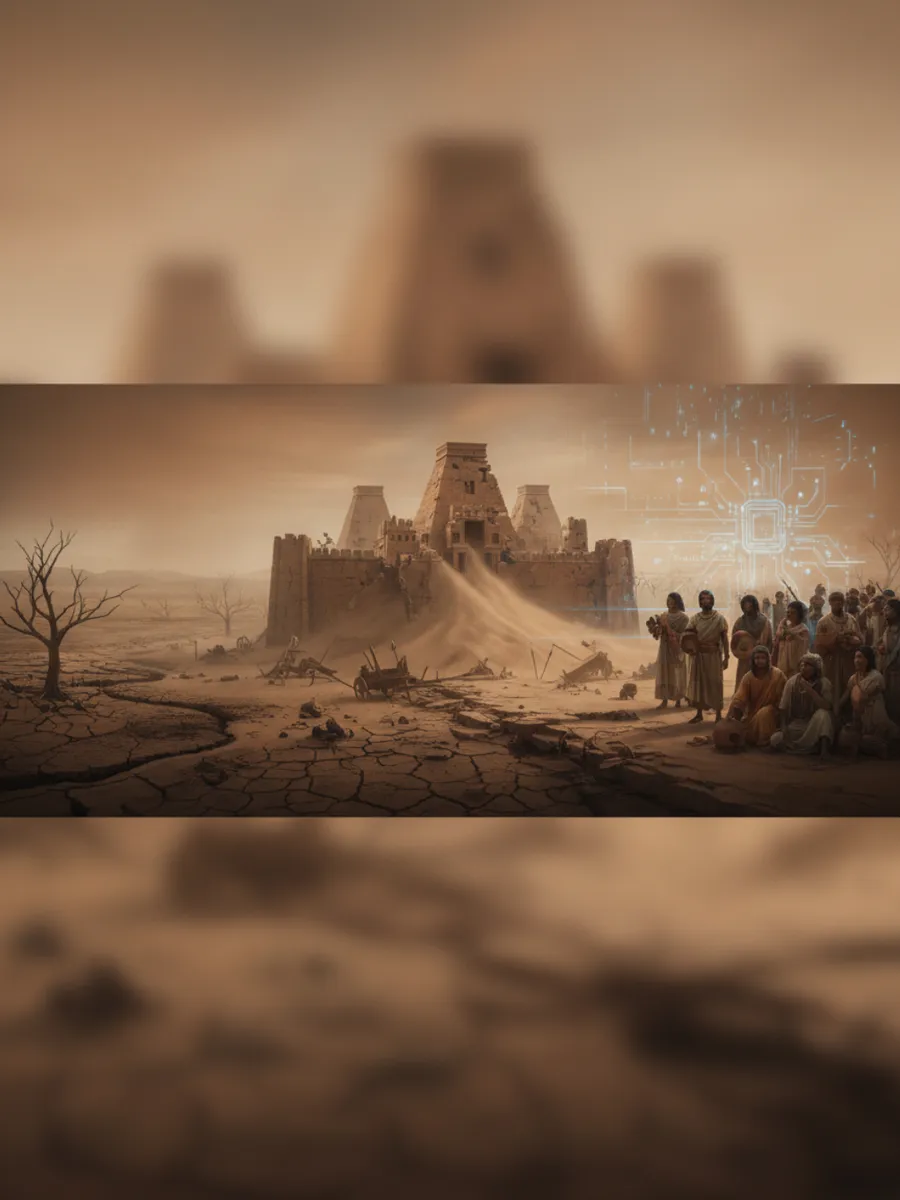
How did every major civilization on Earth vanish at the exact same time?
Prompted by A NerdSip Learner
Identify the 4 main theories behind the Bronze Age Collapse.
Imagine a world more interconnected than anyone thought possible for the time. In the Late Bronze Age, around 1300 BC, the Eastern Mediterranean was a thriving network of superpowers. From the mighty Egyptians and the fierce Hittites to the sophisticated Mycenaeans in Greece, these civilizations traded gold, tin, and olive oil across vast distances.
This wasn't just a collection of isolated tribes; it was a 'globalized' economy. They shared diplomatic letters, royal marriages, and complex trade routes that relied on every partner staying stable. If you lived in a palace in Crete, you likely ate from Egyptian pottery and wore jewelry made with tin from as far away as Afghanistan.
It was a peak of human achievement, characterized by massive stone architecture, advanced writing systems like Linear B, and centralized 'palace economies.' But beneath this shimmering surface of prosperity, the very interconnectedness that made them strong was also their greatest vulnerability.
Key Takeaway
The Bronze Age was a highly interconnected 'global' system of superpowers that relied heavily on international trade.
Test Your Knowledge
What was a defining characteristic of the Late Bronze Age superpowers?
In the year 1177 BC, the world changed forever. Within a single generation, almost every major city in the Eastern Mediterranean was destroyed, abandoned, or reduced to rubble. This wasn't a slow decline; it was a sudden, violent, and total collapse that wiped out writing, art, and complex government for centuries.
Historian Eric Cline uses the date 1177 BC as a shorthand for this catastrophic era. In Egypt, Pharaoh Ramses III fought a desperate battle against mysterious 'Sea Peoples' who arrived by ship, seeking a new home. While Egypt survived, they were never the same, and their neighbors—the Hittites and Mycenaeans—simply vanished from history.
How could such advanced societies disappear so quickly? Archaeologists find 'destruction layers' in the soil—charcoal and arrowheads that tell a story of fire and war. But the mystery lies in what caused this domino effect. Was it one single event, or a perfect storm of disasters?
Key Takeaway
The collapse was a rapid, near-simultaneous event that saw the destruction of major cities and the loss of literacy.
Test Your Knowledge
What does the date '1177 BC' represent in this context?
The first major theory focuses on environmental catastrophes. Modern science, using pollen analysis and oxygen isotopes from caves, has revealed that a 'megadrought' struck the region around 1200 BC. This wasn't just a dry summer; it lasted for decades, causing widespread crop failures and famine.
Imagine a society where the King's primary job is to ensure the gods provide rain. When the grain silos went empty, the social contract broke. Letters found in the ruins of Ugarit plead for help, stating, 'There is famine in our house; we shall all die of hunger.'
To make matters worse, the region entered a period of 'earthquake storms.' A series of massive tectonic shifts leveled palaces from Greece to the Levant. While an earthquake alone wouldn't end a civilization, the combination of starvation and crumbling infrastructure left these empires defenseless.
Key Takeaway
Severe, prolonged drought and a series of earthquakes weakened the foundations of Bronze Age societies.
Test Your Knowledge
How do scientists know a 'megadrought' occurred around 1200 BC?
For a long time, historians blamed a single group of villains: The Sea Peoples. Egyptian records describe them as a 'confederation' of seafaring raiders who came from the islands and the north, 'spreading fire' wherever they went. They were the Vikings of the Bronze Age, but much more mysterious.
These weren't just soldiers; they were refugees. Evidence suggests they traveled with their families and belongings in ox-carts, implying they were fleeing their own dying homelands. They attacked the Hittites, the Levant, and eventually Egypt, acting as a final hammer blow to already struggling states.
While the Sea Peoples were certainly real, many modern historians now see them as a *symptom* of the collapse rather than the sole *cause*. They were people displaced by the same disasters that were toppling the empires they attacked.
Key Takeaway
The 'Sea Peoples' were displaced groups who migrated and raided across the Mediterranean, accelerating the collapse.
Test Your Knowledge
Which of the following best describes the 'Sea Peoples'?
If the world is ending and the King can't feed you, why would you keep serving him? The third theory focuses on internal rebellion and social revolution. The Bronze Age was a time of extreme inequality, where a tiny elite in the palaces controlled all the wealth and resources.
When the trade routes failed and food became scarce, the lower classes—the peasants and the debt-slaves—likely reached a breaking point. Archaeologists have noticed that in some destroyed palaces, the fire was concentrated only on the administrative wings, where the tax records and debt ledgers were kept.
This suggests that the 'invaders' might have sometimes been the city's own inhabitants rising up against a system that no longer protected them. Once the central authority was gone, the complex 'palace economy' vanished instantly.
Key Takeaway
Internal social unrest and peasant revolts likely destroyed the administrative hearts of these civilizations from the inside.
Test Your Knowledge
What evidence suggests an 'internal' rebellion rather than an outside attack?
The most modern and widely accepted theory is the 'Systemic Collapse' or 'Complexity Theory.' This suggests that these civilizations were so interconnected and specialized that if one part failed, the whole machine ground to a halt. It’s the ultimate 'domino effect.'
Think of it like a modern supply chain. If the tin mines in the north closed due to war, the bronze production in the south stopped. Without bronze, you couldn't make tools or weapons. Without weapons, you couldn't defend against the Sea Peoples. Without defense, your farmers were killed, leading to famine.
This theory argues that there wasn't just *one* cause. Instead, it was a 'Perfect Storm' of drought, earthquakes, migration, and rebellion hitting a fragile, over-stretched system all at once. The complexity that made the Bronze Age great also made it impossible to repair once the links were broken.
Key Takeaway
Systemic collapse occurs when interconnected parts of a society fail simultaneously, leading to a total breakdown.
Test Your Knowledge
According to the 'Systemic Collapse' theory, why did the empires fall?
The Bronze Age Collapse was a tragedy, but it wasn't the end of humanity. It led to a 'Dark Age' that lasted for nearly 400 years, but out of that darkness, something new emerged: The Iron Age. Because tin and copper trade had vanished, people learned to work with iron, which was harder to process but much more common.
Without the giant empires of the Hittites and Mycenaeans, smaller, more flexible societies began to grow. This era eventually gave birth to the Phoenicians (who gave us the alphabet) and the Greeks (who eventually gave us democracy). The collapse forced humanity to reinvent itself.
Today, the 1177 BC mystery serves as a warning. It shows us that even the most powerful, globalized civilizations can be fragile. By studying the four theories—Environment, Migration, Rebellion, and Systemic Failure—we can better understand how to build a world that is resilient enough to survive its own 'Perfect Storm.'
Key Takeaway
The collapse ended the Bronze Age but paved the way for the Iron Age and more resilient, decentralized societies.
Test Your Knowledge
Which of the 4 main theories involves 'Systemic Collapse'?
Track your progress, earn XP, and compete on leaderboards. Download NerdSip to start learning.