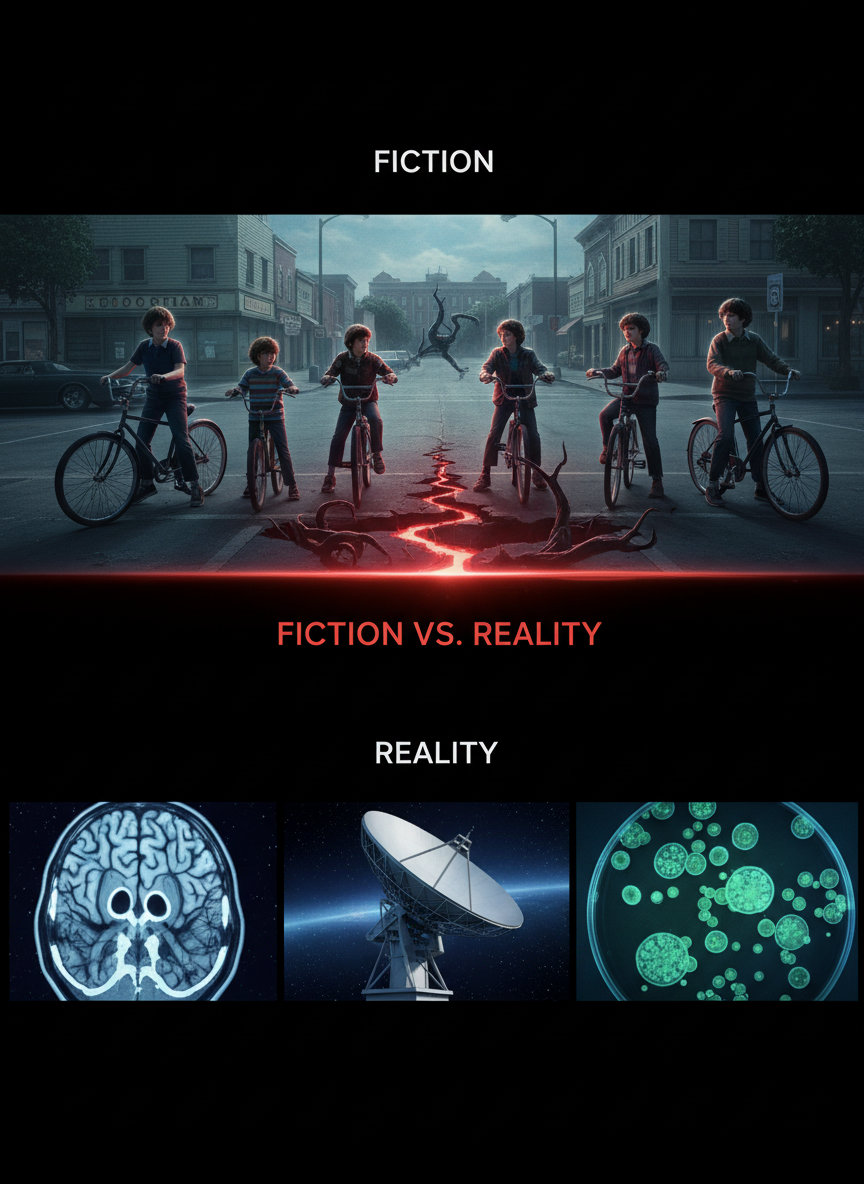
Could the experiments in Hawkins actually happen in real life?
Prompted by A NerdSip Learner
Uncover the true history and science behind the hit show.
You know Dr. Brenner and his creepy lab in Hawkins? He wasn't just a figment of the Duffer Brothers' imagination. His character is heavily inspired by a real CIA program called Project MKUltra. Starting in the 1950s, the US government actually conducted secret experiments on human subjects—sometimes illegal ones—to explore mind control and telepathy.
Just like Eleven, real participants were subjected to sensory deprivation tanks and hallucinogenic drugs like LSD. The goal was to see if the human mind could be weaponized against enemies during the Cold War. While no one developed telekinetic powers to crush Coke cans (that we know of!), the trauma and secrecy were very real.
So, while the monsters might be CGI, the idea of the government tinkering with human consciousness in a dark lab is historically accurate. The show simply took these classified files and turned the volume up to eleven!
Key Takeaway
Eleven’s origin story is based on Project MKUltra, a real CIA mind-control program from the Cold War.
Test Your Knowledge
What was the primary goal of the real-life Project MKUltra?
Before it was called *Stranger Things*, the show was originally titled *Montauk*. Why? Because the script is based on a famous conspiracy theory surrounding Camp Hero in Montauk, New York. According to urban legends, the US military conducted experiments there involving time travel, psychological warfare, and even contact with extraterrestrials.
The central rumor involves the "Montauk Chair," a device said to boost psychic powers. Stories claim that a psychic sitting in the chair could manifest objects out of thin air or open wandering portals—sound familiar? This is exactly how the gate to the Upside Down is opened in the show.
While historians maintain Camp Hero was just a radar station, the legends provided the perfect blueprint for Hawkins National Laboratory. The show runners took these whispers of kidnapped children and interdimensional rifts and relocated them to Indiana for that small-town 80s vibe.
Key Takeaway
The show was originally named after the Montauk Project, a conspiracy theory about military time-travel experiments.
Test Your Knowledge
Which specific device from the Montauk conspiracy theories appears to have inspired the show?
Is a dark, parallel dimension like the Upside Down scientifically possible? In the show, Mr. Clarke uses the "Flea and the Acrobat" analogy to explain other dimensions. Believe it or not, this is a real concept used by physicists to explain String Theory and extra dimensions!
The idea is that we are like the acrobat, moving on a tightrope (our visible 3D world). We can only go forward or backward. But a flea (a subatomic particle) might be able to crawl around the side of the rope, accessing dimensions we can't see.
Furthermore, the Many-Worlds Interpretation of quantum mechanics suggests that every decision creates a branching new timeline. While traveling between them remains pure fiction for now, the math implies that parallel realities—perhaps darker versions of our own—could theoretically exist right next to us, separated only by a vibrational veil.
Key Takeaway
The 'Upside Down' is based on the Many-Worlds Interpretation and String Theory concepts of extra dimensions.
Test Your Knowledge
What analogy does the show (and real physicists) use to explain extra dimensions?
Track your progress, earn XP, and compete on leaderboards. Download NerdSip to start learning.