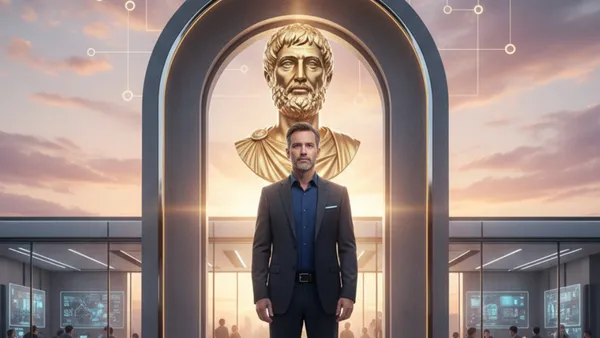
Did you know a Roman Emperor's diary is now a CEO bestseller?
Prompted by NerdSip Explorer #2600
Apply ancient Roman wisdom to modern team management challenges.
Marcus Aurelius was the most powerful man in the world, yet his private diary, 'Meditations', isn't about power—it's about self-discipline. Today, CEOs and leaders read it to master the art of management.
Stoic leadership isn't about hiding your emotions or becoming a robot; it's about not letting those emotions control your decisions. As a young manager, you face rapid changes, difficult personalities, and high pressure. It is easy to feel entirely overwhelmed by the weight of leading a team.
The 'Aurelius Method' teaches you to anchor yourself first. You cannot effectively guide a team through a chaotic project if your own mind is chaotic. By learning to govern your own reactions, you create a stable foundation for your team to rely on when the pressure hits.
Key Takeaway
Stoic leadership is about mastering your own reactions first so you can effectively guide others through chaos.
Test Your Knowledge
What is a common misconception about Stoic leadership?
Imagine your team just lost a major client due to a sudden market shift. You could panic, or you could apply the Stoic 'Dichotomy of Control.'
This principle divides the world into two buckets: things you can control, and things you can't. You cannot control the overall market, the client's internal budget, or a global crisis. You *can* control your team's response, your strategy moving forward, and your own attitude.
In management, wasting energy on the uncontrollable leads to burnout and demoralizes your team. It makes you feel helpless. By aggressively focusing only on what's in your power, you model resilience. You shift the team's mindset from 'Why is this happening to us?' to 'What is our next best move?'
Key Takeaway
Divide your managerial challenges into what you can and cannot control, and focus your energy entirely on the former.
Test Your Knowledge
According to the Dichotomy of Control, which of the following should a manager focus their energy on?
When a project crashes, it's easy to catastrophize. 'This is a complete disaster!' we think. Marcus Aurelius practiced 'objective representation'—stripping away the emotional narrative to see things exactly as they are.
He would look at a luxurious feast and remind himself it was just a dead bird and fermented grape juice. In leadership, when an employee misses a major deadline, it isn't 'a deliberate sabotage of the quarter.' It is simply 'a missed deadline.'
By removing dramatic adjectives, you remove the panic. This allows you to address the root cause with a clear head rather than reacting out of frustration. Your team will naturally trust and respect a leader who remains remarkably objective during a storm.
Key Takeaway
Strip emotional and dramatic language away from business crises to see them objectively and solve them calmly.
Test Your Knowledge
What does 'objective representation' look like in a management crisis?
Marcus Aurelius famously wrote, 'Be tolerant with others and strict with yourself.' As a leader, it's incredibly tempting to micromanage or hold everyone to your exact personal habits.
But Stoicism teaches us that we ultimately only govern our own actions. Great managers set a relentlessly high bar for their own work ethic, punctuality, and integrity. However, when a team member makes an honest mistake, they respond with coaching and grace, rather than harsh judgment.
This doesn't mean lowering performance standards. It means leading by example and showing empathy when people inevitably stumble. You become a magnet for talent when you are demanding of yourself but deeply supportive of your team's growth.
Key Takeaway
Set the highest standards for your own behavior while offering grace, empathy, and coaching to your team.
Test Your Knowledge
What does 'Strict with self, tolerant with others' mean for a modern manager?
A core tenet of Aurelius's philosophy is that what stands in the way becomes the way. When a strong fire burns, it consumes obstacles and uses them as fuel to burn brighter.
In business, setbacks are inevitable. A key vendor backs out. A highly anticipated software launch fails. A Stoic leader doesn't just survive these obstacles; they actively use them to improve. The failed software launch becomes the exact reason your team revolutionizes its quality assurance process.
The lost vendor forces you to discover a more agile, local alternative. By training your team to look at every roadblock as a specific opportunity to get better, you build a resilient culture of relentless innovation.
Key Takeaway
Train your team to view setbacks not as roadblocks, but as the exact raw material needed for improvement and innovation.
Test Your Knowledge
How does a Stoic leader view a sudden project roadblock?
Marcus Aurelius started his days by reminding himself that he would meet people who were arrogant, selfish, and ungrateful. Why? So he wouldn't be surprised or emotionally triggered when it actually happened.
In management, you will inevitably deal with difficult stakeholders or uncooperative colleagues. Aurelius believed people act poorly out of ignorance of what is truly good. Instead of taking bad behavior personally, a Stoic manager views it as a predictable part of human nature.
You can't control their toxic attitude, but you can entirely control your refusal to let it ruin your day. Approach difficult colleagues with firm boundaries and professionalism, but never let them drag you into their emotional chaos.
Key Takeaway
Anticipate difficult behavior so you can respond with calm professionalism instead of emotional reactivity.
Test Your Knowledge
Why did Marcus Aurelius mentally prepare himself to meet difficult people every morning?
When the pressure of ruling an empire felt absolutely crushing, Marcus Aurelius would take 'the view from above.' He would mentally zoom out, imagining the vastness of the world, the millions of people living their lives, and the infinite stretch of time.
Suddenly, his immediate crisis didn't seem so world-ending. As a manager, you will face weeks where everything feels like a top priority and the stress is suffocating. Taking a step back to view your project within the larger context of your company, your overarching career, and your life instantly deflates the pressure.
This macro-perspective prevents severe burnout. It helps you make clear, strategic decisions rather than just anxiously reacting to the loudest alarm in the office.
Key Takeaway
Zoom out mentally during high-stress moments to regain perspective, lower anxiety, and prevent burnout.
Test Your Knowledge
What is the primary benefit of taking 'the view from above' in management?
Track your progress, earn XP, and compete on leaderboards. Download NerdSip to start learning.