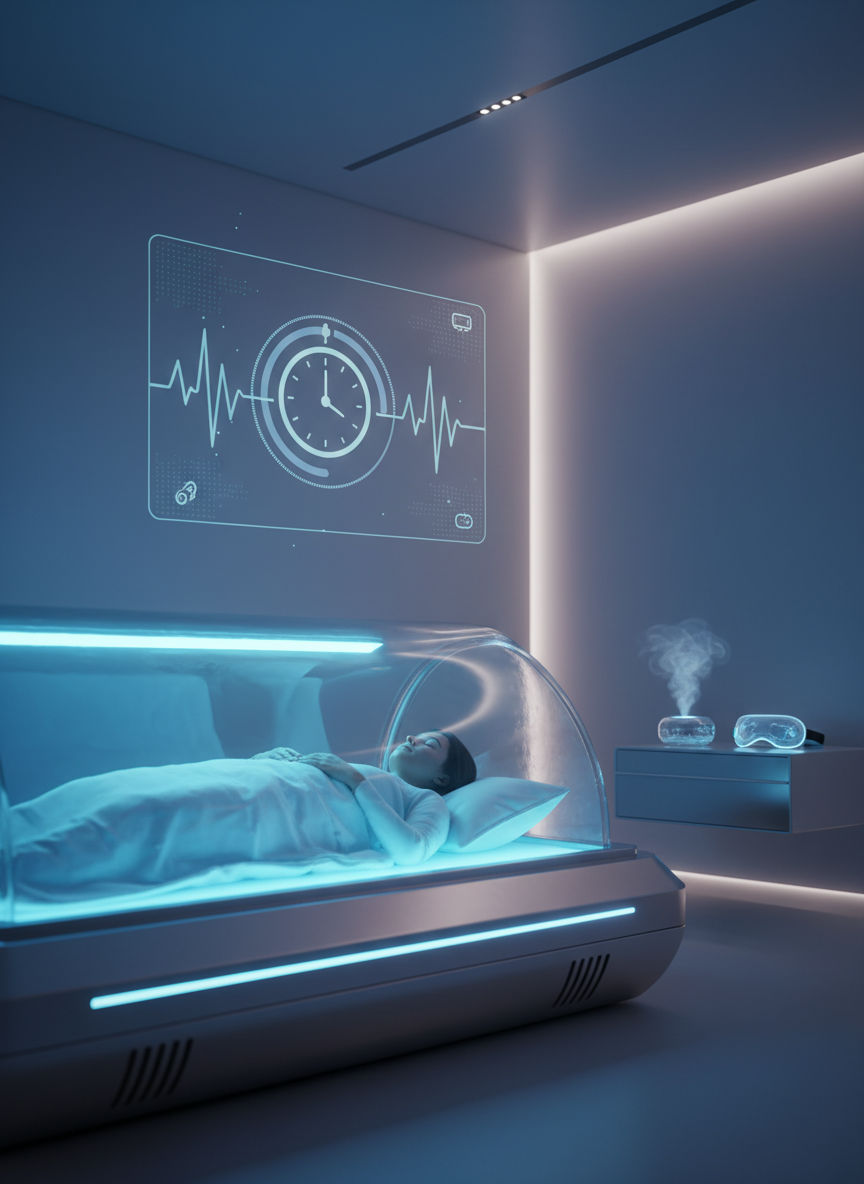
Did you know that sleeping in a room just 2 degrees too warm can ruin your REM cycle?
Prompted by NerdSip Explorer #2352
Mastering the temperature and light variables for peak recovery.
Before we can optimize your sleep environment, we need to understand the biological mechanics of slumber. Our bodies operate on a roughly 24-hour internal clock, known as the circadian rhythm. A crucial, yet often overlooked, component of this rhythm is core body temperature.
To successfully transition from wakefulness into sleep, your core body temperature needs to drop by approximately 1 to 2 degrees Fahrenheit (roughly 0.5 to 1 degree Celsius). This natural cooling process signals to your brain that it is time to shut down and begin the recovery process. Blood vessels in your skin expand, radiating heat away from your core.
If your environment is too warm, your body cannot effectively dump this heat. The result? A delayed onset of sleep and a highly fragmented sleep cycle. By proactively managing your room temperature, you are aligning your physical environment with your evolutionary biology, giving your body the exact physiological cues it needs to wind down.
Key Takeaway
A drop in core body temperature is a biological prerequisite for initiating sleep.
Test Your Knowledge
Why does the body expand blood vessels in the skin before sleep?
While falling asleep is important, the quality of your sleep stages—specifically Deep Sleep and Rapid Eye Movement (REM) sleep—is where true recovery happens. Interestingly, your body's ability to regulate its own temperature diminishes significantly during REM sleep.
During the REM phase, your internal thermostat essentially hands over control to the ambient environment. Because of this, studies suggest that sleeping in a room that is even a couple of degrees too warm can dramatically disrupt or fragment your REM cycle. Without sufficient REM sleep, cognitive processing, emotional regulation, and memory consolidation suffer.
Sleep scientists generally recommend keeping your bedroom between 60 F and 65 F (roughly 15.6 C to 18.3 C) for optimal recovery. If you are waking up groggy despite getting eight hours of sleep, an ambient temperature that is too warm might be secretly sabotaging your REM cycles.
Key Takeaway
Your body loses much of its ability to thermoregulate during REM sleep, making a cool ambient room temperature critical for continuous, high-quality rest.
Test Your Knowledge
What happens to your body's thermoregulation during REM sleep?
It is important to distinguish between the macroclimate (your bedroom) and the microclimate (the immediate environment under your covers). Even if your thermostat is set to a chilly 65 F, your sleep can still be compromised if your microclimate traps too much heat.
The human body continuously produces moisture during sleep to facilitate evaporative cooling. If you are sleeping on a dense foam mattress or using synthetic, non-breathable bedding, this moisture has nowhere to go. It stays trapped against your skin, preventing the cooling process and signaling to your brain that thermoregulation is failing.
To master your microclimate, prioritize breathable, natural fibers like cotton, linen, or bamboo for your sheets and pajamas. If you tend to run hot, consider a mattress or mattress topper designed for airflow. Balancing a cool ambient room temperature with breathable bedding allows your body to effectively release heat without waking you up shivering.
Key Takeaway
A perfect room temperature is useless if your bedding and mattress trap heat and moisture, disrupting your microclimate.
Test Your Knowledge
Why are breathable, natural fibers recommended for bedding?
Temperature is only half of the sleep optimization equation; the other half is light. Your circadian rhythm is heavily governed by light exposure, which dictates the production of melatonin, often called the hormone of darkness.
Melatonin does not act like a sleeping pill; instead, it acts as a chemical messenger that signals to your body that it is time to transition into sleep. In a natural environment, the fading light of dusk triggers a gradual increase in melatonin. However, modern artificial lighting confuses this biological process.
When your eyes perceive bright light in the evening, your brain assumes the sun is still up. This suppresses melatonin production, leaving your body physiologically unprepared for rest. To peak your recovery, you must learn to manipulate your light exposure, mimicking the natural progression of sunset in your own home.
Key Takeaway
Melatonin is a signaling hormone triggered by darkness, and artificial light in the evening actively suppresses its production.
Test Your Knowledge
What is the primary role of melatonin in the body?
Not all light is created equal when it comes to sleep disruption. The receptors in our eyes that communicate with our circadian clock are particularly sensitive to short-wavelength light—specifically the blue light spectrum.
Blue light is highly beneficial during the day; it boosts attention, reaction times, and mood. The sun is our primary source of blue light, which is why getting outside in the morning is highly recommended for waking up. However, smartphones, laptops, and LED lights also emit significant amounts of blue light.
When you stare at a screen late at night, you are essentially beaming a daytime alertness signal directly into your brain. Research has shown that blue light at night suppresses melatonin secretion more powerfully than any other wavelength. While complete avoidance of screens is ideal, using blue-light-blocking filters or glasses in the evening can help mitigate this biological confusion.
Key Takeaway
Short-wavelength blue light is the most disruptive to evening melatonin production because it mimics the alertness signals of daylight.
Test Your Knowledge
Why is blue light exposure beneficial during the morning but harmful at night?
To optimize your environment for peak recovery, you need to treat evening light with the same precision as a medical prescription. Scientists measure light intensity in lux. A bright office might be around 500 lux, while direct sunlight can be over 10,000 lux.
For optimal sleep preparation, research suggests keeping evening light exposure below 50 lux in the two to three hours before bedtime. This means avoiding bright overhead lights. Instead, transition to low-level, warm-colored lighting like table lamps or wall sconces.
Once you actually get into bed, the goal should be near-complete darkness. Even seemingly minor light sources, like a street lamp glowing through the blinds or the standby light on a television, can penetrate your eyelids and negatively affect the depth of your sleep. Aiming for an environment of less than 1 lux is considered the gold standard for uninterrupted rest.
Key Takeaway
Dimming lights to below 50 lux before bed and sleeping in a pitch-black room helps ensure maximum melatonin production and deep sleep.
Test Your Knowledge
What is the recommended maximum light exposure (in lux) in the hours leading up to bedtime?
You now have the blueprints to engineer the ultimate sleep sanctuary. Peak recovery requires a synchronized approach to both the temperature and light variables in your environment.
Start your evening routine two hours before bed by dimming the lights below 50 lux and switching to warm, low-level lamps. Put away devices that emit blue light, or utilize blue-light-blocking technology. Concurrently, allow your bedroom to cool down to the optimal range of 60 F to 65 F (15.6 C to 18.3 C).
Ensure your microclimate is dialed in by outfitting your bed with breathable, natural fabrics that won't trap body heat. Finally, when it is time to close your eyes, make the room as dark as possible—investing in blackout curtains or a high-quality eye mask can yield incredible dividends for your REM cycle. By mastering these variables, you transform your bedroom into a dedicated recovery chamber.
Key Takeaway
Combining dim evening lighting, a cool ambient temperature, and a breathable microclimate creates the ideal biological conditions for peak sleep recovery.
Test Your Knowledge
Which combination of actions best prepares your environment for peak sleep recovery?
Track your progress, earn XP, and compete on leaderboards. Download NerdSip to start learning.